Article | Intelligent Investment
Business Insights | Why Australia’s housing crisis demands bold structural reform and shared delivery
Australia needs to deliver 1.2 million homes in five years, a scale that can’t be supported by the current approval and delivery systems without major reform.
August 14, 2025
Learn about our Development & Infrastructure solutions
Click HereAnd innovation alone won’t solve the crisis. The calls for industry innovation are valid, but they are not a substitute for reform that will have immediate impact. Modularisation, prefabrication, digital platforms and construction technologies are all vital, but they are all generational changes; a number of which have been underway for many years and still not improving housing availability. They will take decades to be highly beneficial. This is not ideal, but in the development and construction industry, it’s a reality.
The crisis we face is immediate. Australia needs to deliver 1.2 million homes in five years. The approval and delivery systems we currently have cannot support that scale. What is needed is structural reform, empowered coordination and real execution capability.
A national challenge by the numbers
According to CBRE data analytics, Australia's housing shortfall is worsening:- 166,000 dwellings short of target between 2024 and 2029 (Master Builders Australia)1
- 171,394 dwelling approvals in the year to April 2025, well below the 240,000 annual benchmark under the National Housing Accord2
- Rental stress is growing, and house prices in Sydney and Melbourne now exceed 17 times average income3
Nationally, social housing development is falling well below increasing demand and its share of the overall housing market is declining. The result? Longer rental waiting lists, rising homelessness and social deprivation.
1. Master Builders Australia (2024), Forecast: 1.034 million new dwelling starts vs 1.2 million National Housing Accord target.
2. Australian Bureau of Statistics (ABS), Building Approvals, April 2025 (8731.0).
3. CBRE Research, 2025; CoreLogic Property Monitor, June 2025.
Supply forecast cuts put pressure on delivery
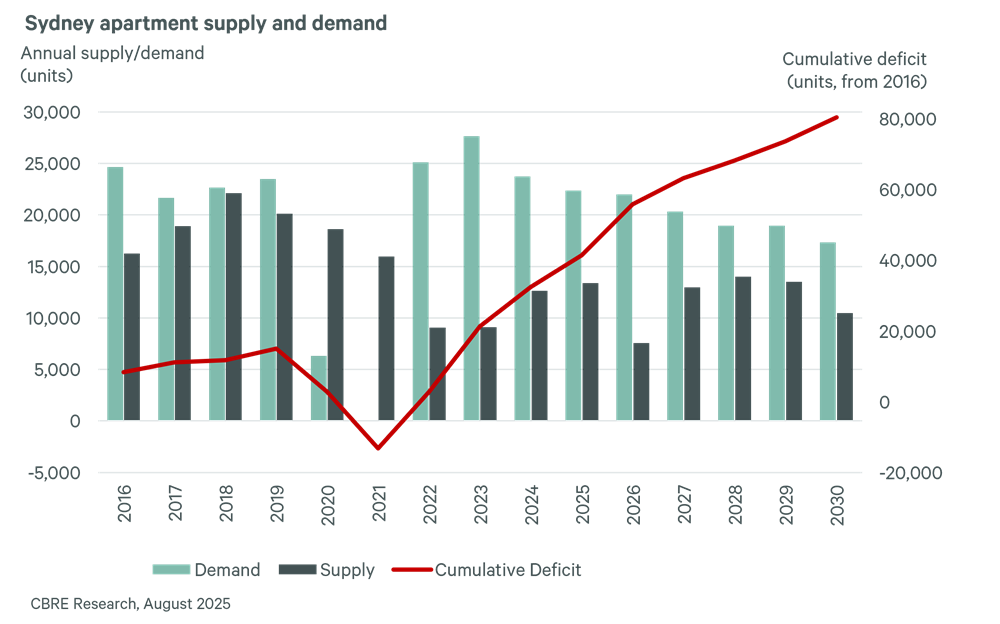
CBRE Research’s latest Apartment Outlook H2 2025 warns that Australia’s apartment pipeline is weakening just when it needs to accelerate. National supply forecasts for 2026 and 2027 have been downgraded by 10%-19%, with major precincts like Inner East and North Melbourne, North Gold Coast and Inner North Canberra seeing larger cuts.Completions are now expected to dip by up to a third in 2026 compared to 2025 before recovering in 2027. Even with that recovery, national supply is projected to hover around 55,000–65,000 apartments annually through 2030 – well short of the 75,000–85,000 needed each year to keep up with demand.
The conclusion is clear: Commencement of approved projects has never been more critical. Any slippage adds to a growing backlog and puts further upward pressure on rents, which CBRE expects to surge again from 2028 as vacancy tightens.
Our latest analysis shows that thousands of apartments that were expected to hit the market in 2026 are being pushed back or shelved.
CBRE estimate Sydney’s apartment delivery will average 11,700 pa over 2025-30. Demand for housing stock (apartments and communities) is likely to average 30,000 pa over the next 5 years. In the next three years, we see city-wide vacancy falling from 2.0% to 1.2%.
We’ve solved urgent housing challenges before
During the Global Financial Crisis, NSW delivered 6,300 social housing dwellings in just two years under the National Building Economic Stimulus Plan (NBESP).It worked because of these factors:
- One empowered agency - controlled land, funding, planning, procurement and delivery
- Public and private sectors worked together under a shared mandate
- Planning, design and delivery were fast-tracked under clear guidelines including pre-approved design guidelines
- The workload was spread geographically and across all levels of the industry, not just the big players
This was not theoretical. It was delivery at pace and scale with a national impact.
NSW Department of Housing, NBESP Completion Report, 2012.
NSW Government, Economic Stimulus Impact Summary (2011).
What reform requires: Policy courage and private sector enablement
Reform must go beyond policy announcements and into program design. The delivery challenge is not one government can solve alone – it requires empowered partnerships. Outlined below is each reform area and our recommended actions and recent announcements.Reform Area
Reform has begun, but it's only just begun
NSW has made a bold move with the January 2025 establishment of its Housing Delivery Authority (HDA).
The HDA consolidates planning and delivery responsibility for large-scale housing and mixed-use precincts, with powers to:
- Lead State Significant Development (SSD) pathways
- Fast-track rezoning
- Assemble land and coordinate infrastructure
Backed by an initial $17.7 million commitment, the HDA aims to activate priority housing in Greater Sydney, the Hunter and Illawarra.
It is the most substantial structural reform to planning approval in over a decade and is showing early signs of success. But to work, the HDA will need greater legislative independence, more resources and bipartisan commitment.
This model is replicable, and it should be. Australia needs state-based housing delivery bodies with real power, cross-agency alignment and the mandate to deliver at speed.
NSW Budget 2025–26, Infrastructure and Planning Statement.
From ambition to action
Australia has the capital, the land, public support and the policy intent to meet its housing goals. But without delivery reform that is bold, centralised and fast, those goals will remain on paper. We must build a national housing accelerated planning process, workforce strategy, align state and federal delivery bodies, and empower precinct scale partnerships.The data underscores a simple truth: getting approved projects built on time is now the defining challenge. Governments and developers each have a critical role to play – and the right support will determine whether the system keeps pace with demand or falls further behind.
Delivering for government
The priority is establishing a program office dedicated to making sure approved projects are delivered on time and at scale. That means tighter oversight, better coordination and support for agencies managing multiple precincts simultaneously. CBRE’s Development & Infrastructure consulting team can bring the program management expertise and delivery frameworks needed to help government execute and derisk these commitments.Delivering for developers
The challenge is unlocking sites that are stuck in feasibility limbo. Developers need clear highest and best use analysis to guide decisions and attract capital to move forward. CBRE’s Strategy and Structured Transactions team can provide the insight, financial and commercial structuring expertise to enhance value and make those sites viable – aligning projects with market demand and investor expectations.The next five years will determine whether this becomes a turning point or a missed opportunity. We’ve seen what works. Now is the time to replicate it – faster, smarter and at scale.
Because the way we start matters. And if we want to solve the housing crisis - we must start smarter.
