Article
Business Insights | Essential Guide to Data Centre Infrastructure
December 19, 2025 8 Minute Read

Worried about your future data infrastructure?
The New Backbone of the Digital Economy
The global digital economy is now highly reliant on data centres. This supports every application, transaction and cloud-based service that is used in everyday life. Originally data centres were on-premise server rooms built to support enterprise applications. They have now evolved into a network of deeply connected, high-performance facilities that enable every digital interaction.
What is Data Centre Infrastructure?
Data centre infrastructure makes up all the physical and virtual components that enable a business to run its operations. This includes:
- The Hardware: Servers, storage systems, networking equipment, routers, switches, racks.
- The Software: The operating systems, apps, software and management tools.
- The Support Systems: Power supplies, air conditioning, security, fire suppression, and cooling systems
- Operational Management: The people and processes that ensure that the data centre runs efficiently.

Why is Data Centre Infrastructure Important?
Today, data centres form the critical backbone of business operations, delivering secure and reliable environments for mission-critical applications and sensitive data. The data centre industry’s rapid growth is being driven by the large scale adoption of innovative applications including AI and Machine Learning.
As demand for AI applications continues to grow, the sector is redefining digital infrastructure, combining performance, scalability, and environmental responsibility to meet the needs of a data-driven future.

Data Centre Components
A modern data centre combines software, hardware and security in a single, highly engineered environment. Each component plays a critical role in ensuring reliability, resilience, and scalability. The core components of a data centre include servers, storage systems, networking equipment, power and cooling systems.
Compute and Storage Systems
Servers provide processing power, while storage infrastructure systems manage massive volumes of structured and unstructured data. Together, they form the foundation of the data centre.
Networking Equipment
High-speed switches and fibre connectivity create the digital backbone that links every component. Low-latency networking ensures that data moves efficiently within the facility and across global cloud computing data centre ecosystems, combined with software-defined infrastructure, enabling businesses to deliver seamless digital experiences.
Power and Cooling Systems
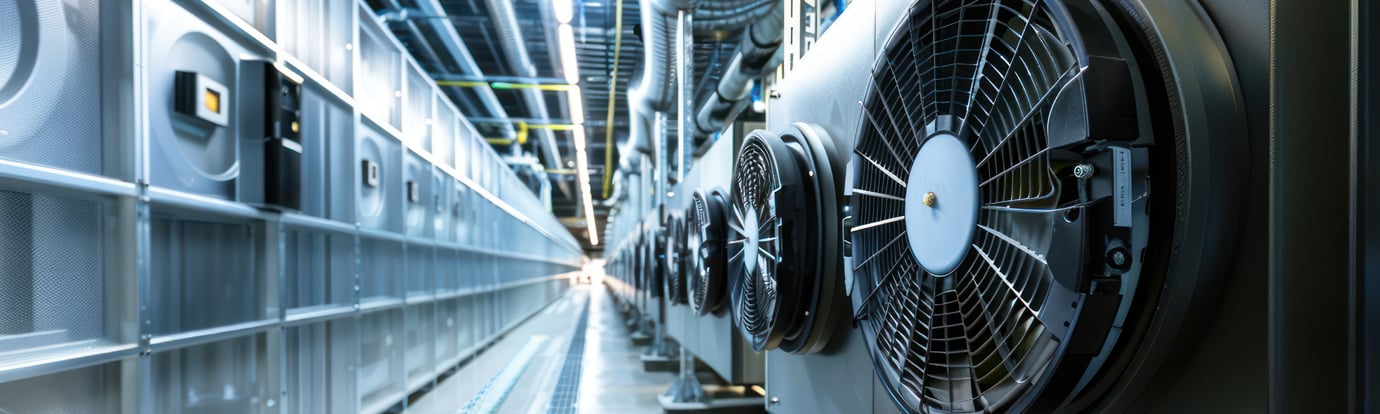
Resilience depends on reliable cooling and power systems. Multiple utility feeds, uninterruptible power supplies (UPS), and standby generators protect against power outages. Cooling systems manage the heat generated by electronic components in data centres.
Cooling systems, whether air-based, liquid, or hybrid, maintain optimal operating conditions and prevent thermal overloads that could threaten uptime.
Security and Monitoring
Data centre security operates on multiple layers. It involves protecting sensitive data and critical infrastructure from unauthorized access.
Biometric access control, CCTV surveillance, and environmental sensors guard against physical and operational threats, while intelligent monitoring platforms deliver real-time visibility across assets, helping teams act before problems arise.
Efficiency and Sustainability
Every element of a data centre is now designed to balance performance with environmental responsibility. From renewable energy sourcing and waste heat recovery to dynamic load balancing and intelligent automation, efficiency is both an operational necessity and a moral imperative.
Learn more about how CBRE designs and manages high performance, sustainable data centres through our Data Centre Solutions service.

Types of Data Centres
Colocation Data Centres – Shared Scale and Individual Control
Colocation facilities provide enterprise-level performance without the capital expenditure of building and maintaining a private facility. Operators deliver the infrastructure that enables resilience, connectivity, and energy efficiency, while clients retain control over their hardware. This model allows multiple tenants to share power, cooling, and network infrastructure, reducing costs and carbon footprint. For many businesses, colocation represents the optimal balance between flexibility, cost, and control. Explore CBRE’s Colocation Advisory Services.
Hyperscale Cloud Data Centres
Hyperscale data centres underpin the cloud computing revolution. Operated by major cloud providers such as Amazon Web Services, Microsoft Azure and Google Cloud Platform, these large data centres deliver computing resources on demand to millions of users worldwide.
By consolidating capacity in highly automated environments, hyperscale cloud providers achieve extraordinary economies of scale and energy efficiency.
Increasingly, enterprises are adopting hybrid cloud computing models that blend private computing infrastructure with public cloud storage and computing flexibility. Read CBRE’s Global Data Centre Trends report to understand how hyperscale cloud service provider growth is reshaping the industry.
AI Data Centres and High-Performance Computing (HPC)
Artificial intelligence and advanced applications are redefining data centre design. AI training clusters demand dense power configurations and cutting-edge cooling technology to support thousands of GPUs operating simultaneously.
These facilities support the future of computing, enabling breakthroughs in healthcare, energy, climate modelling, and autonomous systems. Demand for AI data centres is accelerating, and operators able to deliver high-density, high-efficiency space are setting new industry benchmarks.
See CBRE Research on AI’s impact on data centre expansion.
Edge Data Centres
Edge data centres process data closer to the end user to reduce latency and support real-time applications. They are essential for technologies such as autonomous vehicles, 5G networks, and industrial IoT.
The market is in its early stages, but growth is expected to accelerate as new use cases evolve. The future will be a distributed model where hyperscale hubs and local edge nodes operate together to deliver scale and speed.
Building Sustainably
Data centre sustainability has become a priority as the industry confronts its growing energy consumption and environmental impact. Operators are increasingly designing green data centres to minimize carbon emissions through renewable energy sourcing, energy-efficient technologies, and cooling management.
Modern data centres employ advanced power and cooling systems such as liquid and free air cooling, waste heat recovery, and AI-driven energy optimisation to reduce PUE.
Many hyperscale and colocation data centre providers are committing to net-zero carbon targets by investing in solar, wind, and other clean energy sources. Materials selection, water conservation, and circular economy initiatives are also emerging as part of sustainable construction and operations.
According to the Uptime Institute, the average power usage effectiveness (PUE) of new data centres continues to improve each year, driven by efficiency initiatives and better data centre design integration. However, the growth of data centre power consumption, driven by AI, continues to put pressure on sustainability programmes.
It is now essential to align data centre growth with global climate and ESG objectives. Ensuring the use of efficient data centre designs to reduce costs, enhance reliability and support regulatory compliance. Learn about CBRE’s Sustainability and ESG Advisory and our commitment to net zero.

Shaping the Future
The data centre industry is undergoing one of the largest transformations in its history. Rapid advances in AI, automation and renewable energy technology are reshaping how capacity is delivered and managed.
At CBRE, we help clients identify, evaluate and secure the data centre capacity that supports their ambitions. Our expertise includes site selection, investment strategy, infrastructure & operation advisory, valuation and research. With a global reach and a deep understanding of local markets, we find the right data centre capacity for our customers requirements.
In the future, collaboration across the industry will be essential. Governments, utilities and developers will need to work more closely together to ensure that new capacity can be built responsibly and powered sustainably.
Reports from organisations such as Data Centre Dynamics highlight how innovation in design, materials and automation will continue to improve efficiency and support long term sustainability goals.

Key Takeaway
Data centres are now critical infrastructure. They are the foundation that supports digital progress. From hyperscale campuses to edge facilities, they provide the infrastructure upon which innovation, communications and data processing depend. Organisations that embrace this evolution will not only meet today’s demands but also deliver tomorrow’s digital future.
Future-Proof Your Organisation's Data!
Get in touch with us today to discover how we can support your future.

Frequently Asked Questions
Related Services
Operating specialist teams that offer consulting, advisory and transaction, project management, and integrated data centre operations services.
Leading experts in AI-ready data centres. We tackle the challenges & opportunities in AI infrastructure.