Article | Intelligent Investment
Facilities Management in Thailand: Energy Optimization Case Study
September 3, 2026
Pushing Boundaries to Meet Advanced Sustainability Benchmarks
Energy management has become a strategic priority for organizations pursuing stronger sustainability and ESG outcomes. As organizations increasingly focus on sustainable facilities management, the role of facilities management in Thailand has evolved beyond traditional building maintenance to include operational efficiency, ESG performance and long-term asset value creation. For large commercial structures—especially energy-intensive facilities—even well-managed systems can benefit from continuous optimization to improve energy efficiency in commercial buildings.Our client, a leading Thai banking headquarters in Bangkok's CBD, has a nearly 10-year-old asset. It was already well maintained, compliant with national energy conservation requirements and operating without major energy issues. Structurally, the client did not face an operational energy failure or disproportionately high utility expenses. On the contrary, their baseline management system strictly audited, collected and reported energy efficiency scores to state regulatory departments in full accordance with national energy conservation laws.
In this case, the strategic question was clear: how could an already high-performing facility move to the next level of ESG excellence? This challenge reflects a growing trend in facilities management in Thailand, where organizations are seeking new ways to improve sustainability performance and asset efficiency from existing building systems.
CBRE helped answer this by working alongside the client’s building automation investments to turn advanced systems into measurable energy performance.
Executive Summary: Elevating Energy Efficiency Through Operational Alignment
- Strategic Alliance: CBRE combined facilities management services in Thailand with advanced building automation and AI-enabled HVAC controls to improve operational performance, strengthen energy efficiency in commercial buildings and support long-term sustainability objectives.
- Operational Landscape: Delivered in a high-security headquarters where business continuity, data security and ESG goals had to be balanced.
- On-Site Execution: Applied no-cost/low-cost actions, including establishing a unified zone temperature threshold of 24–25°C and deploying occupancy-based scheduling.
- Verified kW/RTH Enhancements: Chiller plant performance improved from 0.898 kW/RTH to 0.888 kW/RTH, reflecting a steady efficiency gain of 0.010 kW/RTH.
- Energy and Cost Savings: Reduced electricity use by 24,878.61 kWh over 12 months, generating THB 109,959.04 in savings while demonstrating how effective facilities management in Thailand can deliver measurable energy and financial results.
Managing Complexities Through Facilities Management in Thailand’s Mission-Critical Environments
Energy optimization in a major banking headquarters requires tighter control than in a standard commercial building. The facility supports critical operations, so any change to cooling systems had to protect security, comfort and business continuity.This project highlights how facilities management in Thailand extends beyond routine maintenance. In highly regulated and mission-critical environments, facilities management services in Thailand must balance engineering performance, occupant comfort, business continuity and sustainability objectives while ensuring compliance with operational requirements.
The facility team managed three key constraints:
- Strict access and timing: Engineering areas required controlled entry and clear approvals within defined work windows.
- Zero downtime: Core cooling systems could not be shut down during business hours.
- Off-peak testing: Programming, testing and commissioning were completed at night, on weekends or during holidays.
This required disciplined protocols, risk controls and close coordination to deliver improvements without disrupting operations.
Sustainable Facilities Management in Thailand Through Operational and Mechanical Optimization
Effective sustainable facilities management requires both technology investment and operational expertise. While advanced equipment can improve building performance, achieving long-term results depends on how systems are managed, monitored and continuously optimized to improve energy efficiency in commercial buildings and support broader sustainability objectives.To support long-term sustainability goals, the client upgraded key chiller plant components, including cooling tower fan motors, Variable Speed Drives (VSDs), filling panels, exhaust systems and computerized chiller sequencing.
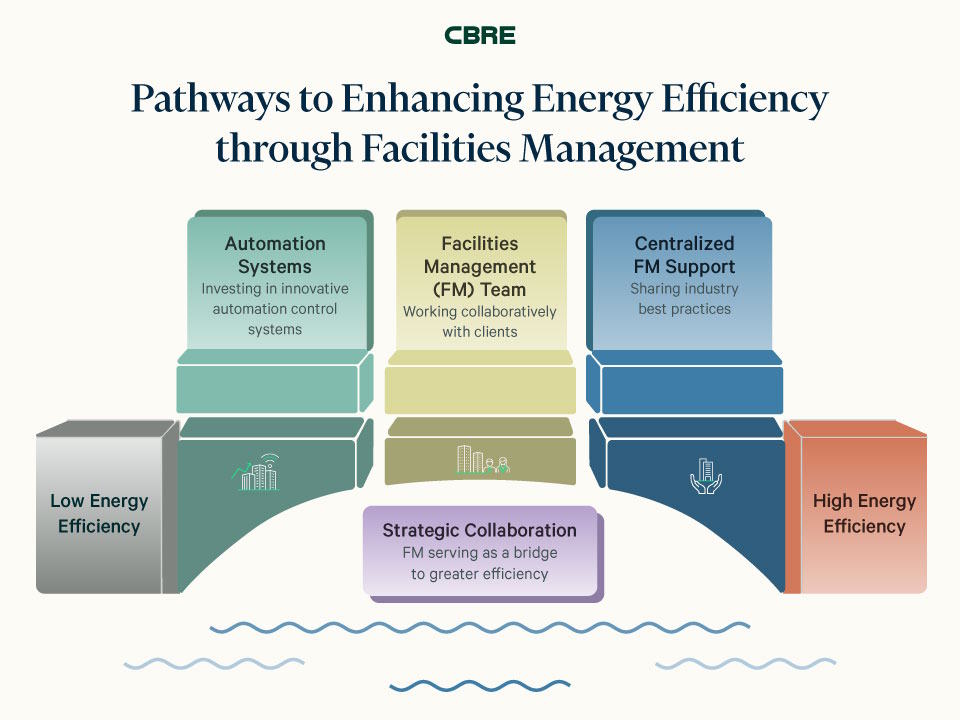
CBRE helped ensure these upgrades delivered real operational value. The team applied no-cost/low-cost actions that matched system settings to actual building use:
- Precision Temperature Control: Cooling zones were maintained at 24–25°C to reduce unnecessary AHU load.
- Occupancy-Based Scheduling: The CBRE team studied building entry patterns, daily worker profiles and overtime patterns at the client's site. AHU and FCU runtimes were aligned with actual occupancy, reducing energy use in underutilized spaces.
Measurable Outcomes and Verification of Engineering Efficiency
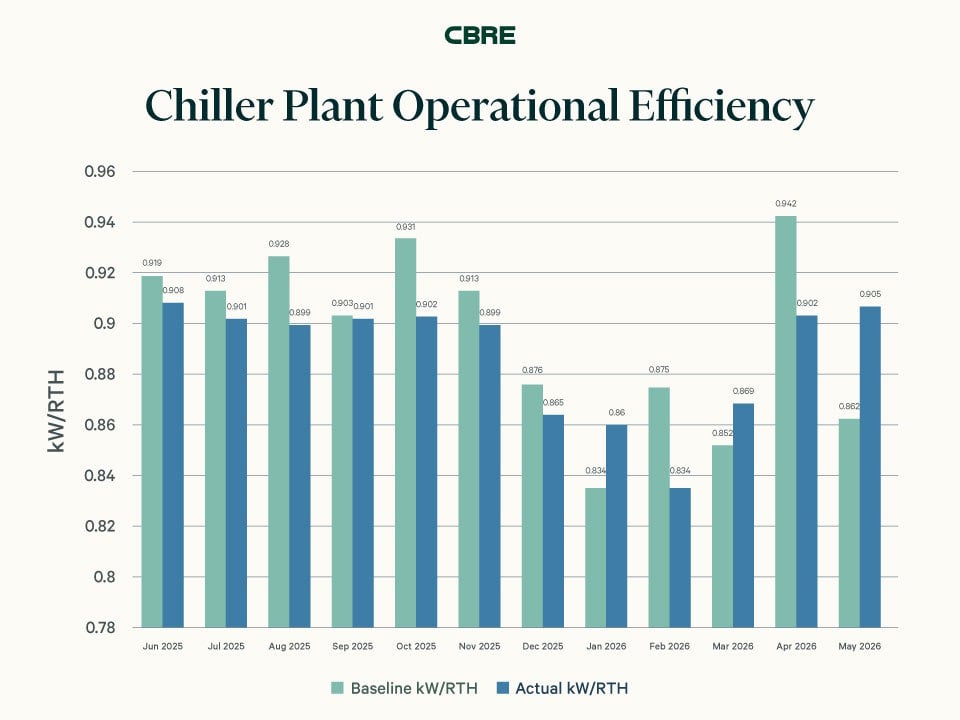
Performance was validated through kW/RT or kW/RTH, which measures the energy needed to produce a unit of cooling and provides a clearer view of chiller plant efficiency than utility bills alone.Across the full 12-month cycle from June 2025 to May 2026, the data showed consistent gains against the historical baseline.
The results highlight how proactive facilities management services in Thailand can unlock additional value from existing building assets. Rather than relying solely on capital expenditure, integrated facilities management practices helped maximize the return on technology investments and improve overall energy efficiency in commercial buildings.
- Accumulated Electrical Reduction: Reduced electricity consumption by 24,878.61 kWh annually.
- Financial Return Values: Generated 109,959.04 THB in savings, based on the MEA rate of THB 4.42 per unit.
- Capital Investment Value: Supported a payback period of under three years for the client’s mechanical upgrades while contributing to future net zero goals.
- Average Efficiency Output: Improved from 0.898 to 0.888 kW/RTH, reducing the energy required to deliver the same cooling output.
The Strategic Value of Facilities Management in Thailand
As sustainability expectations continue to rise, facilities management in Thailand is becoming an increasingly important business function. Organizations are looking beyond maintenance to optimize energy performance, improve ESG outcomes and maximize the value of existing real estate assets. This project demonstrates how a combination of technology, operational expertise and data-driven decision-making can deliver measurable long-term benefits.Leadership Takeaway: Transforming Real Estate Operations into an Ecosystem of Efficiency
This project demonstrated how modern facilities management in Thailand can transform building operations into a strategic driver of sustainability. Energy optimization should not wait for equipment failure. Even high-performing assets can achieve further gains when technology, operational discipline and data-driven decision-making are integrated through a comprehensive sustainable facilities management strategy.The project succeeded thanks to its ecosystem of efficiency:
- The Client: Invested in technology to advance sustainability and improve building performance, repositioning facility operations from a cost center into a core strategic mechanism for achieving the organization's environmental goals.
- The Tech Provider: Enabled intelligent building automation and chiller sequencing with accurate calculation.
- The Facilities Management Expert: CBRE translated technology into daily performance through scheduling, temperature control and engineering analysis. As a leader in facilities management in Thailand, CBRE helps organizations improve asset performance, enhance energy efficiency in commercial buildings and support long-term sustainability goals.
Explore opportunities to improve energy efficiency in commercial buildings through expert facilities management services in Thailand. Connect with CBRE GWS Thailand to assess your building systems, uncover operational savings opportunities and advance your sustainability goals through proven sustainable facilities management solutions.
Frequently Asked Questions (FAQs) for Facility Leadership
Q1: What is the true value of facilities management when a building already utilizes advanced AI automation systems?
A: AI and automation process system data, but facilities teams connect those settings to real building use. As part of effective facilities management in Thailand, CBRE applies no-cost/low-cost actions, occupancy-based scheduling, and equipment monitoring to ensure automation delivers measurable operational and sustainable outcomes. This approach is a key element of sustainable facilities management.Q2: Why is the kW/RT (or kW/RTH) metric more valuable than tracking gross monthly electricity invoices?
A: Utility bills can fluctuate because of weather, occupancy or events. kW/RTH focuses on engineering efficiency by showing how much energy the chiller plant uses to produce cooling. This provides a more accurate measure of operational performance and supports data-driven improvements in energy efficiency in commercial buildings.Q3: What is a no-cost, low-cost strategy by CBRE and how can an asset team activate it?
A: A no-cost/low-cost strategy is a guideline to improves existing systems through operational adjustments, such as maintaining temperature settings of 24–25°C and aligning equipment schedules with actual occupancy. Experienced providers of facilities management services in Thailand can conduct runtime and usage audits to identify immediate opportunities for improving energy efficiency in commercial buildings without significant capital investment.Q4: How do facilities management services in Thailand support sustainability goals?
A: Effective facilities management services in Thailand help organizations reduce energy consumption, improve operational efficiency and extend asset life cycles. Through energy monitoring, occupancy-based optimization, preventive maintenance and smart building integration, sustainable facilities management practices support stronger ESG performance while improving energy efficiency in commercial buildings.
Read More:
Rethinking Facilities Management in Thailand
Facilities Management in Thailand: Solving the Technical Debt Crisis
Driving ESG Success Through Facilities Management in Thailand
Disclaimer:
At CBRE, we prioritize the accuracy and integrity of our market information. While we use generative AI tools to assist in the composition and optimization of its presentation, all information is based on proprietary research and the profound insights from our experienced property professionals. Every article undergoes a thorough human review and fact-check to ensure it meets our standards for professional quality and technical accuracy.