Article
How Modular Building Financing Could Solve Canada’s Housing Crisis
September 9, 2025 5 Minute Read

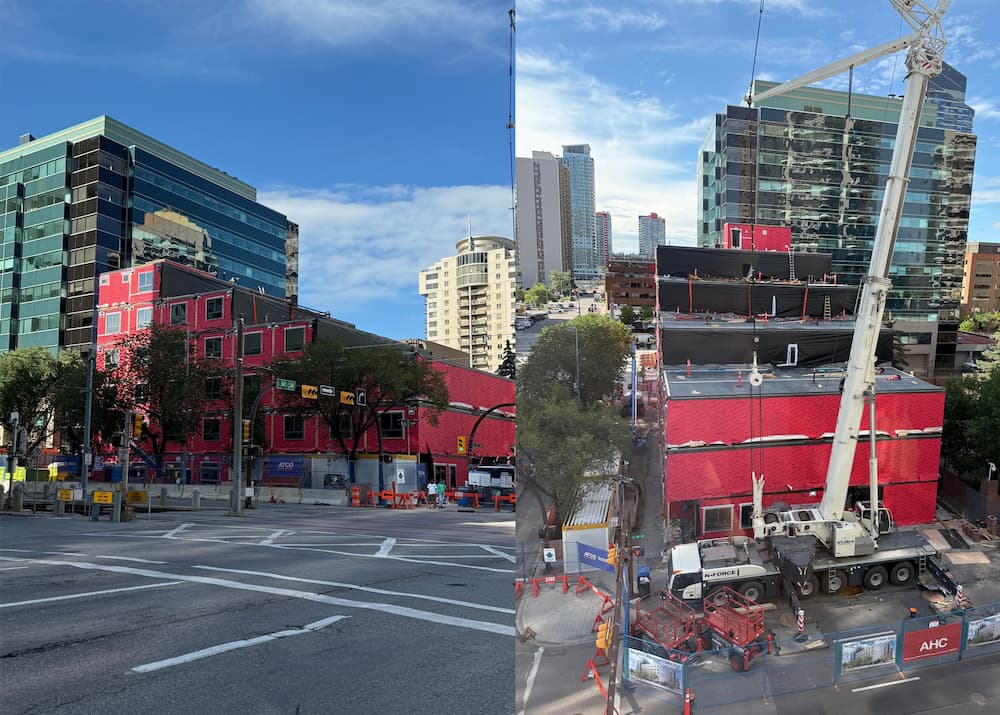
In August a crane placed the last piece of a new six-storey affordable rental development in downtown Calgary that’s part of an initiative to help solve Canada’s housing crisis.
But unlike most apartment projects in Canada, the units at 1007 6 Avenue SW were prefabricated in a factory. Then, 56 modular boxes were assembled like a giant LEGO to create the 84-unit apartment building. Each box contained either two studio apartments with appliances or other building sections like hallways and stairwells.
Calgary-based ATCO Structures manufactured the units in about three months, followed by a 10-day installation on the site. The project resulted from a partnership between ATCO Structures and Attainable Homes Calgary, a subsidiary of the City of Calgary. It will be ready for occupancy in January 2026.
Flexible financing would not have been possible without help from CBRE Calgary’s Jessica Harland. There’s a big push to address the housing crisis in Canada and modular housing is being discussed as part of the solution, but access to construction financing has always held modular solutions back – until now.
Harland worked with the Canada Mortgage and Housing Corp. (CMHC) within a pilot program to supply financing for the modular Calgary project. “There’s historically been stigma surrounding modular and lender security concerns really limited the flow of capital,” she says. “But Canada needs a housing construction boom and traditional thinking is being challenged. Modular can be part of the solution if we solve the financing piece and in working with CMHC, I believe we have a template for success.”
“Jessica is a national leader in finding innovative solutions for obtaining financing support for projects instrumental in building affordable housing capacity and delivering critical inventory across Canada,” says Attainable Homes Calgary’s President Jaydan Tait.

Modular Trailblazers
Factory-built apartments may sound like a modern solution, but modular housing has been around for decades – and as with office conversions in the wake of the pandemic, Calgary has been at the forefront.
ATCO was founded as Alberta Trailer Hire in 1947 to provide accommodation for oil field workers. By 1959, demand for flexible housing led to the development of ATCO’s first manufacturing facility in Airdrie, AB. Today ATCO offers a range of modular structures including offices, hotels and healthcare facilities.
“ATCO has decades of experience in building modules,” says Harland. “They were the ideal partner for this project.”
Inaccessible Financing
Traditional thinking has held back financing for modular construction. The asset class was perceived by lenders as too risky and required huge equity deposits up front. That was the frustration for Harland and her modular clients. The burden was on borrowers to put large deposits down to secure financing, which was not being applied to other types of housing.
“In the lenders’ eyes, anything can happen to the modular units until they are permanently affixed to the foundation,” Harland explains. “So the financing was front-loaded with equity and requirements, which made it inaccessible for charitable organizations and affordable housing groups.”
Replicable Model
The new Build Canada Homes program is encouraging institutions, developers and home buyers to think differently. Renewed interest in modular solutions has led CMHC to consider applications under an innovative pilot program to facilitate construction. The program works with lenders solicitors, insurance coverage over the units, and performance bonding from the manufacturer. These offset the risks to CMHC, enabling them to advance mortgage funds to the developer while the modules are in the factory.
“Bonds are essentially insurance to cover the products and services delivered in the event that the modular provider goes out of business,” Harland says. “The more the bond covers, the more CMHC will advance. That makes modular financing more accessible since less equity is required up front.”
These advances help cover costs required by modular providers before the units are delivered.
Thanks to Harland, 1007 6 Avenue SW was the second project in Canada approved under CMHC’s pilot program.
The reduced equity makes a big difference to organizations who are not traditional developers with easier access to capital. Non-profits and charitable organizations can look to this project as a blueprint to bridge construction funding gaps for modular rental housing projects. “We now have a replicable model to roll out in other Canadian markets,” says Harland. “It lets affordable housing providers access flexible financing while mitigating risk for CMHC.”
Time is Money
While modular housing isn’t always cheaper than traditional multifamily construction, it is much faster. Building an 84-unit project would typically take over 24 months but outsourcing the construction to a modular housing provider cuts that timeline to around three months, in this instance.
“Taking out a loan for three months as opposed to 24 months results in substantial savings from an interest rate perspective,” says Harland. “That will more than offset the cost of the bonds or insurance.”
Building the units in a factory also protects them from the elements, limits waste and makes the construction safer for workers, who don’t have to work several storeys off the ground. The units can easily be customized to meet sustainability or accessibility standards.
Beyond Multifamily
Modular manufacturing can be applied to broader uses like retail plazas, offices and hotels. There’s also potential to leverage smaller modular components within traditional construction. It’s not uncommon to see prefabricated bathroom modules placed into traditional hotel developments.
Modular solutions will likely also help support the development of six plexes in cities across the country. Independent homeowners can also use modular solutions for condos, laneway houses and garden suites. Harland herself is considering modular as a future solution to house aging parents on her property.
“Modular isn’t something I just advocate for. I can easily see how I could also be a user,” she says. “We could have a structure on our property in two weeks and those kinds of timelines aren’t possible with traditional builds.
“I truly believe that modular will be the next big thing now that financing exists to support it.”
Recent Insights
-
CBRE recently brokered the sale of 150 Slater St., a 447,448 sq. ft., Class A office tower in the heart of the capital’s financial district.
-

The seven-storey office building is being built on top of a restored former 100+ year old warehouse, combining the aesthetic of a century-old brick and beam structure with the functionality and sleekness of new, state-of-the-art office space.
-

CBRE’s Jeremy Deeks and John Fisher helped relocate ATCO to a new office building in downtown Edmonton, one of the city’s largest and most impactful office relocations in over a decade.
Stay In The Know
Subscribe today and join hundreds of professionals who get the latest blogs delivered straight to their inbox.