Article
Industrial Financing Amid Tariff Uncertainty Is Tricky Business
June 16, 2025 5 Minute Read

When it comes to Donald Trump’s tariffs, it would be the understatement of the year to say the situation is fluid.
This has made it difficult to finance and transact commercial real estate deals in the industrial sector. But CBRE’s Manish Jain argues that so far things have turned out more favourably for Canada than most expected back in early February, when the tariffs were first threatened.
“We’re in a much better position than we were at that time,” says Jain, who is Senior Vice President at CBRE Capital and whose team specializes in arranging commercial real estate financing for private investors and developers. His group has made a name for themselves by delivering results for clients in complex and challenging situations.
And the tariffs are certainly that. Back in early February, Canada was looking at 25% across the board tariffs. Canadians were also facing federal election uncertainty and there was talk of catastrophic economic damage…
“Meanwhile the rest of the world seemed to have this unbridled optimism,” says Jain. “The S&P 500 was almost at an all-time high and there was a focus on deregulation and growth.”

Not So Bad?
Fast forward to June 1 and things are looking quite different: Better than feared for Canada while the rest of the world has been roped into tariff and economic uncertainty.
Canada has a new prime minister and the potential for a fair trade deal. The country is currently facing harsh tariffs on steel and aluminum (which recently doubled) but otherwise USMCA-compliant products are tariff-exempted, auto parts most crucially for Ontario-based manufacturers.
Plus the Ontario government has announced a $10 billion targeted support package for industries and workers impacted by tariffs, Jain notes. “So tariffs are not at zero but they’re more manageable than we feared at first. Meanwhile the rest of the world now has baseline tariffs of 10%.
“If you look at the change in tariff outlook over the past few months, Canada has gotten significantly better and the rest of the world has gotten significantly worse.”
And because of the volatility in the stock market, “there is a renewed focus from investors on value and stability,” says Jain. “And if you look at Canada and commercial real estate in that context, we look a lot more stable and the benefit of steady returns is highlighted in an environment like this.
“Canada went from very scary to somewhat uncertain in those 90 days where the rest of the world went from very bullish to very scary.”
Caution Not Panic
Large industrial real estate users are “thinking hard about what they want to do” in the current environment of uncertainty, Jain says.
“In anticipation of crippling tariffs they’ve underwritten the worst-case scenario. And they’ve evaluated what tariffs and recession risks mean for their business and are now moving forward with all of that taken into account.”
Some are going to choose to remain on the sidelines and some will make real estate moves, Jain says. There are even some possible upsides for Canada with tariffs. “We are hearing from some larger U.S. clients that they might choose to land 100% of their goods in Canada and then decide which goods to import to the U.S.”
Jain says that commercial real estate lenders are looking to understand tariff impacts on each deal. “But if they can get their head around that risk they are absolutely ready to lend. And the uncertainty has actually caused Canadian bond rates to fall.
“That means lending is more stringent but the rates are better than they used to be. Lenders are open for business and have significant funds to place for quality industrial deals.”

Capital is Seeking Stability
When there is volatility and losses in the market, Jain says, “it highlights the importance of seeking stability in safe and stable returns. So now Canada looks stable compared to other countries, and with CRE, lower but safer returns look more attractive.”
He notes his team has had two large-scale industrial deals approved during the peak tariff uncertainty of the February-March period.
The first deal was a $35 million income bridge deal for an older industrial building. “That’s a deal we got approved right as we were going through the discussions of 25% tariffs,” Jain says. “Things are much better today than at that time and financing is proceeding more smoothly.”
Amid the uncertainty back then, Jain says he had frank conversations with the lender about the nature of the tenant’s business and how it would be impacted by tariffs or a potential recession. “And ultimately the lender was comfortable with the asset quality and the tenant’s ability to navigate any of those concerns.”
“So we’re seeing that lenders are concerned but they’re asking smart questions, not running for the hills. Things are moving just with a bit more caution. But certainly capital is flowing.”
Jain’s second deal involved a 265,000 sq. ft. new industrial development in the Greater Toronto Area.
“What’s interesting is it’s a speculative deal, with no pre-leasing in place,” he says. “It went for approvals as we were having this ‘Will they / Won’t they on 25% tariffs. And it was still approved as proposed on the spec basis, with just some slight adjustments to pricing, which will reverse once pre-leasing kicks in.”
“This is the far end of the curve: new construction without preleasing,” he adds, “and the lender was able to acknowledge that given the time period – it takes one to two years to construct an industrial building – it’s not really about the tariffs today.
“They’re thinking about two years out from now when a lot of this could all turn out to be noise.”
In the meantime – economic and tariff uncertainty is creating opportunities for bridge lenders and more creative capital to win deals on leverage and speed of execution.
“If a deal is more affected by tariffs or economic slowdown – owners may be better served with a flexible, interest only solution until uncertainty is cleared up,” says Jain. “The good news is that there are multiple options available.”
Recent Insights
-
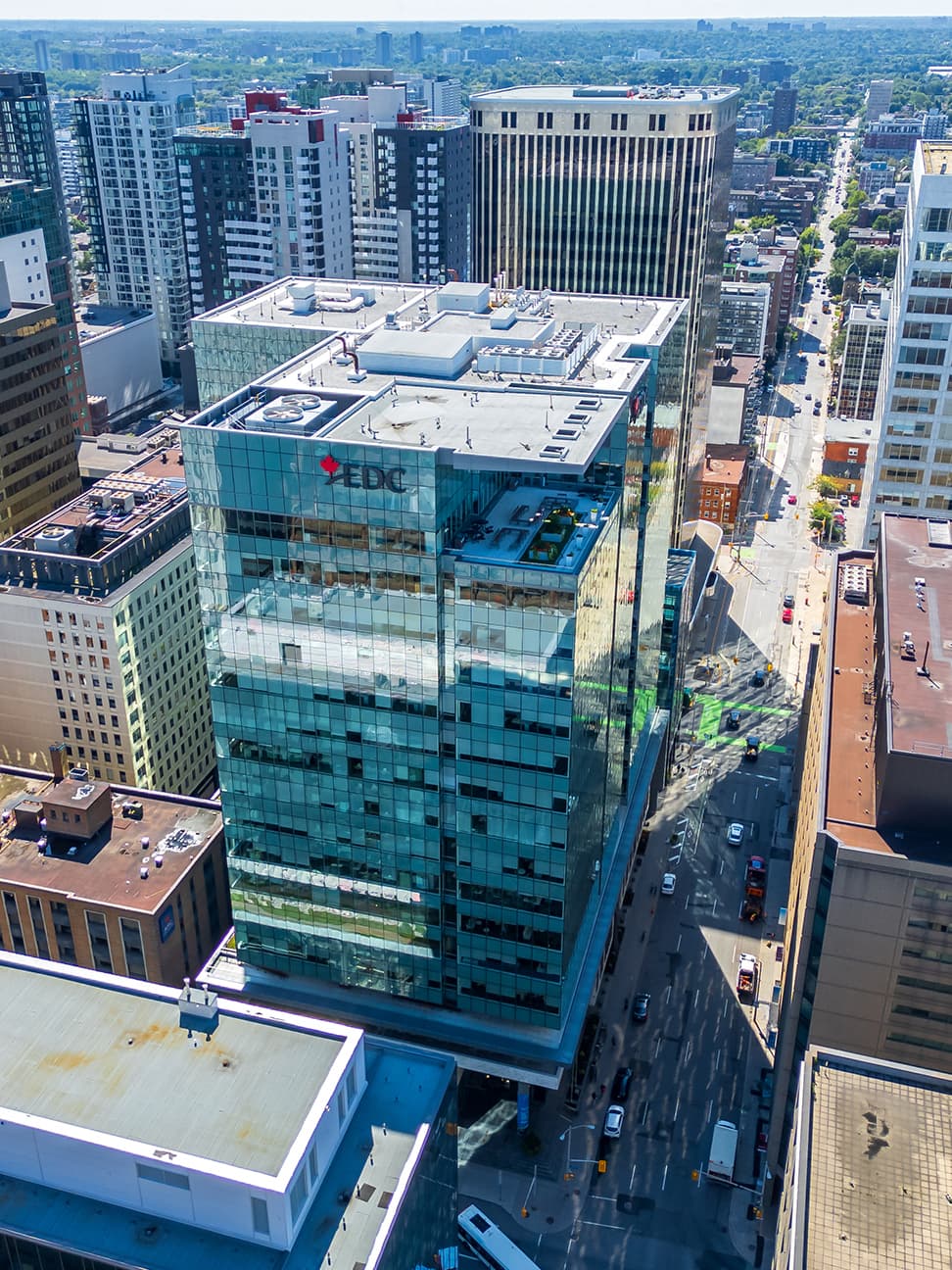
CBRE recently brokered the sale of 150 Slater St., a 447,448 sq. ft., Class A office tower in the heart of the capital’s financial district.
-

The seven-storey office building is being built on top of a restored former 100+ year old warehouse, combining the aesthetic of a century-old brick and beam structure with the functionality and sleekness of new, state-of-the-art office space.
-

CBRE’s Jeremy Deeks and John Fisher helped relocate ATCO to a new office building in downtown Edmonton, one of the city’s largest and most impactful office relocations in over a decade.
Stay In The Know
Subscribe today and join hundreds of professionals who get the latest blogs delivered straight to their inbox.