Article | Creating Resilience
Integrated Strategies to Reduce Total Cost of Occupancy
How cost, value and risk connect across four CRE disciplines
October 14, 2026

The options are not hard to find. Every CRE leader can identify a lever. The difficulty is knowing which combination of decisions will truly drive impact, and which ones will simply move cost or risk from one budget to another.
A CRE department’s Total Cost of Occupancy, or TCO, is commonly viewed across three categories. Operating expenses cover rent, utilities, maintenance and the day-to-day cost of running facilities. Capital expenses cover project and construction costs, and costs amortized over time such as information technology (IT) upgrades, moves, and furniture, fixtures and equipment (FF&E). The balance sheet holds all real estate-related assets, including long-term leases.
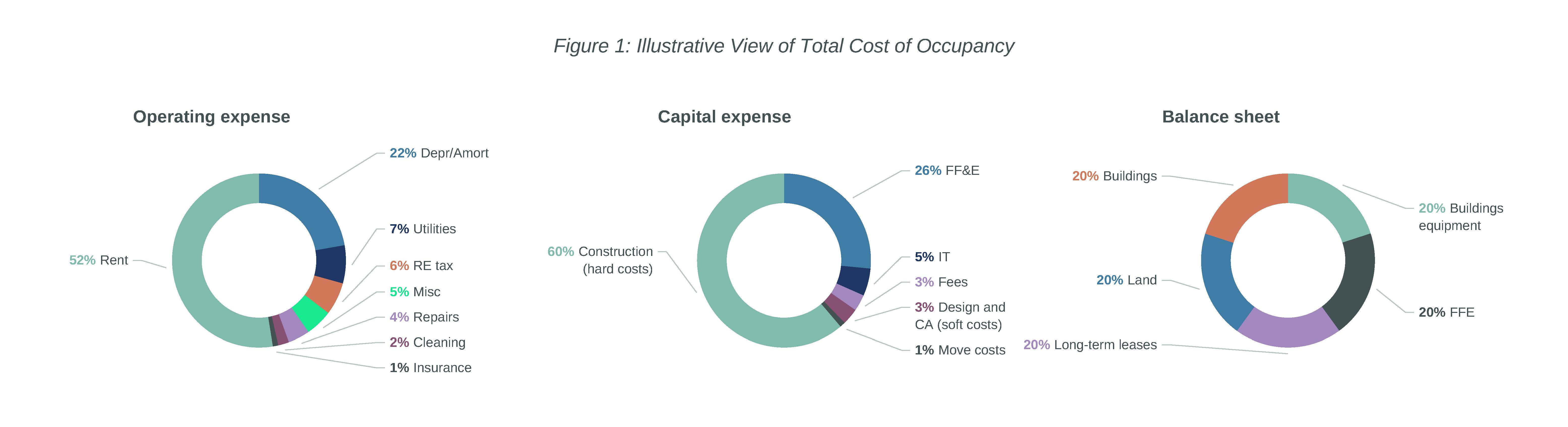
A decision made to reduce operating expenses can drive up capital expenditures. A capital project scoped without sustainability considerations can increase operating costs over the full lease term. A facilities management saving that defers maintenance only pushes cost onto the balance sheet. The costs are connected, and managing them separately is why savings mandates so often prove harder to deliver than they first appear.
CBRE Institute examined each of these CRE disciplines through which real estate cost decisions are made. Each one surfaces different levers, different risks and different time horizons.
Four Disciplines, One Cost Base
Portfolio Strategy and Transaction Management
The opportunity is wider than rent. CRE leaders have long known that smart leasing saves money on rent. What gets missed is the scale of the savings available when portfolio management connects to the full cost base of the business, including labor, which can account for up to 60% of an organization’s total costs. Getting there requires a single source of truth on portfolio obligations, a clear view of how much space the business actually needs over the next three to five years, and a strategy the business owns.
Project Management and Workplace Design
Design decisions can cost you for a decade. Capital expenditure for workplace design and fit-out is a much smaller cost than the lease. But it is where decisions get made that determine what the occupancy fully costs over the term of that lease. Get the design wrong and you lock in a decade of operational inefficiency, remediation costs and churn. Thorough property due diligence, designing for flexibility from the start, and a programmatic rather than project-by-project approach to capital all bring TCO down.
Facilities Management
Every day is a cost decision. Lease events get the attention. What happens after the organization moves in rarely gets the same scrutiny, even though facilities decisions made daily across every site add up to numbers that rival the costs everyone spent months optimizing upfront. The leverage sits in the specification rather than the tender: matching building operating strategy to actual occupancy data, re-specifying before re-tendering, and driving visibility and accountability into overtime costs.
Sustainability
A cost discipline, not a compliance checkbox. Regulatory expectation, mandatory disclosure and climate resilience are turning sustainability from a corporate communications exercise into a cost and risk management discipline. Treating it as a TCO discipline makes those risks visible early enough to manage, and the opportunities part of the budget cycle rather than a surprise. The practical fix is a balanced scorecard that tracks cost metrics and carbon metrics together, maintained by the same function and reviewed on the same cycle.
The thread running through every discipline is the same: the decisions that determine Total Cost of Occupancy are made earlier than most organizations treat them, and the consequences of those decisions arrive later than most budgets account for.The CFO’s 10% savings mandate is achievable. The question is whether the savings are real, durable and distributed across the right combination of decisions, or whether they are simply being moved somewhere less visible for now.
Related Insights
-
Report | Creating Resilience
Managing Corporate Real Estate: Leading and Emerging Practices

Corporate Real Estate teams have evolved new strategies to enable the business, engage employees and enact future-proofed plans.
-
Report | Creating Resilience
5 Trends Shaping Outsourcing Contracts

Explore key trends in real estate outsourcing contracts, including financial benefits, risk management, and C-suite involvement, with insights from the 2025 CBRE Institute report.
-
Report | Adaptive Spaces
2026 Global Workplace & Occupancy Insights

This year, our series offers a data-driven roadmap to help organizations adapt to today's hybrid workplace, covering design, leadership, technology and the future of work.