Article | Intelligent Investment
Rethinking Facilities Management in Thailand
August 10, 2026

From Presence to Performance: Rethinking Facilities Management in Thailand
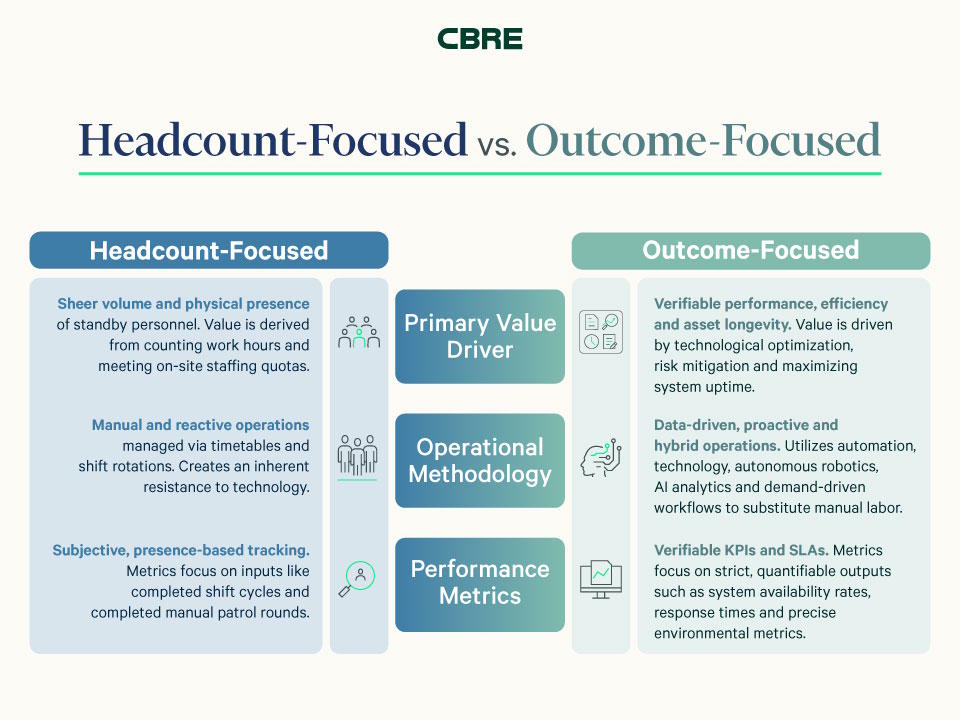
As labor costs rise and skilled manpower tightens in Thailand, organizations are re-evaluating how they procure and manage facilities management in Thailand. Many building owners still buy facilities management based on headcount rather than measurable outcomes. While this approach may feel familiar, it can make it harder to control cost, improve service quality, and capture the full value of technology investments.
In a headcount-based model, organizations are effectively paying for presence. In an outcome-based model, they pay for defined results such as uptime, response time, cleanliness, comfort, and energy performance. For owners of complex commercial and industrial assets, this shift can create a stronger link between spend and value, provided the contract is supported by clear key performance indicators (KPIs), service level agreements (SLAs), and reliable operational data.
Executive Summary: Key Trends Shaping Facilities Management in Thailand
1. Labor pressure is reshaping Facilities Management in Thailand: A tightening labor market and wage hikes are making traditional headcount-based models more expensive without necessarily improving outcomes.
2. Compliance requirements can add hidden staffing cost: Frameworks such as the Responsible Business Alliance (RBA) Code of Conduct place clear expectations on working hours and labor practices. In sectors where such standards matter, providers may need additional staffing buffers to stay compliant, which can raise baseline cost under headcount-based contracts.
3. Headcount-based contracts can weaken innovation incentives in facilities management services in Thailand: When revenue is tied mainly to labor hours, providers may have limited commercial incentive to reduce manual activity through automation, analytics, or redesigned workflows. 4. A phased transition reduces disruption: Moving to outcome-based facilities management in Thailand does not need to happen all at once. Many organizations can start by improving data visibility, piloting measurable soft services, and then expanding outcome-based approaches to critical engineering systems.
Why Traditional Facilities Management in Thailand Is Under Pressure
Across the facilities management industry in Thailand, traditional labor-based service models are facing growing pressure. Organizations increasingly expect outsourced facilities management in Thailand to deliver measurable business outcomes rather than simply provide staffing resources.
1. Labor Supply Pressure and Rising Wage Cost
Thailand is an aging society, and official and policy sources point to continued labor-market pressure over time. At the same time, minimum wage adjustments took effect across all provinces in 2024. For Facilities Management contracts priced mainly on labor inputs, these shifts can translate directly into higher cost for owners, even when service outcomes remain unchanged.
2. Hidden Cost of Staffing Buffers
When labor markets tighten, providers may struggle to fill every on-site position exactly as planned. In sectors with strict customer, legal, or ethical labor expectations, relying heavily on overtime or repeated back-to-back shifts can create compliance risk. To manage that risk, providers may need reserve staffing capacity, which can raise the baseline cost of a headcount-based contract without necessarily improving asset reliability or user experience.
3. Misaligned Incentives for Proptech Adoption
When revenue generation is primarily linked to billable labor hours, the business case for automation can become weaker. While innovations such as IoT sensors, workflow automation, analytics, and robotics may improve efficiency, they often reduce the very labor volume that traditional contracts depend on. This creates a fundamental tension where the operating model may not adequately reward providers for bringing these efficiency-driving innovations that reduce manual effort.
When Headcount Works — and When Outcomes Work Better
When a Headcount Model Still Makes Sense
Headcount-based contracts still have a place where human presence is itself a core part of the service, or where work is highly manual and not easily optimized by software or automation. In these settings, staffing visibility may remain an appropriate part of the service design.
- Front-of-house and concierge services: In premium offices, mixed-use assets, and hospitality-led environments, the service value often comes from personal interaction, responsiveness, and visible support.
- Stationary security posts: Some environments still require visible guard presence at entrances, exits, vehicle gates, or public-facing checkpoints to support deterrence and physical access control.
- Landscaping and grounds work: Tasks such as mowing, watering, pruning, and debris removal are labor-intensive and often better managed through straightforward workforce planning than through complex outcome-based logic.
When Outcome-Based Contracting Delivers Better Value
Outcome-based contracting is especially well suited to services where performance can be clearly measured and where asset risk, uptime, cleanliness, safety, or energy efficiency matter more than visible manpower. In these environments, the contract can focus on results rather than staffing volume, while giving the provider flexibility to redesign workflows and use technology more effectively.
As facilities management in Thailand continues to evolve, leading providers are increasingly adopting outcome-based delivery models. Rather than measuring success by workforce size alone, these providers use digital tools, operational data, and performance benchmarks to improve efficiency while giving asset owners greater transparency and accountability for service outcomes. This shift is helping redefine how facilities management services in Thailand deliver value across commercial, industrial, and mixed-use assets.
In this model, providers delivering facilities management services in Thailand are accountable for service outcomes through agreed SLAs and evidence from operational systems. That allows them to combine people, process, and technology in the most efficient way, rather than simply maintaining a fixed labor footprint.
- Smart cleaning operations: Cleaning can move from fixed schedules to demand-driven delivery using robotics, occupancy signals, digital alerts, and mobile work orders. The focus shifts from completed rounds to verifiable cleanliness outcomes and response performance.
- Hybrid security models: Security can combine core manned presence with CCTV analytics, remote monitoring, and mobile response. In this case, outcomes such as incident response time and system availability become more meaningful than counting patrol loops alone.
- Building engineering and central plant operations: For critical engineering systems, payment can be linked to measurable outcomes such as uptime, response performance, and energy efficiency, supported by predictive maintenance and sensor-based monitoring.
Benefits of Outcome-Based Facilities Management in Thailand
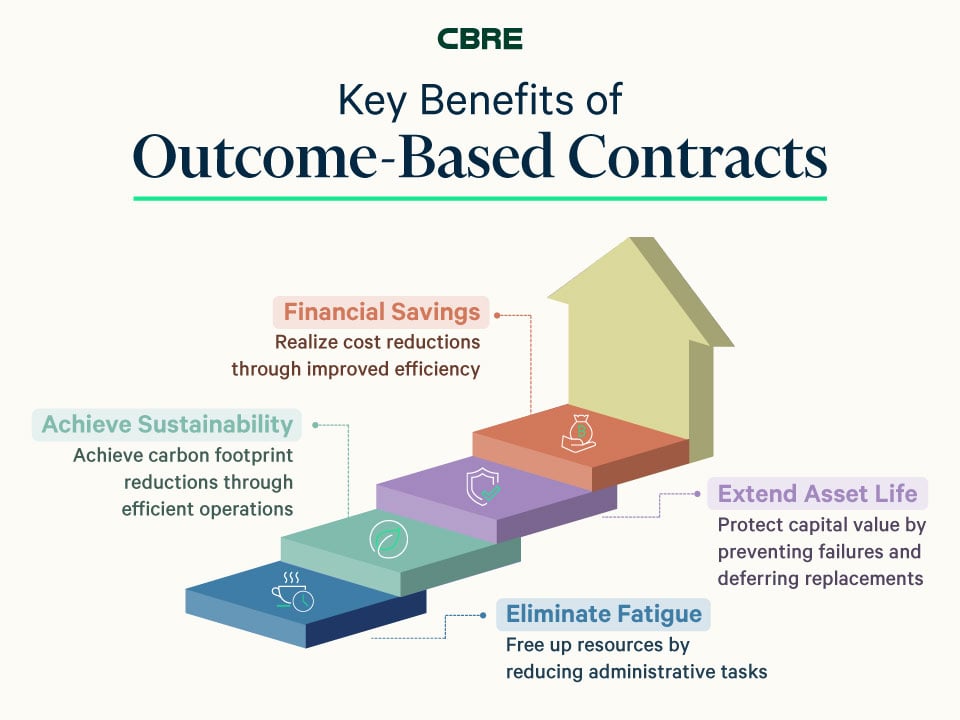
Cost efficiency is only part of the story. When designed well, an outcome-based model can also simplify governance, support sustainability goals, and improve long-term asset performance.
- Reducing administrative burden: Teams spend less time reconciling attendance records and debating input-based service delivery, and more time focusing on operational priorities and business outcomes.
- Supporting sustainability and energy goals: When service delivery is linked to operational efficiency, providers have stronger reason to maintain systems well, reduce waste, and help improve building energy performance over time.
- Protecting asset performance and capital value: Predictive and performance-led maintenance can help reduce avoidable failure, extend asset life, and defer unnecessary capital replacement.
How to Transition to Outcome-Based Facilities Management
A successful transition depends on three foundations: reliable data, clearly measurable service outcomes, and a commercial model that rewards improvement.
1. Build a Reliable Digital Data Foundation: A computerized maintenance management system (CMMS) or equivalent platform should provide a dependable record of asset history, work orders, response times, and service performance. This data trail supports performance reviews, service credits, and governance decisions.
2. Define Clear, Measurable KPIs: Legacy service descriptions should be replaced with specific, observable performance measures.
- Headcount Style: "Ensure the office environment is cool and comfortable."
- Outcome-Based Style: "Maintain corporate workspace temperatures between 22°C–24°C with relative humidity capped below 60% during operational hours, verified via automated building management system logs."
Facility owners can align mechanical engineering and energy management targets with global benchmarks like ASHRAE, while workplace cleanliness, hygiene, and indoor environments can be benchmarked against the WELL Building Standard to maximize occupant confidence.
3. Design a Balanced Gain-Share Mechanism: Contracts can include a transparent gain-share mechanism so that verified savings from better workflows, lower energy use, or smarter maintenance are shared between owner and provider according to agreed rules. This helps align commercial incentives with continuous improvement.
How to Select the Right Facilities Management Partner in Thailand
As demand for outsourced facilities management in Thailand continues to evolve, selecting the right service provider requires a broader assessment than simply comparing staffing levels or contract pricing. Organizations must evaluate providers across multiple dimensions—from operational readiness and governance discipline to the technical capability required to manage risks. This ensures total confidence in the concrete delivery of overall outcomes. Key dimensions to further consider for this model include:
- Data and technology capability: The provider should be able to manage CMMS data, sensor inputs, dashboard reporting, and workflow integration in a way that supports preventive and predictive decision-making.
- Workforce and training model: Teams should be appropriately trained, safely deployed, and capable of working across tasks where the model depends on multi-skilled delivery.
- Financial resilience and governance: Because the provider may carry more delivery risk, buyers should assess financial stability, escalation management, reporting discipline, and the ability to invest in continuous improvement.
A Practical, Phased Implementation Path
A phased approach is already enables your organization to build confidence, establish crucial baselines, and significantly reduce implementation risks. This transition begins with enhanced data capture and expands into pilot services, ultimately leading to broader outcome-linked delivery.
| Phase | Contract Model | Role of Technology | Primary Objective |
| Phase 1: Digital Infrastructure Readiness | Traditional Headcount | Initiate CMMS deployment to capture raw operational data from the field. | Establish accurate, transparent operational and energy consumption Baselines. |
| Phase 2: Smart Soft Services Piloting | Hybrid Model | Integrate cleaning robotics and IoT sensory arrays into Soft Services. | Pilot outcome-based cleaning metrics over rigid shift-rotation counts. |
| Phase 3: Full Outcome Integration | Outcome-Based | Bind financial payouts to core infrastructure uptime (e.g., 95%–98% Chiller Uptime during operating hours). | Fully onboard hard engineering and MEP systems into the outcome-based framework. |
| Phase 4: Mutual Value Management | Outcome-Based + Gain-Share | Utilize advanced digital analytics to extract maximum operational efficiency. | Apportion documented financial and energy savings into mutual performance bonuses. |
Why More Organizations Are Outsourcing Facilities Management in Thailand
The demand for outsourced facilities management in Thailand continues to grow as organizations seek greater operational efficiency, workforce flexibility, and access to specialized expertise. Rather than managing multiple vendors independently, many organizations are adopting integrated facilities management services in Thailand to consolidate service delivery under a single governance structure.This approach can improve reporting consistency, simplify vendor management, and create stronger accountability for both cost and performance outcomes. As facilities become increasingly complex and data-driven, many organizations view outsourced facilities management in Thailand as a strategic solution for improving operational resilience while controlling long-term costs.
For large commercial, industrial, and mission-critical facilities, integrated facilities management in Thailand can also enable greater standardization, stronger compliance oversight, and more effective use of digital technologies across the asset lifecycle.
Key Takeaways: Facilities Management in Thailand
- Headcount-only approaches to facilities management in Thailand are becoming harder to sustain: Headcount based models carry structural risks due to labor shortages, wage pressure, and increasing compliance requirements. It can raise cost without guaranteeing stronger service outcomes.
- Outcome-based models can better align cost with value: They are especially useful where uptime, cleanliness, response time, and efficiency can be measured and actively managed.
- Data is the enabler: A credible transition depends on reliable operational data, clear KPIs & SLAs, and governance linked to recognized standards where relevant.
- A phased transition is often the lowest-risk path: Organizations can start with pilots and baselines before expanding outcome-based methods into critical systems and shared-savings arrangements.
- Demand for outsourced facilities management in Thailand is increasing as organizations seek operational resilience, cost transparency, and technology-enabled service delivery.
Why Early Action Matters
For organizations relying on facilities management in Thailand, the question is no longer whether labor and cost pressures exist, but how contracts should respond to them. Moving from presence-based buying to performance-based delivery can help improve transparency, strengthen accountability, and create a more resilient operating model for the years ahead.Organizations considering this shift should begin with a readiness assessment covering asset criticality, current service measures, data availability, and the areas most suitable for phased adoption.
Contact CBRE GWS today to receive an organizational readiness assessment and learn how modern facilities management services in Thailand can improve performance, optimize costs, and support long-term asset value through an outcome-based operating model. Whether your organization is evaluating integrated solutions or outsourced facilities management in Thailand, a structured transition strategy can help unlock measurable business outcomes.
Strategic FAQ for Executives and Procurement
Q1: How do we transition our current headcount contracts to an outcome-based model without disrupting daily operations?
A: Start with a phased approach. Establish baseline operating and energy data, identify services that are easiest to measure, and pilot outcome-linked delivery before extending it into more critical systems. External benchmarks can help set realistic targets, but internal operational data should remain the starting point.Q2: How can we ensure that service quality won't decline if the service provider reduces their on-site headcount?
A: Service quality should be governed by outcomes, not by headcount alone. In an outcome-based model, quality is protected through clear SLAs & KPIs, digital evidence, and clear escalation rules.For example, engineering systems can be monitored through uptime and response data, cleaning through inspection or trigger-based evidence, and security through incident response metrics. When these measures are recorded consistently, they provide an auditable basis for service credits, remediation, or improvement actions.
Q3: Which international standards should we look to when defining these new KPIs and SLAs?
A: The answer depends on the service being measured. ASHRAE standards are commonly used to guide thermal comfort, ventilation, and broader HVAC performance; WELL can help frame occupant-focused outcomes such as indoor environmental quality and comfort; and ISSA guidance can support more structured cleaning performance discussions. The goal is not to reference standards for their own sake, but to use them where they help define fair, measurable, and relevant service outcomes.Q4: What is outcome-based facilities management?
A: Outcome-based facilities management is a service model where performance is measured against defined results such as asset uptime, response times, cleanliness standards, occupant comfort, and energy performance rather than the number of personnel deployed on-site. This approach gives providers greater flexibility to use technology, automation, and process improvements while maintaining accountability through agreed KPIs and SLAs.Q5: Which facilities management services are best suited to an outcome-based model?
A: Services with clearly measurable performance indicators are often the strongest candidates for outcome-based contracting. Examples include building engineering and MEP maintenance, HVAC operations, cleaning services, energy management, and certain security functions. Services where human presence is a core requirement, such as concierge services or fixed security posts, may remain better suited to a headcount-based approach.Q6: How does technology support outcome-based facilities management?
A: Technology enables providers to monitor performance, automate workflows, and generate objective service data. Solutions such as CMMS platforms, IoT sensors, predictive maintenance tools, building management systems, and analytics dashboards help track KPIs, improve decision-making, and support performance-based service delivery.Q7: Why are organizations increasingly outsourcing facilities management in Thailand?
A: Organizations are increasingly adopting outsourced facilities management in Thailand to improve efficiency, access specialized expertise, and simplify vendor management. By consolidating services under a single provider, they can enhance governance, increase cost transparency, and leverage technology to support performance, reliability, and long-term operational value.
Read More:
Facilities Management in Thailand: Solving the Technical Debt Crisis
The Second Life Strategy: Navigating Facilities Management in Thailand
Driving ESG Success Through Facilities Management in Thailand