Article | Intelligent Investment
Business Insights | Why housing choice is key to Sydney’s future competitiveness
While transport networks are advancing in Sydney, housing supply is falling critically behind. These are the changes needed for it to remain a competitive global city.
September 15, 2025

Start your journey in build to rent
Click HereSydney is growing quickly. By 2032, the city is expected to welcome around 700,000 new residents. This marks a 13% increase in population, equivalent to adding a city the size of the Gold Coast to our urban footprint.
Sydney is undergoing a transformative wave of infrastructure investment, with new metro lines, light rail extensions, the Western Sydney International Airport, and major road and tunnel upgrades reshaping how people move across the city. However, while transport networks are advancing, housing supply is falling critically behind.
The result? Increasing rents, rising home prices, and a growing affordability challenge that threatens to undermine Sydney’s status as one of the most desirable cities in the world.
The affordability test
Sydney is already one of the least affordable cities globally for home ownership. Over the past 30 years, more people have turned to renting, a trend that mirrors other global cities. However, unlike many of our international peers, our planning systems and tax settings have been slow to evolve and focus on the delivery of more rental housing at scale.
If we do not respond to the changing needs of our population by offering a broader mix of housing options in the locations where people want to live, we risk losing the talent that drives our economy. Whether it is a local graduate, an interstate professional, or an international migrant, people will choose cities that offer not only opportunity but also liveability.
Housing choice is not a luxury. It is essential infrastructure, just as important as roads, rail, and airports. The answer to tackling affordability across all tenures of housing is to focus on dramatically increasing supply.
Numbers tell the story
The NSW State Housing Accord has set a target of 377,000 new homes by 2029. To meet this goal, nearly 20,000 homes need to be completed every quarter. In the second quarter of 2025, less than half that number was delivered.
There are some early signs of progress, with commencements rising to 13,573 in the same quarter. However, this is still well below what is needed to meet demand.
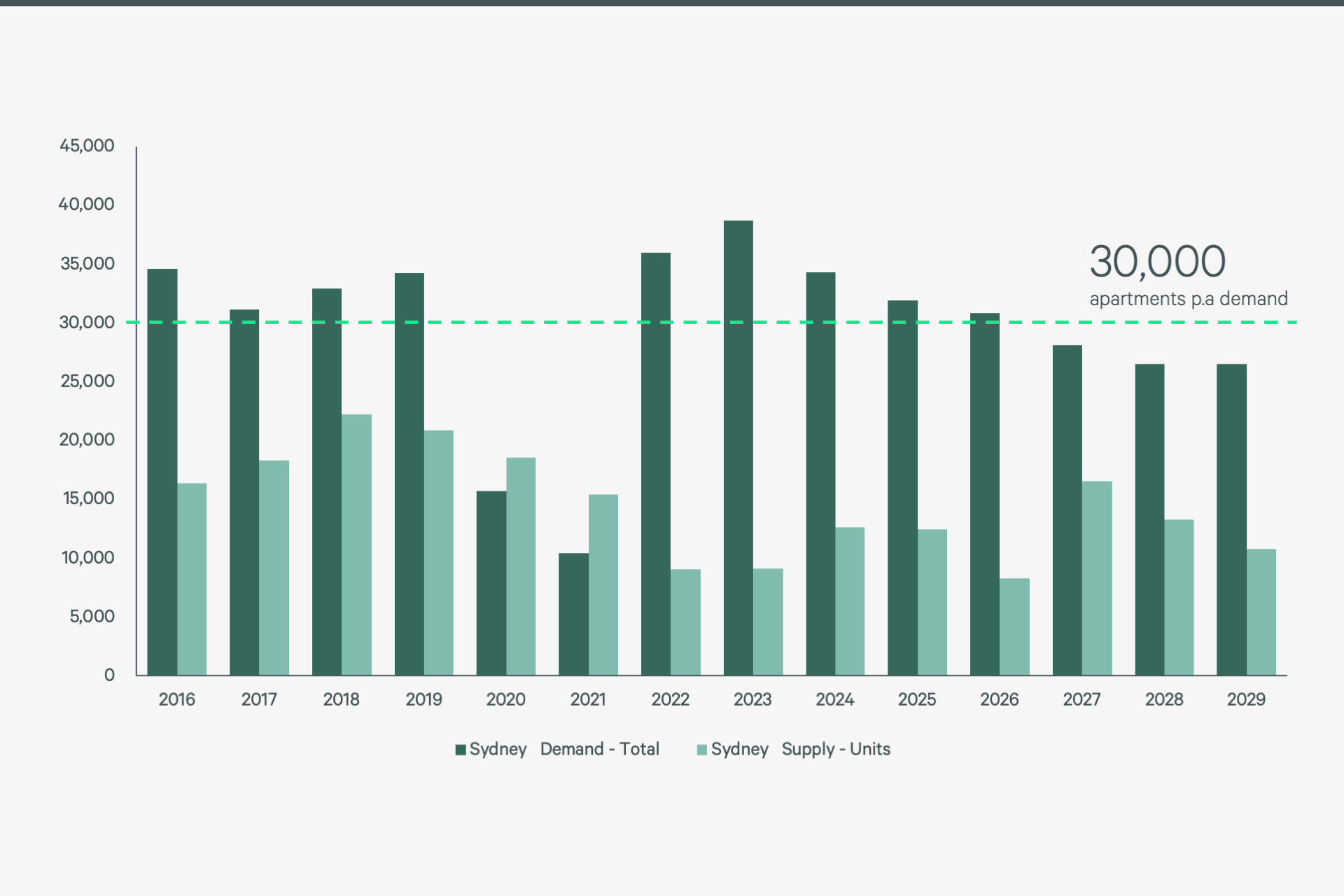
Apartments are a particular area of concern. Sydney needs to deliver 30,000 new apartments each year. Currently, just 12,250 are being delivered.
Rental vacancy rates remain low across Sydney, at around 1.7%, with many submarkets below 1.0%. A balanced market typically sits closer to 4.0%. When vacancy rates fall below 1.5%, rents can increase by more than 10% annually. This is not sustainable, especially for moderate and lower-income households who are being priced out of the neighbourhoods they desire for access to employment, family connections and community.
Figure 1: Demand far exceeds the supply pipeline in Sydney
Supporting every stage of life
A liveable Sydney requires a rental housing ecosystem that supports people at every stage of life. Most people will rent at some point in their lives, whether by choice or necessity, and Sydney must be ready to meet that demand, especially as home ownership has become out of reach for so many people.
The rental journey often begins with purpose-built student accommodation (PBSA) for those aged 18 to 23. As graduates enter the workforce, co-living in the CBD fringe and inner ring offers a flexible, community-oriented option for young professionals. Inner city build-to-rent (BTR) apartments then provide more privacy and space for individuals and couples aged 20 to 40 who want to stay close to work and lifestyle amenities. For those needing more room, suburban build-to-rent in the middle ring delivers one to three-bedroom apartments and townhouses suited to families, couples, or shared households. Later in life, land lease communities offer a low-maintenance, right-sized solution for people aged 55 and over.
This full spectrum of rental options allows people to remain in Sydney as their needs evolve, supporting a more inclusive and future-ready city.
Figure 2: Supporting every stage of life

What needs to change
-
Plan for people, not just postcodes
In some inner Sydney neighbourhoods, renters make up over 50% of the population. These areas are typically well-connected, vibrant, and attractive to younger, more mobile residents. They need housing that reflects this reality. Build-to-rent apartments, co-living spaces, and student accommodation near universities are essential. These formats support higher density, smaller footprints, and reduced car dependency, aligning with sustainability and ESG goals.
-
Prioritise essential workers
Cities rely on nurses, teachers, paramedics, and other essential workers. Yet many cannot afford to live near their workplaces. We need to zone land specifically for rental housing near hospitals, schools, and transport hubs. Purpose-built, professionally managed homes with short commutes will support these workers and attract long-term investment in stable, needs-based housing.
-
Unlock institutional capital
Australia’s tax and foreign investment settings are restricting the capital flows needed to build more homes. Tax rules for offshore investors and GST treatment for build-to-rent are reducing returns at a time when construction costs are already high. A policy reset is needed to attract additional institutional capital, both local and global, to help finance the housing Sydney urgently requires.
The competitive advantage
Sydney’s housing challenge is real, but it is solvable. What is needed is a shift in mindset. Housing should not be treated as a by-product of growth. It must be recognised as a key driver of economic resilience, social equity, and global competitiveness.
Housing choice is central to this. When people have access to a range of housing types, tenures, and locations, they are more likely to stay, contribute, and thrive. A well-functioning rental ecosystem supports workforce mobility, attracts talent, and enables people to remain in Sydney as their needs change. It also provides the stability that families, essential workers, and older residents need to plan for the future.
To remain competitive on the global stage, Sydney must deliver housing that works for everyone. This is not just about meeting population growth targets by 2032. It is about building a city where people want to live, work, and invest for generations to come.

Shaping Sydney’s Tomorrow
Discover expert insights on how Sydney is evolving across housing, workspaces, retail, and industrial growth.