Article | Intelligent Investment
Facilities Management in Thailand: Solving the Technical Debt Crisis
June 2, 2026

Every CFO knows exactly how much debt sits on the balance sheet—and how dangerous compound interest can become when ignored. Leverage ratios are monitored weekly. OPEX is scrutinized line by line. Capital allocation decisions are debated at board level.
Yet across corporate real estate portfolios, facilities management in Thailand is confronting a fast-compounding financial threat—one that never appears in a financial statement. Across office towers, manufacturing plants, data centers, and mission critical facilities, rising energy costs, aging infrastructure and escalating ESG expectations are increasing the cost of decisions deferred for too long.
That cost has a name: technical debt.
Executive Snapshot
- Facilities management in Thailand is entering a technical debt crisis that will become critically expensive by 2027.
- Without strategic intervention, MEP lifecycle costs can triple—driven by emergency failures, energy waste and supply chain pressure.
- Strategic, data-driven facilities management converts reactive OPEX into CAPEX decisions that deliver positive ROI.
What is Technical Debt in Facilities Management?
The term originates in software engineering: the hidden cost of choosing a quick fix over the right solution. Technical debt accumulates silently. Every deferred maintenance cycle, every aging Mechanical, Electrical, and Plumbing (MEP) system kept alive with short-term fixes and every critical upgrade postponed to protect near-term cash flow adds to a liability that compounds as relentlessly as financial debt itself.
Facilities Management in Thailand: Why Technical Debt Is Accelerating
Thailand presents one of the most demanding operating environments for building systems in Asia. Relentless heat, extreme humidity and urban air pollution place building systems under sustained stress, accelerating equipment degradation and shortening MEP lifecycles far beyond global averages.
At the same time, volatile electricity pricing driven by Thailand’s Fuel Adjustment Tariff (Ft) penalizes inefficient systems. Aging chillers and cooling plants don’t just underperform; they actively erode profit margins with every billing cycle.
A tightening labor market is also reducing the pool of skilled engineers capable of executing predictive maintenance and integrating IoT enabled systems. Meanwhile, a large share of corporate MEP equipment is now approaching end of life simultaneously, creating a compounding burden across Thailand’s built environment.
The 2027 Tipping Point for Facilities Management in Thailand
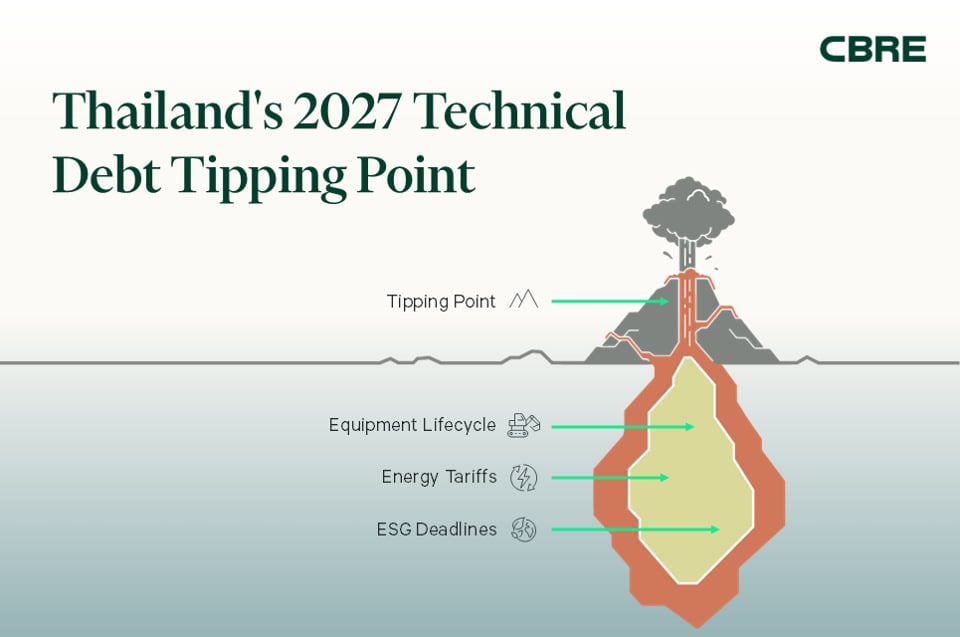
For facilities in Thailand, three converging pressures are set to reach a critical threshold by 2027:
1. End of Equipment Lifecycle
Between 2012 and 2015, Thailand experienced a massive corporate construction and industrial expansion boom. The heavy MEP equipment installed during that era—specifically central chillers and massive cooling towers—typically carries an operational lifecycle of 12 to 15 years. By 2027, a large percentage of corporate infrastructure will reach that threshold within a compressed timeframe. When thousands of facilities require major equipment replacement at the same time, procurement bottlenecks become inevitable. Lead times extend, costs rise and the ability to plan and schedule on your own terms diminishes.
Industry Benchmark: According to building lifecycle benchmarks from the Chartered Institution of Building Services Engineers (CIBSE) Guide M and industry standards by BOMA International, standard central cooling plants and water-cooled chillers reach the end of their optimal economic lifecycle at approximately 15 years. Beyond this threshold in tropical climates, failure rates and maintenance OPEX spike exponentially.
2. Energy Tariff Exposure
Global fuel markets remain volatile, while Thailand's Ft rate continues to expose electricity pricing to those fluctuations. Operating outdated, energy-intensive machinery is becoming financially unsustainable. For manufacturing plants and data centers, even modest inefficiencies can translate into millions of baht in additional energy costs.3. ESG Deadlines and Corporate Valuation
Global stakeholders and regulators are currently enforcing strict environmental, social and governance (ESG) mandates. Major multinational corporations have publicly committed to aggressive Net Zero carbon targets by 2030, with significant carbon-reduction milestones expected by 2027. Facilities that fail to meet these interim targets face a corporate "brown discount"—a depreciation in asset value that makes properties less attractive to institutional investors and top-tier talent seeking sustainable workplaces.Industry Benchmark: As highlighted in the CBRE 2025 Asia Pacific Real Estate Chief Sustainability Officer Survey, ESG is now a global mandate driven by international frameworks like the IFRS, making sustainable facility operations a non-negotiable requirement for corporate valuation.
How Technical Debt Multiplies MEP Costs in Thailand
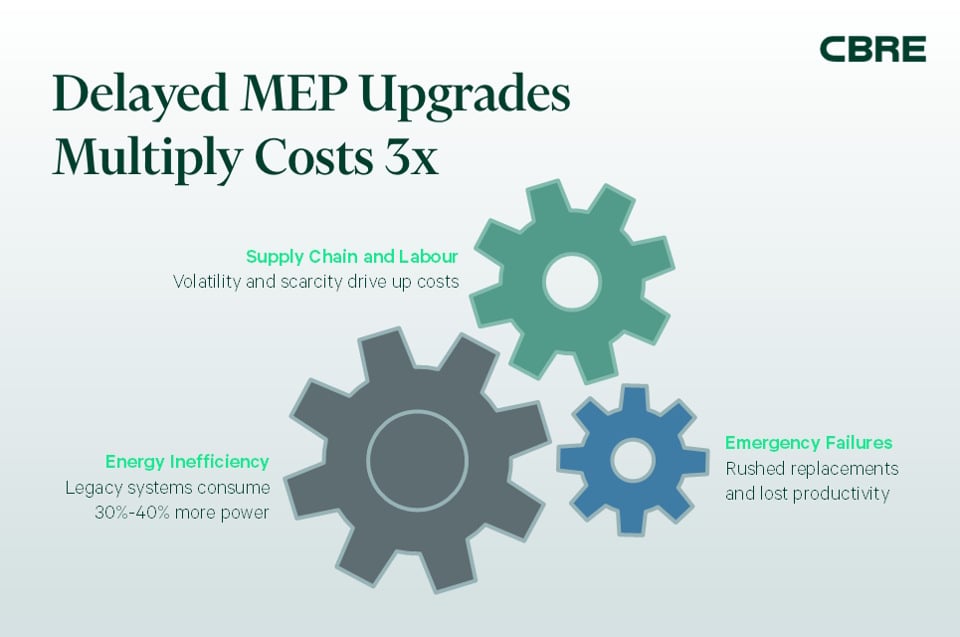
Deferring MEP upgrades is a profound financial gamble. Industry data suggests that organizations which defer necessary upgrades today face MEP lifecycle costs up to three times higher by 2027.Industry Benchmark: The U.S. Department of Energy’s Operations & Maintenance Best Practices Guide notes that highly reactive, "run-to-fail" maintenance strategies can cost up to 40% more than proactive, predictive maintenance strategies, not accounting for the total loss of productivity during outages.
That multiplier works through three distinct mechanisms:
1. Emergency Failure vs. Planned Replacement (The Business Interruption Tax)
A planned, proactive chiller replacement allows for competitive vendor bidding, scheduled downtime and minimal disruption to operations. An emergency failure offers none of those advantages. Rushed equipment delivery, premium labor rates and unplanned downtime create a cost profile that bears little resemblance to the original upgrade budget. For a 1,000-person corporate headquarters that loses air conditioning for three days, the cost of lost productivity, halted server rooms and plummeting employee morale can quickly dwarf the cost of the chiller itself.2. Supply Chain and Labor Pressures
The global supply chain for specialized MEP parts remains tight. As Thailand’s equipment wave cycle approached, demand for both imported hardware and skilled engineering talent will intensify. Organizations that delay will be competing for the same resources at the same time, with less negotiating leverage and fewer options.3. The Energy Inefficiency Penalty
Outdated MEP systems consume 30% to 40% more power than modern, AI-optimized alternatives. The gap is not a future problem; it is a recurring monthly cost that accumulates for every year an upgrade is deferred. For a manufacturing plant with a monthly electricity bill of THB 3 million, a 30% inefficiency costs THB 900,000 every month. Over a three-year period, that represents an unrecoverable penalty of THB 32.4 million.The Real Cost of Deferred Maintenance
The financial consequences of technical debt are not hypotheticals. Global and regional data consistently points to the same conclusion: deferral is always more expensive than planned action.• Cost of Downtime: According to the Ponemon Institute "Cost of Data Center Outages" Report, failures in facility cooling and UPS (Uninterruptible Power Supply) systems are the primary root causes of non-IT corporate operational downtime. Unplanned facility outages cost large enterprises an average of $8,851 (approximately THB 310,000) per minute of downtime.
• Penalty of Delay: The U.S. Department of Energy (DOE) Operations & Maintenance Best Practices Guide indicates that deferring maintenance to the point of a "run-to-fail" emergency increases direct replacement and repair costs, driven by emergency logistics, expedited shipping for heavy parts and premium overtime labor.
Manufacturing Reality in Thailand
Consider a high-output manufacturing plant in Rayong or Samut Prakan that decides to defer a THB 10 million industrial chiller replacement to "preserve cash flow" for another three years. When that aging system inevitably collapses during an April heatwave, the facility faces a compounding operational disaster.Emergency replacement costs can surge to more than THB 13 million, a direct result of emergency logistics, expedited shipping and premium installation rates. Beyond the equipment cost, a mere 48-hour cooling failure can trigger critical machine overheating, damage temperature-sensitive raw materials and breach delivery contracts with global clients. The cost of this production disruption—combined with wasted inventory and contractual penalties—cam quickly exceed the equipment cost, transforming a deferred CAPEX decision into a multi-million-baht operational crisis.
The Solution: Strategic Asset Lifecycle Planning
Strategic asset lifecycle planning requires a shift from reactive maintenance, where equipment is repaired only after failure, to predictive, data-driven decision-making that identifies operational risk before disruption occurs.This is where professional facilities management providers prove their real value. Rather than simply maintaining equipment, experienced FM teams conduct comprehensive technical audits, deploy non-invasive IoT sensors and analyze historical performance data to map out real-time health of infrastructure across a portfolio.
For CFOs and asset managers, this translates into clarity. Which liabilities carry the highest cost of delay and require immediate action? Which upgrades can be safely deferred without increasing risk? By converting unpredictable emergency expenditure into a clear CAPEX roadmap that delivers positive ROI, strategic facilities management transforms technical debt from an invisible liability into a manageable, planned cost.
Key Takeaways: Facilities Management in Thailand
- Climate stress, energy volatility and synchronized MEP aging are amplifying the cost of delay.
- Deferred maintenance can triple total lifecycle costs through emergency failures, energy waste and business interruption.
- By 2027, Thailand’s corporate and industrial facilities will face a critical asset lifecycle tipping point.
- Data driven facilities management converts reactive OPEX into predictable, planned CAPEX.
- Early action protects ESG performance, asset valuation and workforce productivity.
Delay Is the Most Expensive Decision
The calculus for asset owners and business leaders across Thailand is straightforward. Every month of deferral adds to a liability that continues to grow. By 2027, the convergence of end-of-life equipment, rising tariffs and tightening ESG deadlines will leave organizations with far less flexibility to delay action.Organizations that act now—commissioning technical audits, deploying IoT-enabled diagnostics and implementing structured CAPEX plans—will be positioned to manage their assets on their own terms. Those that don't will be forced to manage on the market's terms, at the market's prices and under the market's timeline.
FAQs: Technical Debt and Facilities Management in Thailand
What is a technical debt in facilities management?
It is the cumulative financial and operational risk created by deferred maintenance, aging MEP assets, and reactive FM strategies. Every postponed upgrade or short-term fix adds to a liability that grows more expensive to resolve over time.Why is technical debt accelerating in Thailand?
Thailand’s tropical climate places building systems under sustained stress, compressing MEP lifecycles significantly. Energy tariff exposure, a tightening skilled labor market, and the simultaneous end-of-life of large a large proportion of corporate MEP equipment are combining to create conditions that accelerate technical debt faster than other markets.How does strategic facilities management reduce MEP lifecycle costs?
Through predictive maintenance, comprehensive lifecycle audits, and data driven CAPEX planning, professional facilities management teams identify and address risk before they escalate into emergency failures—converting unpredictable OPEX into a structured and manageable investment cycle.Are you ready to understand the true cost of technical debt in your facilities? Contact the experts at CBRE GWS to discuss a comprehensive asset lifecycle audit. We will partner with your team to identify hidden OPEX leaks, assess your equipment health and build a self-funding CAPEX roadmap that protects the long-term value of your corporate portfolio.
Read More:
The Second Life Strategy: Navigating Facilities Management in Thailand
Driving ESG Success Through Facilities Management in Thailand
Facilities Management in Thailand: Escaping the Cycle of Reactive Spending