Article | Intelligent Investment
Business Insights | How intermodals are driving a more efficient, greener and valuable industrial future
As Sydney’s industrial market continues to evolve, intermodal freight terminals are emerging as critical infrastructure with a host of benefits.
September 15, 2025

Start your intermodal investment journey
Click HereAs Sydney’s industrial market continues to evolve, intermodal freight terminals are emerging as critical infrastructure - reshaping supply chains, reducing road congestion, and unlocking long-term value for occupiers, investors, and the broader economy.
In today’s challenging freight environment, marked by rising costs, tighter margins and ongoing supply chain disruptions, the pressure on transport operators is mounting. Recent administrations of carriers like XL Express and Don Watson are early indicators of further industry strain, and with some of the highest freight costs in the world, more are expected to follow.
Shifting from road to rail is becoming a more logical step. Yet, according to the Australian Railway Association, just 2% of freight on the country’s busiest corridor between Melbourne and Sydney currently moves by rail. In contrast, rail accounts for around 20% of freight in Europe and over 27% in the United States, based on 2020 data.
Strategic shift from road to rail
The Australian Government is driving a clear shift from road to rail, backing it with serious investment. Over $1 billion has been committed to the dedicated freight line between Port Botany and Moorebank, along with an additional $570 million to support the Moorebank Interstate Terminal.
This infrastructure is designed to streamline freight movement across inland Australia, reduce reliance on road transport, and accelerate the decarbonisation of the logistics sector.
At the heart of this shift is the Moorebank Intermodal Terminal, a landmark joint venture between The National Intermodal Corporation, QUBE Holdings, and ESR. Spanning 243 hectares, it’s one of the largest logistics hubs in the southern hemisphere, capable of servicing up to 850,000 sqm of warehousing and handling 1.55 million TEU per year.
That scale, and its rail connectivity, is translating into strong occupier demand:
- Woolworths has committed $780 million to a state-of-the-art regional and national distribution centre
- Kmart is developing a $200 million, 100,000 sqm omnichannel fulfilment centre, due to be operational by late 2027
- Other major tenants include Mainfreight, Maersk, and Sydney Tools
Moorebank Intermodal offers these national occupiers with a more resilient and balanced freight network, enabling them to keep pace with economic growth, global competitiveness and climate goals.
I was fortunate to work with both Mainfreight and Sydney Tools during their consideration for Moorebank Intermodal. For Mainfreight, the terminal has allowed them to consolidate their wharf, warehousing and domestic transport operations – streamlining their supply chain and reduced costs for customers. Their new 55,000 sqm warehouse features 70,000 racked pallet spaces, temperature control and dedicated dangerous goods areas.
They’ve also embraced automation, integrated robotics and smart technologies to lift productivity. On the sustainability front, the facility features 1,864 solar panels, battery energy storage systems, electric forklifts and an in-house training centre to support staff development.
For Sydney Tools, Moorebank Intermodal has been key to strengthening their supply chain, enabling them to centralise their operation through the site as a national distribution centre and better service regional stores via efficient rail access. This shift has not only improved delivery timeframes across their 110 retail outlets across Australia and New Zealand but also reduced the need for large warehouse footprints in major capital cities – future proofing their network and creating a more scalable, efficient distribution model.
Economic and environmental impact
The benefits of intermodal infrastructure stretch well beyond logistics. These hubs deliver wide-reaching economic and environmental advantages, including:
- Job creation and economic uplift in both regional and metropolitan precincts
- Reduced congestion on key corridors such as the M5 Motorway - Moorebank alone is expected to remove over one million truck movements annually, the equivalent of 3,000 heavy vehicles per day
- Lower emissions, with an estimated 110,000 tonnes of CO₂ equivalent saved each year
- Improved delivery times and more efficient warehouse footprints, reducing land and energy consumption
ESG and the future of industrial
Intermodals are increasingly aligned with ESG objectives and the shift toward responsible, future-ready development.
- Fewer trucks on roads means safer streets, less noise, and significantly lower emissions
- Rail freight is significantly more carbon-efficient than road transport, particularly over long distances
- Integrated logistics precincts like Moorebank enable green building design, renewable energy integration, and circular supply chain models
As these terminals grow in strategic importance, they’re also reshaping the investment landscape, putting upward pressure on land values in key logistics corridors. Locations like Tamworth, Wagga Wagga, and Parkes once considered peripheral, are now central nodes in a more connected national freight network. This shift is driving stronger tenant covenants, longer lease terms and increased demand for infrastructure-ready land.
What's holding intermodals back?
There is no questions Australia's vast landscape and high freight costs provides the perfect ingredients for lower emissions and cost savings over long distances that rail can provide.
Here’s what’s holding it back:
- Fragmented ownership across federal, state and private entities, creating gaps in infrastructure and inconsistent connectivity
- Chronic underinvestment, with road infrastructure historically favoured over rail
- Outdated infrastructure, with single track bottlenecks slowing down freight
- Limited access to transparent data and cost benefit analysis to support further investment
A network for the next generation
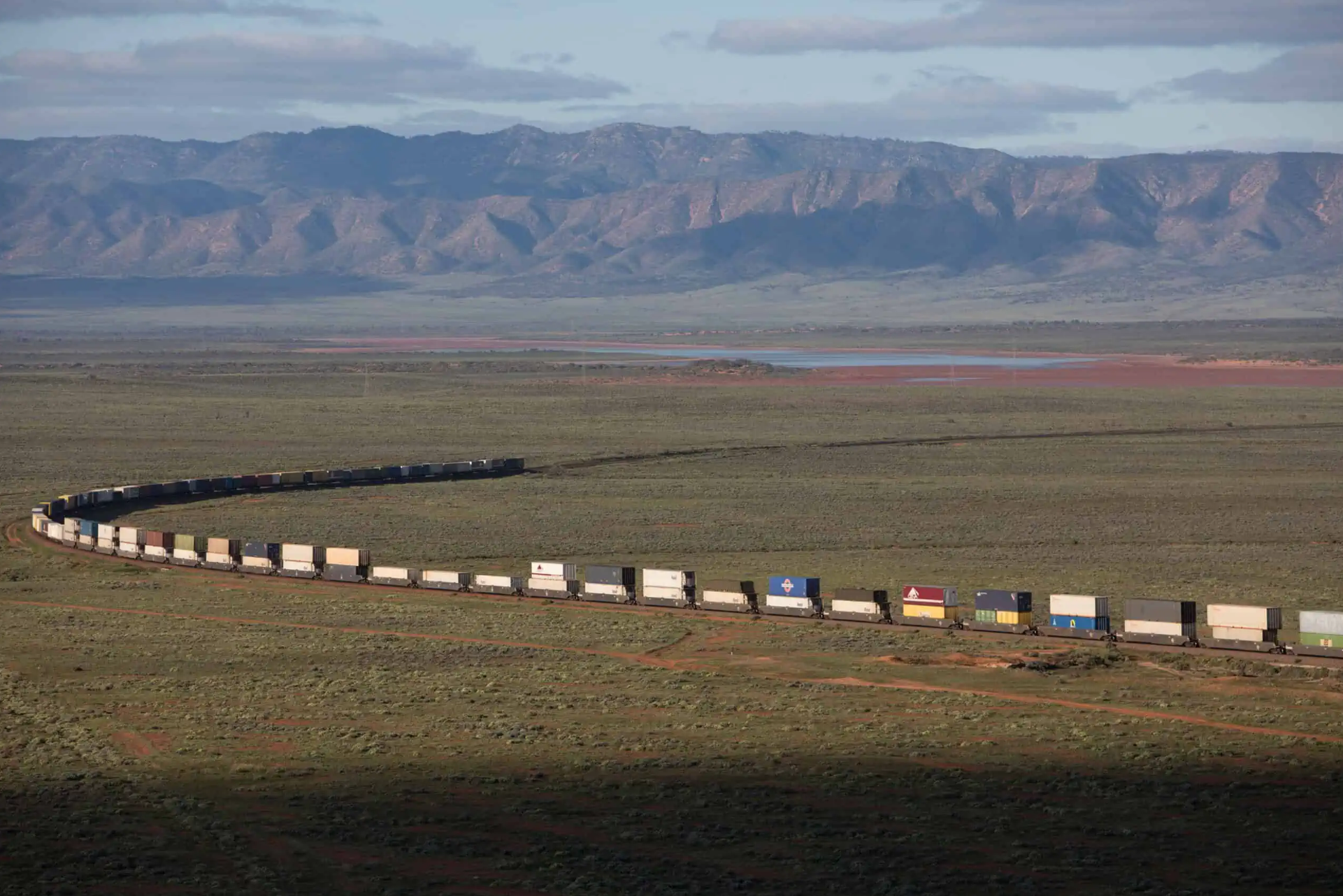
(Supplied: Australasian Railway Association)
From Moorebank to Tamworth, intermodal terminals are no longer just freight facilities - they are vital pieces of national infrastructure enabling a more resilient, sustainable and productive industrial economy. As Sydney continues to densify and industrial land becomes increasingly scarce, these hubs will be central to how we plan, invest and move goods across the country.
One train has the capacity to remove 54 trucks from our roads. Multiply that across a growing network of intermodal hubs, reshapes how freight moves in Australia – smarter, cleaner and built for the future.
Intermodal terminals are no longer just logistics assets, they are critical infrastructure for a more efficient, sustainable and resilient freight network. As costs rise and ESG pressures grow, shifting from road to rail is not just logical, it’s essential.
With the right investment and coordination, intermodals can reshape how goods move across NSW and Australia, reducing emissions, easing congestion and unlocking long-term value.

Shaping Sydney’s Tomorrow
Discover expert insights on how Sydney is evolving across housing, workspaces, retail, and industrial growth.