Article | Evolving Workforces
Business Insights | Are we selecting offices for the wrong generation?
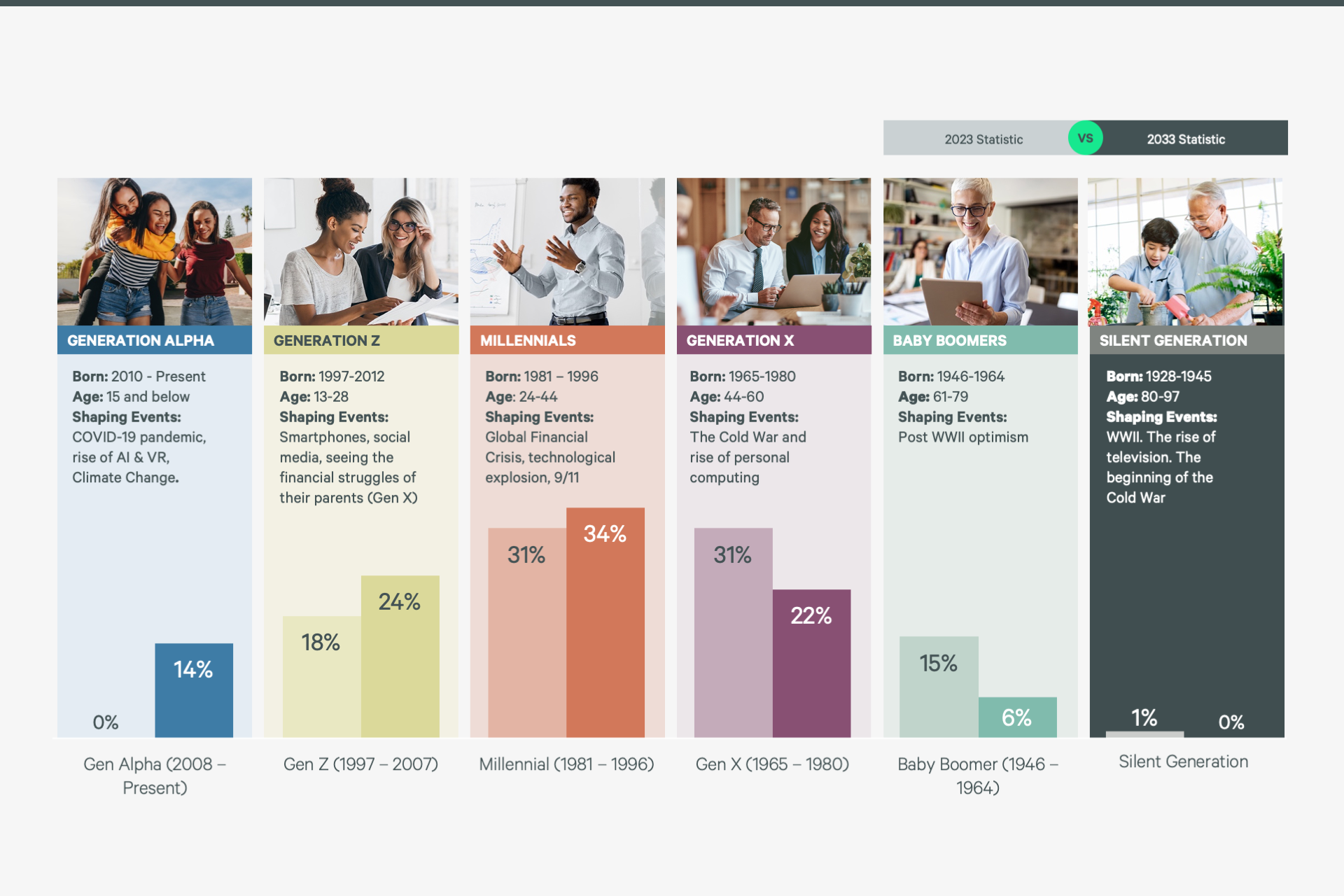
Millennials and younger generations now account for over 56% of the country’s workers, but are they in the right work environment?
September 15, 2025

See our tenant expertise
Click HereOne of the largest trends impacting the office sector entering 2025 is the demographic shift from the previously dominant baby boomers to millennials and younger cohorts.
As of the most recent ABS population data, millennials are now the largest population cohort in Australia, accounting for 23% of the country’s residents. Millennials and younger generations now account for over 56% of the country’s workers. This is a big shift from the past 20 years when baby boomers were the prominent voices in the workplace. Given the ageing profile of the Australian workforce, this isn’t a passing trend. It’s a structural shift that’s redefining how, where, and why we work.
Yet many corporate real estate decisions (location, layout, amenities) are still shaped by leaders whose careers were built in a different era. These decisions are often finalised by gen X and baby boomer executives, while the people who will occupy, lead, and grow within those spaces belong to entirely different generations with different expectations, social norms and views of what a “typical” workplace experience should be.
The long-term impact of short-term thinking
Real estate decisions are made every five to ten years, but they affect people every single day. From employees and clients to future talent, your office is more than a workplace. It’s a long-term signal of what your organisation values. It reflects your culture, your priorities, and your future.
A growing disconnect
Today’s workforce spans five generations. What one group sees as ideal, another may find irrelevant or even counterproductive.
- Executives often prioritise CBD locations, proximity to clients, and traditional layouts that support visibility and confidentiality.
- Middle managers, balancing careers and caregiving, need convenience, predictability, and flexibility.
- Younger professionals seek vibrant precincts, community, transport access, and purpose-driven spaces.
The variance in what people want from their offices has arguably never been wider. This gap is very clearly noted when looking at data collected during CBRE's annual Office Occupier Survey process. In this year's survey, occupiers were asked which office attributes they’d be willing to pay a premium for. Surprisingly, nearly 20 different office attributes were selected in response to this question.
Figure 1: Attributes that occupiers would pay a premium for

When real estate strategies over-index on legacy preferences, they risk alienating the very people they’re meant to support. A high-end centrally located office may look impressive on paper - but underdeliver in practice if it doesn’t reflect the varied and evolving needs of a diverse workforce.
Cost of getting it wrong
Real estate is typically an organisation’s second or third largest cost, after talent. The return on that investment? How well it enables people and businesses to perform.
The right real estate strategy can:
- Support multi-generational productivity by aligning space, location, and amenity with diverse workforce needs.
- Enhance employee experience, improving attraction, retention, and day-to-day effectiveness.
- Reinforce brand and culture, sending the right signals to staff, clients, and the market.
But decisions made purely on cost, tradition, or hierarchy can constrain growth, frustrate talent, and erode competitive edge.
Designing for life stages: Real estate that evolves with people
Many firms are reimagining their spaces to include on-site childcare facilities, dedicated parent rooms and real estate choices that prioritise proximity to early learning centres. These thoughtful real estate decisions help working parents stay connected and reduce the daily friction of balancing work and care.
These aren’t just perks. They’re strategic enablers of performance. They reflect a shift from treating real estate as a static asset to seeing it as a dynamic platform for talent engagement, inclusion, and productivity.
The real question isn’t where, it’s why
Corporate real estate is no longer just about floorspace. It’s about foresight.
The decisions you make today about where to locate, how to configure, and what to invest in, will shape your organisation’s trajectory for years to come. Making the right decision will enable the organisation to extract value from the real estate decision for decades, rather than making regular changes.
So, before you sign your next lease, ask:
- Will this space support both today’s leadership and tomorrow’s talent?
- Does it reflect who we are and who we’re becoming?
- Are we building for familiarity, or for flexibility?
Because the best real estate strategies don’t just preserve the past, they empower the future.
Figure 2: The composition of the workforce will shift dramatically by 2033

Shaping Sydney’s Tomorrow
Discover expert insights on how Sydney is evolving across housing, workspaces, retail, and industrial growth.