Adaptive Spaces
Availability of Older Bulk Warehouses Presents Renovation Opportunities
June 10, 2025 3 Minute Read

Industrial occupiers’ post-pandemic flight to quality has left behind a raft of obsolete facilities that lack the modern amenities necessary for today’s distribution operations. Approximately 2 billion sq. ft. of bulk (100,000 sq. ft.+) warehouses built since 2020 have further fueled rising vacancy of older warehouses—those that are more than 25 years old and have clear heights of less than 30 feet.
Figure 1: Vacancy Rate & Net Absortion for Older Bulk Warehouses
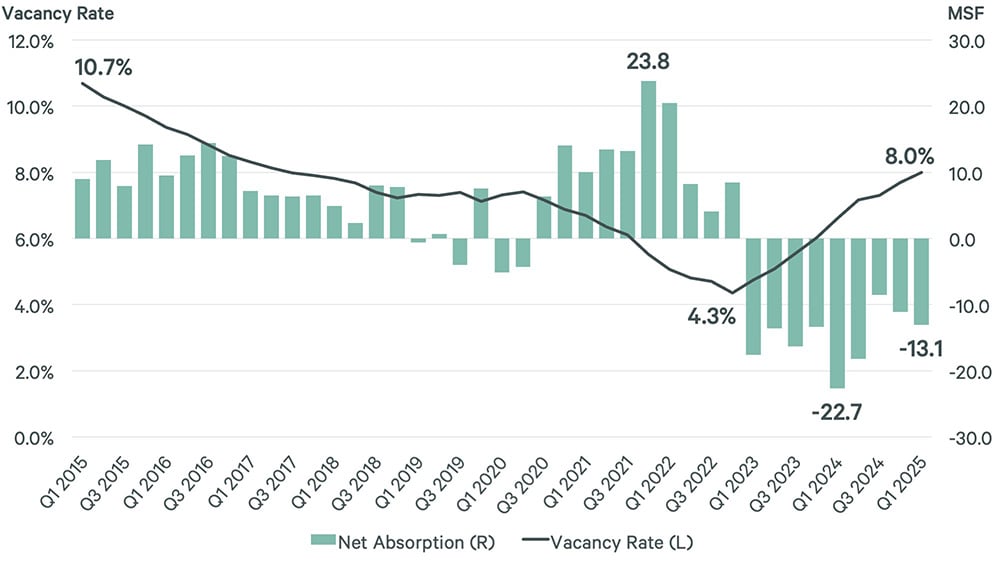
Source: CBRE Econometric Advisors, Q1 2025.
Older warehouse inventory now totals more than 3 billion sq. ft. The vacancy rate for these older properties has nearly doubled over the past two years to 8.0%, with 133 million sq. ft. of negative net absorption. Owners of these facilities increasingly are facing two options: sell them to users who do not require modern amenities or retrofit them with modern amenities.
For owners opting to modernize their facilities, the following elements should be considered.
Structural Improvements:
Facades
Refreshing the facade of an aging asset by painting it or adding new elements gives the asset a modern look. This curb appeal may attract prospective tenants who otherwise might not have considered the property.
Clear Heights
Most pre-2000 bulk warehouses have clear heights of less than 30 feet, which is the minimum for most modern facilities. A capital-intensive but effective solution is to raise the roof of the existing structure with hydraulic post-shores or telescoping columns to a clear height of 30 feet or more. This will make the building more competitive for high-quality tenants and increase its value.
Fire Sprinklers
Early suppression fast response (ESFR) sprinklers are the current gold standard for fire suppression. These systems more effectively suppress fires than older in-rack sprinkler systems. Upgrading to ESFRs can reduce tenant concerns over potential fire damages.
Electric Capacity
Owners of older facilities should consider electrical upgrades such as new panels and wiring to handle the increased load required by modern tenants.
Energy Efficiency:
Windows
Windows are responsible for approximately 10% of direct energy use in commercial buildings and can contribute to as much as 40% of total energy consumption.1 By investing in highly insulated replacement windows and shading, owners can reduce the utility load required for industrial tenants in older bulk warehouses.
Lighting
Lighting accounts for more than 10% of utility costs in commercial spaces. Replacing fluorescent tube lights with LED fixtures, which are 44% more efficient,2 can reduce that expense.
Solar Panels
Solar panels can provide a significant amount of power for tenants. Despite this, less than 2% of U.S. industrial assets have them, creating an opportunity for owners of older assets to differentiate themselves from newer Class A product. Of the 181 Energy Star-certified industrial buildings that currently have solar panels, more than half of their total power consumption is met by this renewable resource.3
HVAC
Cooling accounts for 14% of total energy consumption in commercial buildings, with an additional 18% used for ventilation.4 By leveraging digital sensors that collect patterns on temperature, humidity and occupancy, AI systems can automatically adjust the climate to reduce energy consumption.
Although capital-intensive, extensive renovations have the potential to extend the useful life of older bulk warehouses. Headwinds include higher construction costs due to labor availability and tariffs; however, with 325 million sq. ft. of older bulk warehouse inventory facing lease expiration over the next three years, there will be a growing need to deploy capital for modernizing these facilities.
2 “U-M study outlines cost, energy savings of switching from fluorescent lamps to LEDs,” University of Michigan, Dec. 5, 2023.
3 “Commercial Buildings and Onsite Renewable Energy,” Energy Star.
4 “How much electricity is used for air conditioning in the United States?”, U.S. Energy Information Administration, March 15, 2024.
Related Insights
-
Podcast | Intelligent Investment
Forward: Navigating Industrial Real Estate Market Dynamics
May 6, 2025

Robinson Weeks Partners’ David Welch and CBRE’s Chris Riley discuss market opportunities and challenges in the industrial real estate sector. Chris will be leaving CBRE to join Robinson Weeks in a senior position effective June 1.
-

Property sales to industrial occupiers increased by 32% last year to 2,504,1 resulting in a 5% increase in the average sales price to $152.42 per sq. ft.
-
Brief | Intelligent Investment
Mega Big-Box Signings Dominate 2024 Top 100 Industrial Leases
January 30, 2025

Record online sales helped to fuel more big-box leases of 1 million sq. ft. or more in 2024 (49) than in 2023 (43).
Related Services
- Property Type
Industrial & Logistics
We represent the largest industrial real estate platform in the world, offering an integrated suite of services for occupiers and investors.
- Property Type
Industrial & Logistics Investor Services
Purchase, lease, and manage and sell your assets with proven real estate strategies for industrial investors, property owners, developers and landlords.
- Property Type
Industrial & Logistics Occupier Services
We help businesses drive sustainable value through the entire real estate lifecycle to meet clients’ objectives, mitigate risk and optimize performance.