Future Cities
Emerging Industrial Markets: Baltimore
January 20, 2021
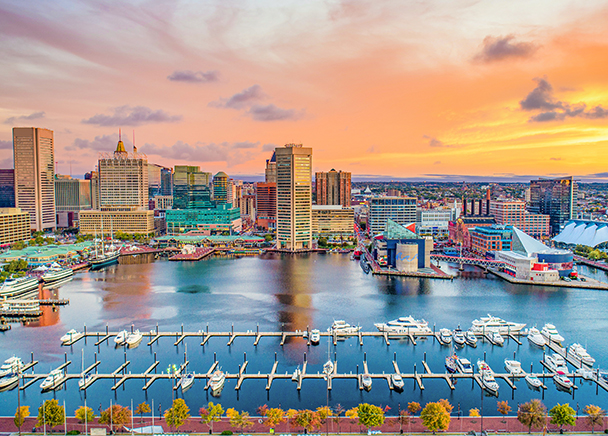
The Baltimore industrial market continued its robust leasing activity in 2020 after a record-breaking year in 2019. This has led to historically low vacancy rates, record-high asking rents and a sizeable development pipeline. We fully expect these trends to continue in 2021, which will further increase both rental rates and underlying land values.
Demographics
More than 18 million people—23% of them in the 18-to-34 age demographic—live within 100 miles of downtown Baltimore, with a 3.4% projected growth rate over the next five years. Baltimore is ranked among other major industrial markets (such as New Jersey, Inland Empire, Los Angeles and Chicago) for reaching a high population concentration within a 100-mile radius. Furthermore, its proximity to Washington, D.C. makes it an ideal location for distributors to service the larger regional population, especially as e-commerce grows.Figure 1: Baltimore Population Analysis
Source: CBRE Location Intelligence.Figure 2: Midwestern Ontario Warehouse & Storage Labor Fundamentals
Source: Conference Board of Canada, Government of Canada Job Bank, 2021.
Location Incentives
Among the top incentive programs available in Midwestern Ontario is the Ontario Development Charge Act, which provides a development charge discount for projects that increase an existing industrial building’s gross floor area. Brownfield development is also encouraged and supported through various municipal programs. In Hamilton, grants and tax abatements are provided through the ERASE Program to help cover the cost of remediation. In the Waterloo region, direct remediation costs and up to 20% of indirect costs can be applied against the project’s development charges.Midwestern Ontario is a major part of Canada’s Innovation Corridor. Several government-support programs foster innovations in manufacturing, clean tech, “agri-tech”, life sciences and autonomous vehicles. Notable examples include:
- Funding of up to 15% of the costs of a new expansion or innovation project through the Southwestern Ontario Development Fund.
- Grants through the provincial Achieving Innovation and Manufacturing Excellence (AIME) program to support training and innovation within the manufacturing industry.
- The Ontario Innovation Tax Credit, which covers between 8% and 12% of scientific research and experimental development (SR&ED) costs accrued in Ontario.
Figure 3: Top Incentive Programs
Logistics Driver
Land availability is the main driver of Midwestern Ontario’s industrial development market. Formerly a cost-effective standalone market, the region is fast becoming an extension of the Greater Toronto area, where a lack of developable land and strong demand has led to a razor-thin 0.6% industrial vacancy rate. Left with virtually no options, Toronto area investors and occupiers are shifting their sights westward to Midwestern Ontario.As occupiers essentially filled all of the available industrial space in Milton, the western-most Greater Toronto submarket, in 2019 and 2020, developers set their sights on the closest Midwestern Ontario market of Cambridge. Connected by Highway 401—the busiest highway in North America—Cambridge is one of the tri-cities jointly referred to as Kitchener-Waterloo-Cambridge (KWC).
KWC boasts a diverse and well-educated workforce that serves the high-tech manufacturing sector, food & beverage producers and the cold-storage industry. It has seen a wave of new warehousing and logistics operators. The region’s mix of rapidly growing occupiers include e-commerce companies and manufacturers in need of off-site warehousing space. New entrants to the market are predominantly from Greater Toronto that account for more than half of the region’s occupier requirements.
Hamilton also is a key market in Midwestern Ontario. Southwest of Toronto, Hamilton has roots in steel manufacturing and now also serves the tech and life science industries. The market is in the early stages of spillover demand from the Toronto submarkets of Oakville and Burlington, with mid-to-large distribution users making up most of the relocating new entrants. Hamilton’s multi-modal amenities include one-hour highway access to Greater Toronto, rail services, a Lake Ontario port and a 24-hour heavy cargo airport. Land availability is beginning to dry up as developers bought more than 1,000 acres since 2018 and began new projects.
Developers are now moving westward to Brantford, which has recently seen land purchases of more than 500 acres. Brantford still has the most land availability of any other Midwestern Ontario market, but this is expected to change in the short-to-medium term given current activity levels.
Figure 4: Midwestern Ontario Historical Data
Note: Excluding Hamilton.
Source: CBRE Research, Q3 2021.
Figure 5: Midwestern Ontario Breakdown by City
Source: CBRE Research, Q3 2021.
Emerging Industrial Markets
Spotlighting markets across North America that offer demographic, logistics and incentives advantages for industrial investors and occupiers
Related Insights
The Waterloo Region’s availability rate decreased quarterly by 20 bps to a record low 0.7%, while the vacancy rate remained at 0.6% for the second consecutive quarter.