Intelligent Investment
Insurance Costs Suppress Multifamily Values Most in Certain Sun Belt Markets
July 18, 2024 2 Minute Read

Rising insurance costs have caused a 3.6% decrease in multifamily property values nationwide since Q4 2019, with the South-Central region and Florida recording the biggest drops of 7.8% and 6.8%, respectively. Houston (-11.1%) and Jacksonville (-9.6%) were the most affected markets in each region, while Oklahoma City (-3.8%) and West Palm Beach (-5.0%) were the least affected.
Figure 1: Effect on values from change in insurance expenses since Q4 2019 by region
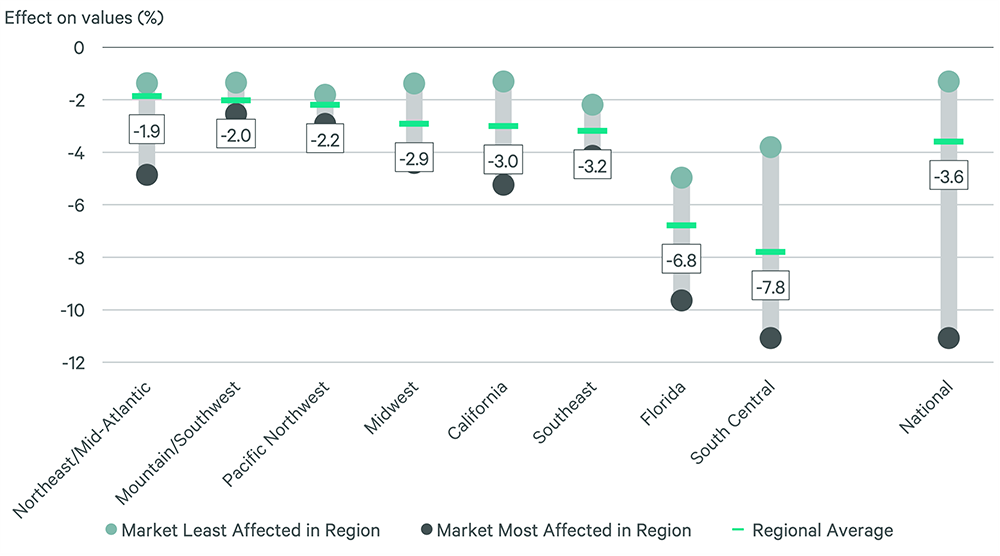
Note: South Central includes markets in Texas and Oklahoma, as well as Kansas City and Omaha.
Although South Florida multifamily owners have seen some of the most substantial increases in insurance premiums, their effect on value has been less than one might expect given the region’s increased frequency of hurricanes over the past few years. Resilient renter demand, along with unprecedented rent growth in 2021 and 2022, has offset some of the negative impact that rising costs have on a property’s net operating income (NOI). Likewise in California, a surge in insurance costs in 2020 due to wildfires and other environmental factors has not significantly affected multifamily property values due to higher rents.
Growth in insurance costs is beginning to moderate nationwide, even in Florida where premiums have more than doubled over the past two years. Q2 2024 marked the first quarter of lower insurance cost growth across all regions since mid-2022.
Figure 2: Year-over-year change in insurance expenses by region

Note: South Central includes markets in Texas and Oklahoma, as well as Kansas City and Omaha.
While insurance generally is the sixth biggest expense for multifamily property owners, it has been the second biggest contributor to total expense growth since 2019. Even though insurance only makes up 8% of total expenses, it has contributed to 17% of total expense growth over this time. All other expenses have contributed proportionally to expense growth relative to their overall size.
Insurance was the only component of total expenses whose annual growth rate had continued to increase heading into 2024, albeit at a slower pace. All other expense categories have seen declining growth rates since peaking in mid-2023.
Figure 3: Contribution to total expenses increase by component (Q4 2019 to Q2 2024)

Although rising insurance costs have had an adverse effect on multifamily property values over the past few years, the biggest contributors to value degradation have been higher cap and vacancy rates, along with lower rent growth.
However, these negative trends are poised to begin reversing this year. Improving renter demand led to absorption outpacing new supply in Q2. The shrinking supply pipeline will eventually drive above-average rent growth in most markets. Cap rates have stabilized and will begin to fall once the Fed cuts interest rates, improving investor demand. For the first time in over two years, most markets are seeing their estimated multifamily values increase. Even as expenses remain high, we expect that multifamily values in some markets will begin to surpass their previous peaks as early as mid-2027.
Related Service
- Property Type
Multifamily
Unlock the potential of your residential real estate with expert investment, financing, valuation, due diligence, design, management and leasing strat...