Intelligent Investment
Most US Office Buildings More than 90 Percent Leased
August 1, 2023 2 Minute Read

Two-thirds of all U.S. office buildings were more than 90% leased as of Q2 2023—not far off from the 71% of all office buildings in pre-pandemic Q1 2020.
While the overall U.S. office vacancy rate hit a 30-year-high of 18.2% in Q2, it is not indicative of the performance of most buildings. Only 10% of all U.S. office buildings account for 80% of the occupancy losses between Q1 2020 and Q4 2022, according to a recent CBRE Viewpoint. These tend to be older buildings in downtown submarkets with relatively high crime rates and few surrounding amenities.
Figure 1: Share of U.S. Office Buildings by Percentage Leased, Q2 2023 vs. Pre-Pandemic

Source: CBRE Econometric Advisors, Q2 2023.
Note: Excluding owner-occupied buildings.
Many secondary and tertiary Sun Belt markets have a higher share of near fully leased buildings than the national average. Since the pandemic, most of those markets have seen their office inventories increase by less than the 2.4% national average.
Figure 2: Markets with Highest Share of Office Buildings More than 90% Leased
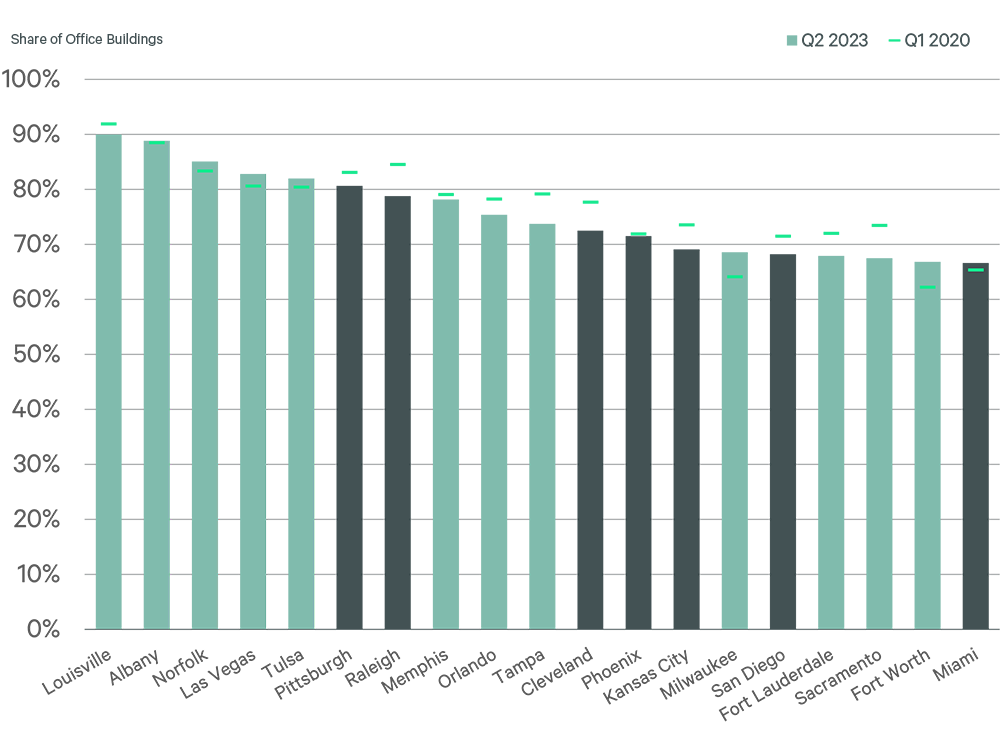
Source: CBRE Econometric Advisors, Q2 2023.
Note: Vertical dark grey bars indicate a top 30 market by inventory.
Larger, more expensive markets like Manhattan and San Francisco that saw a greater reduction in new tenant demand during the pandemic tend to have a lower share of buildings (typically between 45% and 55%) that are more than 90% leased. Despite Manhattan’s lower share, it has at least 80 million sq. ft. more leased space than any other market. Markets with large clusters of technology companies, which are the biggest adopters of hybrid work, and those with above-average inventory growth like Salt Lake City, Los Angeles and Minneapolis also have a lower share of near fully leased buildings.
Figure 3: Markets with Lowest Share of Office Buildings More than 90% Leased

Source: CBRE Econometric Advisors, Q2 2023.
Note: Vertical dark grey bars indicate a top 30 market by inventory.
The total number of buildings that are more than 90% leased accounted for about 50% of total office space by square footage in Q2 2023, compared with 62% in Q1 2020. The drop was primarily due to the nearly 60% of larger buildings (800,000 sq. ft. or more) with leasing levels below 90% in Q2 2023, compared with only 40% of larger buildings in Q1 2020.
Seventy-eight percent of smaller buildings (50,000 sq. ft. or less) had leasing levels of more than 90% in Q2 2023. This has changed little since Q1 2020, likely because employee attendance rates of smaller companies tend to be higher. On average, only 49% of buildings totaling over 50,000 sq. ft. are more than 90% leased.
Figure 4: Percentage Leased Levels by Office Building Size

Source: CBRE Econometric Advisors, Q2 2023.
CBRE Econometric Advisors currently forecasts that the overall U.S. office vacancy rate will hit a peak of 19.7% by year-end 2024 as a likely recession and office-using job losses exacerbate the ongoing trend of occupier rightsizing. However, we expect that most of this rise in vacancy will be limited to the 10% of all U.S. office buildings that are most troubled.
Related Insights
-
Viewpoint | Adaptive Spaces
Office Buildings Hardest Hit by Pandemic Share Common Characteristics
April 4, 2023

As the U.S. office market grapples with its highest vacancy rate in 30 years, we explore which buildings and markets are facing the greatest challenges.
Related Service
- Property Type
Office
Use the world’s most comprehensive real estate services platform to find innovative solutions for your needs as a corporate occupier or office investor.


