Intelligent Investment
The One Big Beautiful Bill Act’s Potential Impacts on Healthcare Real Estate
August 14, 2025 3 Minute Read

The recently enacted One Big Beautiful Bill (OBBB) that extends the 2017 tax cuts and slows government spending may have significant impacts on the healthcare real estate market, particularly as a result of stricter qualifications for government-funded health insurance programs. These potential impacts include:
- More demand for medical outpatient buildings (MOBs) and ambulatory surgical centers (ASCs) due to fewer inpatient-only restrictions for medical treatment and procedures, accelerating a longer-term trend toward finding lower cost healthcare delivery solutions (Figure 1).
- Stronger portfolio rationalization efforts by hospitals and healthcare systems reliant on government-funded programs, including consolidation, asset monetization and sale-leasebacks, to achieve greater cost savings and better space utilization.
Figure 1: Community Hospital Outpatient Visits per 1,000 Population

The OBBB’s most significant potential impact to healthcare real estate stems from stricter qualifications for enrollment in Medicaid and Affordable Care Act (ACA) marketplace insurance exchanges. The Congressional Budget Office (CBO) forecasts more than $1 trillion in healthcare spending reductions over the next 10 years and the number of people without health insurance to increase by 14.2 million.
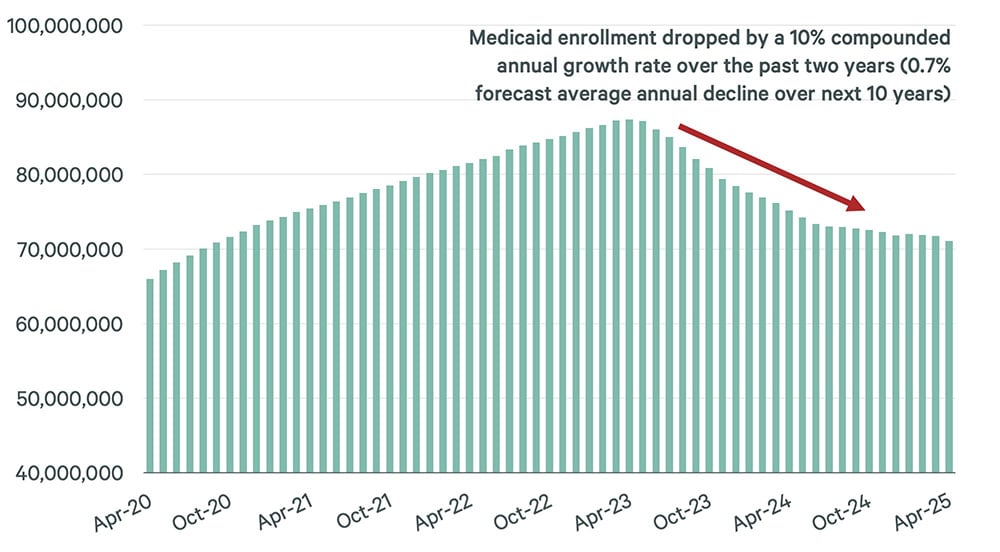
Medicaid enrollment is expected to fall by 0.7% annually through 2034. New requirements include 80 hours of work or other qualifying activity per month for adults eligible for Medicaid through the Affordable Care Act (ACA). Rules making eligibility and renewal in Medicaid enrollment easier have also been repealed.
Provider taxes, which states have historically used to partially fund their share of Medicaid, will be reduced to 3.5% of net patient revenue over several years, down from 6%. New or increased provider taxes cannot be enacted.
Enhanced federal tax credits that lowered the cost of ACA marketplace insurance plans during the pandemic will expire at the end of 2025. The CBO estimates that this, coupled with stricter eligibility and income verification requirements, will cause an estimated 4 million people to become uninsured due to higher premiums.
There are several important points to consider when evaluating the OBBB’s impact on the healthcare real estate market:
- Some measures don’t take effect until 2028, including the phasing out of provider taxes. Medicaid work requirements won’t go into effect until year-end 2026.
- Considerable assumptions underpin the expected effects of the OBBB, so actual outcomes may vary significantly. For example, how much states may raise their own spending to backfill lost federal funds could reduce the number of newly uninsured.
- A 19% drop in Medicaid enrollment between April 2023 and April 2025 due to the lapse of pandemic-era continuous coverage protections did not result in significant impacts to healthcare providers.
- $50 billion in additional funding over the next five years has been targeted for rural hospitals and community health centers, which may be disproportionately affected by OBBB spending cuts.
- Demand for MOBs and ASCs may accelerate significantly due to a three-year phase out of certain inpatient-only treatments and procedures.
- Hospitals and healthcare providers that are more reliant on revenues from Medicaid may require greater scrutiny of their real estate footprints to achieve better space utilization and cost savings.
- More consolidation and M&A activity among hospitals and healthcare systems may result from the loss of Medicaid revenue. This may give rise to opportunities for asset monetization and sale-leasebacks of property as some hospitals and healthcare systems seek greater efficiencies.
Figure 2: Medicaid Enrollment
For healthcare real estate, potential effects of the OBBB include:
Many OBBB provisions are subject to revision and government guidance. Flexibility in planning and scenario modeling will be essential to navigate an evolving regulatory environment.
Related Insights
-
Article | Creating Resilience
Business Insights | Portfolio Strategy in Healthcare Real Estate: Using Data to Achieve Success
June 11, 2025

Real estate plays a crucial role in the delivery of healthcare services.
-
Article | Evolving Workforces
Business Insights | Hitting the Ground Running: The Value of Transition and Activation Planning When Opening a Healthcare Facility
April 14, 2025

Healthcare organizations can master every aspect of readiness when opening a new facility or expanding or renovating space.
-

Demand for U.S. healthcare real estate is expected to increase in 2025, driven by lower inflation, expected interest rate cuts and new technologies.
Related Services
- Industry
Healthcare
Create better patient outcomes and healthier communities through our total lifecycle real estate and facility solutions for the global healthcare indu...
Expert healthcare guidance elevates operations, develops efficiencies across the care continuum, ensuring improved outcomes throughout your facility.


