Intelligent Investment
Top-Tier Office Effective Rents Rise as Concessions Fall in H1 2024
August 27, 2024 3 Minute Read

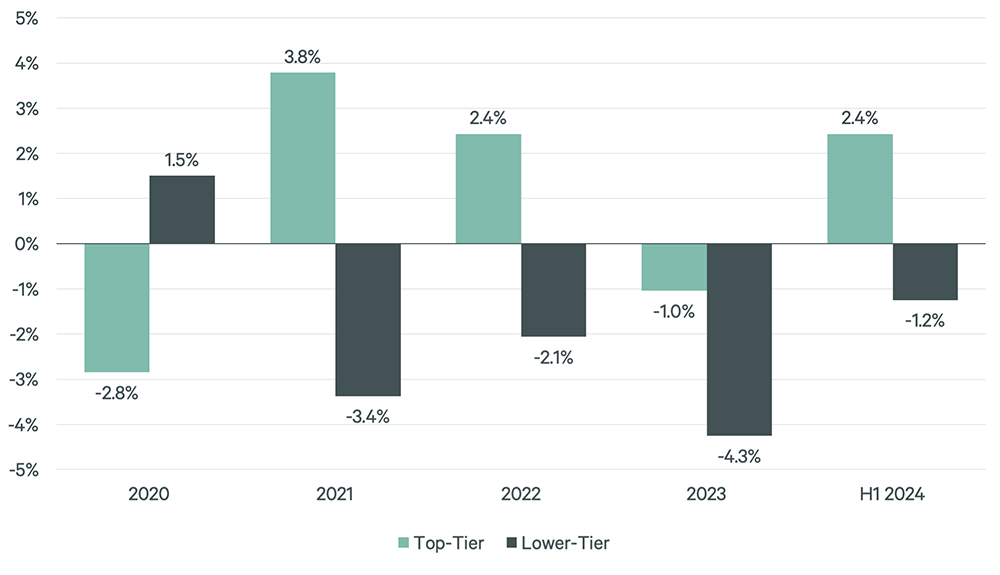
CBRE’s analysis of 3,900 lease transactions1 across 12 office markets2 shows that effective rents3 for top-tier office buildings (Class A+/A) increased by 2.4% since 2023 and fell by 1.2% for lower-tier (Class B/C). This continues a pattern of effective rent growth for top-tier office buildings exceeding that of lower-tier buildings since 2021. Many occupiers have focused only on the best amenity-laden buildings in the most convenient locations for their employees.
Figure 1: Annual Office Effective Rent Growth by Building Class
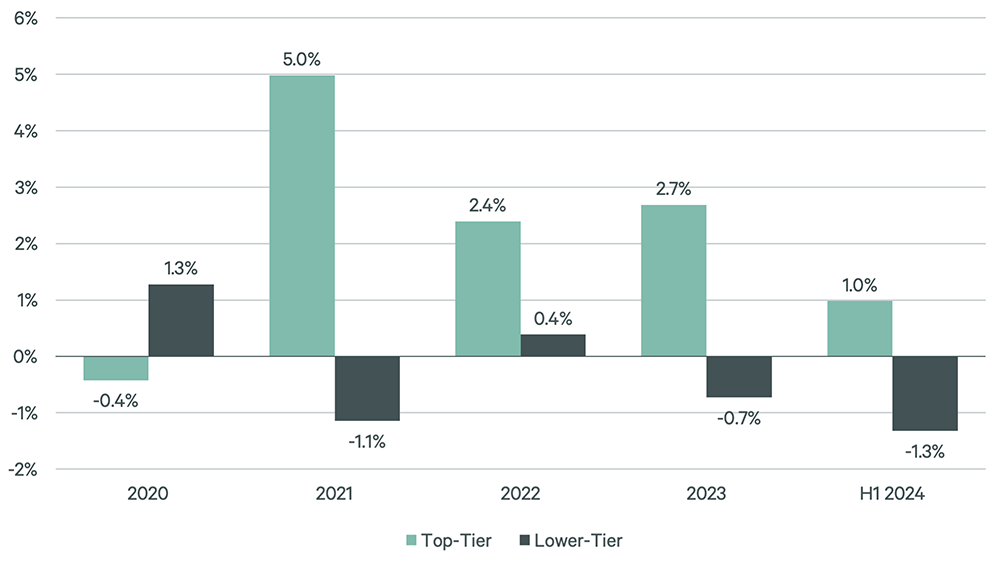
This outperformance is in part due to base rents—the starting rent for the first year of a lease term—growing by an average of 3% annually since 2021 vs. a decrease of 1% annually for lower-tier buildings. Despite less demand, the impact on base rents has been modest for lower-tier assets because landlords have offered generous concessions packages. This allows landlords to meet financing requirements and maintain property values by keeping base rents relatively stable.
Figure 2: Annual Office Base Rent Growth by Building Class
Growing tenant improvement (TI) allowances and free rent by landlords have not impacted effective rents uniformly. Since 2019, TI allowances are up by 37% in top-tier buildings and by 51% in lower-tier buildings. The higher TI allowances have suppressed effective rents of lower-tier assets, while prime buildings have continued to see growth due to base rent increases.
Concessions began to stabilize in H1 2024 and may be near a peak. TI allowances for top-tier assets averaged $98 per sq. ft. in H1, down by 9% since 2023. Those for lower-tier assets fell by 8% to $86 per sq. ft. This reduction in concessions is in part due to some landlords’ inability to continue offering generous packages at a time when high interest rates depress building values and limit capital sources.
Figure 3: Average Tenant Improvement Allowance & Free Rent by Building Class

Landlords who are under financial pressure likely will reduce concession packages and lower asking rents to attract tenants. Additionally, if a building changes hands and its value is reset, tenants could benefit if the savings are passed on through lower rents.
CBRE Econometric Advisors forecasts that overall asking rents will decrease 1.8% by mid-2025. Base rents in top-tier assets will likely hold steady or increase while concessions continue to moderate, contributing to more effective rent growth as demand for this asset class remains strong. On the other hand, lower-tier assets will see a more pronounced drop in base rents, lowering effective rents even if concession packages are reduced.
Landlords are exploring alternative ways to attract tenants by offering shared building services, flexible office space for ad-hoc needs and more flexible expansion and contraction options. A dwindling supply of prime office space amid strong demand will drive tenant interest in the next class of office space, reducing the amount of concessions needed for lower-tier buildings.
1 New direct deals with a term of at least five years. Average lease term in the analysis is 9.2 years.
2 Atlanta, Boston, Chicago, Dallas-Fort Worth, Denver, Houston, Los Angeles, Manhattan, Philadelphia, San Francisco, Seattle and Washington, D.C.
3 Effective rent incorporates escalations, free rent and tenant improvement allowances over the entire lease term.
Related Service
- Property Type
Office
Use the world’s most comprehensive real estate services platform to find innovative solutions for your needs as a corporate occupier or office investor.

