Download Transcript
Sergio Simental
Hispanic Heritage Month to me is a great opportunity for our HoLA chapters across the nation, and the globe, to get together in-person and online, to celebrate the drive, perspective and results that we Latinos bring to the table every day here at CBRE, for our clients and in our personal lives.
Spencer Levy
We're coming to the end of Hispanic Heritage Month. And as you just heard from Sergio Simental of HOLA, CBRE’s business resource group for Hispanic employees, it's a time for honoring the success and diversity of this influential demographic and also to celebrate the diversity of cultures within it. On this episode, we dig even deeper, with the support of HOLA and some 250 of its members remotely in attendance and asking questions, we welcome two executives from the pinnacle of the corporate world. They share business acumen, career advice and their unique experiences as Hispanics in the broader cultural fabric of America.
Sol Trujillo
I've carried my heritage everywhere I've been, from the time I started my career, and I was always a maverick.
Spencer Levy
That's Sol Trujillo, who currently serves as chairman of the Trujillo Investments Group and has been a pioneering leader for more than 40 years. Sol has been a top executive CEO and board member at major international companies such as AT&T, U.S. West, Telstra, Orange and more. He also served as a trade policy adviser to two U.S. presidents, Bill Clinton and George W. Bush.
Oscar Munoz
The size, the impact, the economic power, the political will, the affluence, the education that Latinos have, and to lump them all into one is a bit difficult for me, not only to understand, but to pronounce.
Spencer Levy
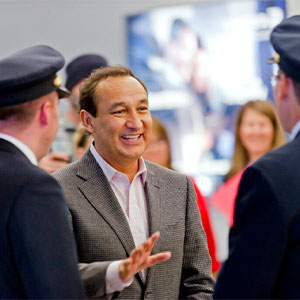
And that's Oscar Munoz, another well-traveled C-suite veteran who's probably best known for his tenure as CEO of United Airlines. Oscar flew the friendly skies through some turbulent times during the last decade, including United's navigation of the pandemic. He wrote about the company's journey and how it emerged as the world's largest airline in his memoir, Turnaround Time, and he currently sits on CBRE’s Board of Directors, which he joined in 2020. Coming up, two influential leaders talk about their roots and their impact — not just who they are, but what they accomplished and how. Oscar Munoz and Sol Trujillo — a celebration of Hispanic heritage, and more. I'm Spencer Levy, and that's right now on The Weekly Take.
Spencer Levy
Welcome to The Weekly Take, starting with Oscar Munoz. Oscar, thank you so much for coming out today.
Oscar Munoz
It’s a pleasure. Thanks for having me.
Spencer Levy
Great to have you. And then we have Sol Trujillo. Thanks so much for coming out today.
Sol Trujillo
Well, I have to say hola to you.
Spencer Levy
Hola. And so I know I gave you a brief intro, but just very briefly, Oscar, why don’t you tell our audience who you are and what you do?
Oscar Munoz
Oh, it's just a wonderful U.S. citizen that wants to do anything he can to bring opposing sides together in this divided country and do that from a platform of the business and success I've had there. My Latinidad, I can't even say that word, by the way, so, but at the same time, it's just… In a chapter of our lives, when we've done the things we do in work, it's important to focus your efforts on things that are important to you. And I'm doing a lot of that. And one of the main things is, of course, my heritage. And I've been partners and worked with Sol for a long time. So we are, you'll find us very tied in with each other in that regard.
Spencer Levy
And Sol, just for the benefit of our listeners. Please tell them briefly who you are and what you do.
Sol Trujillo
Well, kind of like last year, I had a business track. I ran a Fortune 150 company here in the U.S. called U.S. West. Went over to Europe, ran a company called Orange or Orange, depending upon whether you were in the UK or in France. I then went over to Telstra in Australia. So I've operated businesses on virtually every continent, minus one. And so business is my background. And my heritage, my Latinidad is, I was born as a Trujillo. Have lived as a Trujillo for my whole life and my family goes back almost 500 years in this country. So when you hear me refer to my country, I really do mean my country.
Spencer Levy
So Oscar, Latinidad, or maybe stated more broadly, Latino heritage, what does that term mean to you and why is it important?
Oscar Munoz
I think it's meant to provide context and fiber and emotion and a reaction to our heritage, our shared heritage, which is many widely and varied. And so I think an expression and an embracing of your heritage is probably what it's meant. I worry about lumping everyone into one giant bucket. We tend to want to do that in this country, not just for Latinos but everyone else. And we are so very different, right? The political spectrum is probably a good place where you see the difference, where historically, Latinos were Democrats and increasingly they are not. And one of the things that Sol and I and others are wanting to do in this country is express the size, the impact, the economic power, the political will, the affluence, the education that Latinos have, and to lump them all into one is a bit difficult for me, not only to understand but to pronounce. So it will mean something more, but I'll always carry it as an embracing of our culture.
Sol Trujillo
And that means to me, pride in your heritage. If I'm Jewish, I have pride in my heritage. If I'm Irish, I have pride in my heritage. If I'm Italian, I have pride in my heritage. But for some reason in the United States until recently, it's been difficult having that, “pride in your heritage,” if people are talking about keeping relatives of yours from coming across borders or deporting people or doing all that kind of negative attribution. Much like Oscar, my life has been one, Latinidad, but it's been as a businessperson. And the one thing I've learned in business, everywhere in the world, has been that you always look for win-wins. And so right now, I'm spending a lot of my time. I founded an organization called Latino Donor Collaborative, which is getting data and information about the Latino cohort so that people don't have misperceptions. They have the right perceptions. And the one thing I've learned around the world is that when you have shared data and everybody has shared understanding, you move from that divided or polarized kind of world to a more common, you can talk, you can get together, you can do deals, you can do things that are commonly bonding and profitable.
Spencer Levy
Oscar, there was a terrific exchange you had in your book, your book, “Turnaround Time”, and I'm just going to read it because I think it gets to the essence of it, because what it talked about was a meeting you had at L.A.X. and you met with many of the workers on the tarmac that you determined and said, “A lot of these guys are Latino”, but then you said this. “Then I noticed something that most corporate leaders probably are trained to ignore because it's not politically correct.” And then you go on to talk about the expression used, which I'm going to butcher the pronunciation, orale, is that how you pronounce it? To address the workers on the tarmac. You were able to use your Latino heritage to connect with your employees. Is that a fair way to put it?
Oscar Munoz
Yeah, it was. You know, it's, Latinidad, probably a kind of phrase of this. You're sitting in front of a group. They don't know who you are. You're their new CEO. They've had many. They're naturally reluctant to accept people from management. And so there's a lot of tense faces looking at you like, so what do you got here? This is L.A.. I grew up in Norwalk for a long period of time, for all of you who know the L.A. real estate. And so it just came to me. And the term is pronounced oralé, which is kind of like, what's up, kind of. But it is a very street slang term that, if you could feel a glacier melt in nanoseconds, that's exactly what happened. And to the point that I made, they have had a lot of CEO’s in front of them with a lot of things to say. There ain’t never, ever been one that said that with the phrase and with the Latinidad that it meant because I was clearly one of them. And the ice melted and we were able to have a really meaningful conversation.
Spencer Levy
Sol, same question to you. Use of your Latino heritage to better communicate with others.
Sol Trujillo
In my case, it's a little bit different. I've carried my heritage everywhere I've been, from the time I started my career, and I was always a maverick at that point in time because I wanted to make sure that the inclusiveness that we all see included the Latino cohort. And so you can track my history, whether it be here in the United States or whether it be over in EMEA or in the Asia-PAC corridor. Everybody knew this notion of this Latino cohort. But today, I want to move it fast forward. This notion of oralé, and I say it con orgullo, oralé is this idea that says we have a unique character in this country called the United States of America. And it is the Latino cohort, which is what's going to define our difference between us and all other mature economies, because it's youthful, it's big, it's contributing, it's the most productive, it's driving GDP growth, it's driving consumption growth at inordinate rates, and it's right here in our United States. And so what you're doing here with Hispanic heritage every day as opposed to month, is really core to at least how I feel about my country and the competitive advantage that we have as a nation, because we have a cohort that’s young, that’s active, that are entrepreneurs, that are capitalists, that are about every, and loyal, and patriots, right here. And so when we think oralé, I do get excited. Con orgullo, which is “with pride” and Latinidad is a great use of a term here inside your company of CBRE. And I applaud all of you because this is, we grew up over the last 20 years learning hip hop language, right? A lot of us have embraced a lot of hip hop phrases. Well, guess what? There's a lot of phrases that you will hear if you're ever around me all the time about how we as an American community and country should be embracing everything and embedding it just like we did with the Irish, just like we did with the Jews, just like we did with the Italians. That's the beauty of this country, especially if you've lived abroad and operated abroad.
Oscar Munoz
Spencer, if I could just weave in to that, because Sol started with a very important distinction between he and I and how I came to this country as an immigrant. And he describes this country rightfully as his four 500 years, right? And so he has carried his heritage, that's the word he used, I did not. As an immigrant, I was forced into, my mind anyway, into this world of having to just roll with the punches to become Oscar and Munoz as opposed to Munoz, so it's that process of going through and people like me have learned from people from Sol to stand proud and succeed not just as a Hispanic, but as a person who's intelligent and capable. And the true meaning of DEI for me is when we can achieve the things we do. People recognize that and then also say, oh, it just happens to be that he or she or whatever they are, so that's an important thing. And Sol has been carrying this around for a long time. I have learned to do that later in my life, to accept who I am. And for all of you out there, there's probably an increasing ability to express yourself with Latinidad, without the repercussions that a lot of us in our generation felt. When Sol says, it wasn't the thing to do back in the day, trust me, it was not the thing to do back in the day.
Sol Trujillo
One other thing, Spencer. I have a belief in life about respecting yourself. If you can respect yourself, others are more likely to respect you as well. But if you tend to hide things in terms of yourself, you become somewhat of a mystery, maybe not so certain, maybe not a lot of things. And I don't say that as a criticism because Oscar's explanation of his journey is very common with a lot of immigrants. I don't care where you came from. But when you carry that pride in terms of who you are, people notice, and they will listen, and they will respect.
Spencer Levy
Oscar, one of the things that struck me about your book, among many things, is not just the journey and the journeys. It's an incredible journey. And what I really found fascinating and important was how often you went back to your roots when you had to make really important decisions. From your decisions not to transfer from USC to Harvard, to go from CSX to United, and then when at United, there were some challenging situations where you would literally say in the book you got down and prayed or thought about your grandmother, and what would be the right thing to do? Can you tell us a little bit more about that?
Oscar Munoz
Yeah. As you write books about, all of us, if we write a book about our history and our years together, you would have a series of stories, wonderful stories, that you want to tell to folks, and they tend to be linear stories. This happened in this year and then this happened in this year. I attempted to write a book that was not linear, but it interwove people in my life throughout the book. You introduce them early on, only to realize later why they were so important. In the particular case of my maternal grandmother — Mama Josefina was what I called her — she was, it was not even blue collar — she was very much a person that of not necessarily any means, but an incredible array of love and caring and respect and work ethic for others. And in the early years of my life, when I lived with her by myself and we traveled the country of Mexico, without a home, but not homeless, because in the familia, and in our world, there's always somebody that's willing to embrace you. But throughout those years and those hardships and those, literally dusty roads and bus rides, I never heard her say a bad word, never not smile. So that latent dormant values is what arose in my leadership style when I took over companies and it’s why people would listen to me, whether it's oralé or, you know, hey, Bill or Mary, how's it going? How's the family? Those soft, caring, genuine moments that is our heritage were a real important factor in how I began to lead. And so the book is intended, just as you said just now, is to interweave this Hispanic heritage in a wonderful storytelling way that also has led to great success, and the metrics that are today's world of business sort of thing. And so it is hopeful that people will see the merits of accepting, embracing and loving people of all heritages because we do bring a lot of value, and in this particular case, some success.
Spencer Levy
Sol, I'd like to hear your story, similar to Oscar's, on how you were learning those lessons growing up and applying them to business today.
Sol Trujillo
Yeah, it is different because I grew up in a place called Cheyenne, Wyoming, but I had a father and a mother that grew up in the state of New Mexico, which is where the history is back 500 years. And they were always proud and prideful of who they were. And we learned that. But one lesson my father taught me was, he said, I just want to teach you one thing. He said, whenever people talk down to you, do not take it, because you should go through life, when you look up, when you look at people, you don't look at anybody because nobody's better than you. And you don't look down at anybody because you're not better than anybody else. You always look people in the eye. And that I carried with me because I never backed away from any, let's call it, misperceptions of who I was, because my name was Trujillo. Or because earlier in my life I had hair that was this big, it was almost like an afro. And so I looked different than all the people. And I started in a company called AT&T, which then was the biggest company in the world. And in my first job I was changing things because they didn't make sense to me. And so at the end of my first year, somebody, my boss and his boss, they had a review with me on my career, on my appraisal and then my career. And at the end of the appraisal, which was a pretty decent appraisal, they said, so what are your aspirations? And I said, I want to be CEO of this company. And the shock on their face was palpable. And they told me, they advised me, don't ever say that in a corporate world environment, because it's too presumptuous. It's all kinds of things that you should never show as you're going up in a corporate world. And I looked at them, because my family never talked about the budget deficit and all that when we were sitting at dinner eating our tortillas y pepitas y frijoles and things like that. We didn't have those conversations. So I didn't grow up with any kind of notion of protocol, and I didn't grow up with the rules of the game. I just went into it, and it turned out to be one of the biggest competitive advantages I had in my whole career. Because I stood tall, I stood proud, and I said what I thought, and I supported it with what I did. And to me, that was the greatest life lesson. The last thing I'll just say is that I also learned from my parents, always give back. Never forget where you came from. And that's why I'm doing what I'm doing with Latitude, what I'm doing with the Latino Donor Collaborative, in addition to personal stuff, because we all need to give back.
Spencer Levy
I want to thank our listeners. We do have a few questions that came in, and I think this is a good follow on question, which I will direct to you, Oscar. And this comes from an anonymous attendee that says, “As you navigated your career, have you felt that it was more difficult to climb the corporate ladder based on your name? As we look around at executive leadership in this industry, we see it is predominantly Caucasian with very little color. I'd like to know how you broke through that glass ceiling.” Oscar?
Oscar Munoz
With the help of others, for sure. So of course you felt that. And I told of my reticence to adopt and embrace my heritage, because as an immigrant, you were made to feel differently. I didn't have the guidance and counsel of parents like Sol did to stand tall. People literally told me, you know, you're going to have to work a little harder because of who you are. And I'm like, what do you mean? I've had the parents of girlfriends say to the girlfriend, don't you want to be with someone more like you? Of which I interpreted, they want her to be with another woman? So you go through all these things in your youth, but over time, you begin to, and the term I use now is, people like Sol, certainly myself and others, tired of always being the exception. The only one to do this, the only one to do that, and the youngest, all that kind of... we share a lot of those same ties. I want to build a world in this new phase that it's not the exception, but the expectation that you too can say you want to be CEO of a company. And people say, hey, that's great. Let's figure out what your business path and career should be as opposed to that. So we stand on the shoulders of others, as the saying goes. But why it's important to do these conversations so that people can see folks like Sol and I and increasingly so many others and it creates this expectation and support.
Spencer Levy
Sol, I'd love your reaction to the question we receive from the audience about the challenges you faced with your name, but also knowing where you're from.
Sol Trujillo
My parents got married at 14 and 16, so they were babies, right? So we didn't have much. And I don't mean to dwell on that. It's just that life was not an easy path. My father didn't go to school. My mother, she went to sixth grade or whatever. And so there was this notion about, you have to make your own way. And when I started my career, everybody had a stereotype. I don't want to repeat stories about what people expected of somebody named Trujillo, but it wasn't much. So I quickly learned as I saw other people that I entered the company about the same time, they were getting promoted and their performance was not anything close to mine. So I sat down one day with myself because there were no mentors, no sponsors, because there was nobody like me. And I said, I'm going to change my career path. And the career path is I'm going to sit down with my boss, whatever job I have, and ask him, what was the best job ever done in this job? Give me the metrics. And then I would triple it, quadruple it, quintuple it, so that if he gave me something that said this was super hero performance, I would do better than that. So that there was no question about what could happen on my next career step, because they were already acknowledging what was the best ever kind of performance. And I did that basically throughout most of my career. When I became the CEO of U.S. West, it wasn’t because my boss recommended me, it’s because the board said they wanted me, because I had been through all the jobs. So I was a bit of a maverick, but I played the game differently because I had to, because the expectations were not as high. And also I knew I needed to be five or ten times better in that era, when you're the only person there. But I didn't complain. I didn't lament. I just said, okay, those are the rules of the game, so how do I play it best?
Spencer Levy
Oscar, there was a theme in your book that struck me about your tenure as Chairman of United Airlines, and the word I kept coming back to was humanizing. We talked about you being able to communicate with the folks on the tarmac at L.A.X., but you had some tremendous challenges as well. In your most difficult moments, how did your background help you?
Oscar Munoz
I want to differentiate because the humanity, the way I led and dealt this particular company came from a process, to your question, of my heritage is, I have an instinct to listen to people, to really listen to them and learn before I leave. If there's a great success in our turnaround of United was we put 100,000 people back on the same boat, if you will, heading in the right direction because they felt like they were part of something. The ability to get them that way was who I am and how I connected with them. The other difference, the success we had as a company was not only that, we learned to be the friendly skies again, through reinvention. We did some really hard, difficult business work. The book is also filled with our stock almost doubling and in the reaching numbers well before they’re canned. So there is a lot of intellect and acumen and strategic abilities, and it has to be built in with things. So none of us can just go and say, hey, I'm going to be all Latino, you have to bring the requirements of the game, which is success in both the customer world as well as the investor world. But fundamentally, I attribute a lot of my things back to my grandmother. The things she taught me and the way I've always led is trying to bridge two sides. I dealt with a lot of unions. I’ve dealt with the U.S. government on COVID, and frankly, the book is probably more about failings or mishaps than just, oh, look at me. Look at all the things that I did. That's woven in there because it's part of the story. But really, it's a lot about the things that didn't go well. The way I overcame them was bringing my heritage and roots and dormant values that I created to fix that problem in that particular instance.
Sol Trujillo
Oscar's right in the sense that you have to be accepted by the people that are reporting into you. You have to be bought into in terms of the strategies that you bring to a company. So each of the companies that I've been CEO of, it was always a transformation. And transformations are tough. As Oscar's described in his book, not everything is right, you're way behind your competitors, you've got people that are demotivated and they haven't been inspired for a long time. So the word I like to use is inspiring people, but it's inspiring them to achieve great success, not just as a company, but in their own personal ways and their own personal jobs that they have within a company, but building it as a team. And I'll give you an example. In the communications room, when I was in Australia, the company was really in trouble, and our number two and number three competitors were taking over and all that. So we created a vision about how we were going to build something that nobody had anywhere else in the world, and everybody was skeptical. You can't build a nationwide network and in a year, which was my target. There are no examples ever in the history of mankind. You can cover what we're experiencing here in the United States. 5G is we call it, it’s going to take six, seven years. We did all that in one year because we had to. We ended up doing it. Dramatically, it took market share and all that kind of stuff. And we had a closing dinner where we invited in the workers, not the executives, the workers. And to a person, they all came up to me and they said, now I know what it's like to win the World Cup. Now I know what it's like to, as you would say in the U.S., win the Super Bowl. And it's because they accomplished something. Not me. They accomplished something that they did not think was possible. And to me, that's what inspired leadership is, because after that, there wasn't anything I couldn't ask them to do, that they wouldn't jump at it, and prove me wrong that they could do even more.
Spencer Levy
Well thank you Sol, and unfortunately, I have to throw in as a lifelong New York Jets fan, I have no idea what it's like to win the Super Bowl, but thank you for bringing that in just the same. So, Oscar, let's bring in another maybe somewhat lighter note. And there's an expression we use all the time about bringing your true self to the office. And I note in your book, you’re a big music fan. You're a big Rolling Stones fan. One of your favorite songs, “You Can’t Always Get What You Want” is one of my very favorite songs, and I'm glad you brought it up in the book. But how important is that bringing yourself and bringing some of these things that may seem ancillary to work, to work?
Oscar Munoz
Again, as an early immigrant trying to make it in a world that was very different around me, I learned to bring the self that people wanted you to be or I perceived people wanted you to be. And as I've grown up and matured and learned from people, I've learned from a business perspective in particular, for you to really know who you are, truly, not who you tell people you are or what you want to be. But what are your real skills? I call it “Know Thyself.” And as you really dig deep into who you are, you begin to sense that, I for one, I lived in a very corporate world where I had to have the deep voice and I had to wear the coat all the time, and I had to make sure that nothing ever failed and I would work 100 hours when I could do it in ten if I had called someone. So I had that world of, I think they call it the burden of perfection, where everything had to be right. And so being who I am, which is the person you're sort of seeing, gosh, I grew up in Huntington Beach surfing, right? I mean, it's not a big stretch for me to say oralé, or “hey, outside,” which means a waves coming to crash on you if you don't get your butt moving. That's who I am. I'm affable, I like people, I like to talk to them. But I can also go into a boardroom. I can go into the Senate hearings. I can go in front of the President of the United States and make very meaningful conversation. That breadth and scope has come from learning who I was and being comfortable with who I was, being confident in who I was, and being able to project that to others. And so the freeing aspect of that is to be yourself. We often think people want us to be someone else, but the people that are closest to you, they know who you are, yet you're still trying to make... it’s too damn hard to try to be someone else. So I have no problem saying I'm not just Latino but that I'm Mexican. In the book, I say for the first time ever publicly that I was an undocumented person that came across the border with my uncle who was a citizen. And that's the first time, I get a lot of, oh my God, I can't believe you said that. It's like, well, you may as well know the truth now, because that's the one thing. For me personally, that ability to unshackle from the, gosh, 20 years of having to be someone else or act like someone else has been really helpful. Importantly, my career progressed very quickly. How I met Sol — I was at Coca-Cola. I was doing all these great things all over the world and I get this job. And then there was a guy named Trujillo in charge of a company, and he gave me a shot and an opportunity, and so, the kind of paying it forward thing, I have a phrase called truth, not promise. Was I ready for the job I took? Yeah, I think so. Was there 20 other people that were just as qualified, if not more? I guarantee you there was. But there was someone there, if you will, that says, let's give this guy a shot and hopefully our conversation is going to give you that same freedom to go forth and be yourself.
Spencer Levy
Sol, one of the questions that just came into the chat room is, how did you know you wanted to be CEO? I think it's hard enough to know that you want to have a family, you want to make money, you want to be in a certain industry. But knowing you want to be the leader of a large organization is something that comes from a different place. How did you know you wanted to be the CEO?
Sol Trujillo
Now that I look back, you know, it was odd, but I started and I saw all these things in this massive, the largest company in the world, that could have been done better, right? And then I got exposed to some decisions that were being made, and that's how I got recognized. I was in a meeting making a presentation to the top executives, and I made my presentation. They sat me in the back of the room and they said, just in case we have questions, right? And they have this big table. Then something came up that they were deciding. They made a decision. Everybody was in agreement. And I was sitting there not knowing protocols, shaking my head, and the CEO called on me and he said Sol, you're shaking your head. You don't agree with the decision? And this is like after one year in the company. And I made a decision at that point in time about being true to who I was. And I said, I don't think so. I still remember this picture. There were all these guys that had buzz cuts and these reader glasses. The average age of the room was probably 60, and I was 21, 22, and all these heads swung, looking at me like, who are you, challenging the decision we just made? So then smart CEO says, so tell me why. So I gave my reasons why. He then said, well, what would you do? And that was the moment of truth. Because it's easy to criticize, it's easy to shake your head, but then to put yourself out to be either right or wrong is another thing. So this notion of being true, I grew up having to be a maverick because of the way things were when I was growing up. And people used to coach me. They'd take me aside and say, Sol, you know, you understand, you should wear, part your hair on the side, you should wear wingtips, you should play golf on the weekends, all that kind of stuff, which I never did. And they said, this is the way that the system works. And I said to them, and I said to myself, I'm not going to do it that way. I'm going to do it my way. I wanted to make a difference. And that's, to me, the key is being true. And so Oscar, he had his upbringing and where he came from. I had my upbringing and where I came from. And we had to take, kind of, two different paths to get to the same point. And that's the big lesson here. There's no one path.
Spencer Levy
How do we use your heritage to help bring people together, big picture? But then from a very tactical perspective, what is the best advice you can give to our listeners we have on the call here today moving forward?
Oscar Munoz
There's a phrase that I learned and heard somewhere early on that all great civilizations first implode from within. And I think if you look at the Greek civilization, Roman civilization, the implosion came from the inner dysfunction of those great civilizations. I have feared for some time that our very nation is on that path, and everything has become politically divided. I mean, you can't want to recycle a plastic bottle without being dubbed one way, and no one is talking to each other. So I don't want to use my heritage to bridge this. I want to bridge the success I've had to prove it. So the proof, not the promise of it. That's the effort. That's the accomplishment, not projecting the left further into the left and the right further to the right, which is kind of what we have today. So I hope to do that sometime. With regards to advice, I mean, it's always so easy to just throw out words or whatever. I would say this concept of “know thyself, really!” Find people around you that can tell you the things that you're good at. And then work on it, and the concept of “be yourself” is one around that, but really knowing yourself. And it's just a wonderful thing to be. Don't try to be someone you're not because it's just not going to work over the long run. Trite and simple, but I would say that.
Spencer Levy
Sol, I'm going to give you the last word. Any final thoughts on tactical advice you can give to our listeners about moving forward?
Sol Trujillo
To me, it's just twofold. One is, you have to be yourself. You can't try to be what you learn in books or you read about it or whatever. You mold yourself over time. And who you are at 25 probably isn't going to be the same person at 45 or 55 or beyond. So be yourself, number one. And number two. I would say this notion of giving back. The most rewarding things in life are when you're giving to others as opposed to receiving. I think you learn that over time, and I encourage people to do that. And to the point about division, the best way I learned how to deal with division is you bring all parties to the table. You don't just talk to one side. Don't deal with choruses. Deal with everybody and try to bring people together that might have different perspectives. And then we talk about it with data at the center, understanding at the center, and any other examples that we can bring. We moved things over the last decade in terms of perceptions because we measured it, but also because people are responding to it. To me, that's my advice. Always try to give back. Always be true to yourself and think about bringing people together as opposed to speaking in tribes.
Spencer Levy
Those are great words to end on. Very similar words from Sol and from Oscar. Thank you all, our friends and colleagues of CBRE, for giving us this opportunity in honor of Hispanic Heritage Month, to talk to both Oscar Munoz, Board Member of CBRE and former CEO of United Airlines. Oscar, terrific job. Terrific book. Thank you.
Oscar Munoz
Thank you all. Spencer, you were great. Appreciate everyone.
Spencer Levy
You bet. And Sol Trujillo, currently the Chairman of Trujillo Group Investments and so much more. Sol, thank you so much. Terrific job today.
Sol Trujillo
All right. Thank you all.
Spencer Levy
Once again, a profound thanks, gracias, to our guests and to the members of the CBRE HOLA Group for their interest and support. For more information and related content, please visit our website at CBRE.com/TheWeeklyTake, and make sure to subscribe, rate and review us wherever you listen. We'll be heading back into core real estate topics in the coming weeks with insights about industrial asset types such as ports and data centers. We'll also cover retail and restaurants, including a sit down with an entrepreneur who's out to disrupt the traditional model with culinary engineering and more. Thanks again for tuning in. I'm Spencer Levy. Be smart. Be safe. Be well.


.jpg)


