Download Transcript
Spencer Levy
Times of uncertainty, kind of like the period we're navigating through these days, can also present upside and opportunity – treasure, so to speak, to be found on stormy economic seas. Avast, ye! On this episode, we learn how to pursue such bounty with business lessons from the author of a best-selling book about... pirates!
Sam Conniff
If you want to think about workplace innovation, if you want to think about democracy, if you want to think about notions of storytelling, you will find the earliest seeds of these ideas on board pirate ships.
Spencer Levy
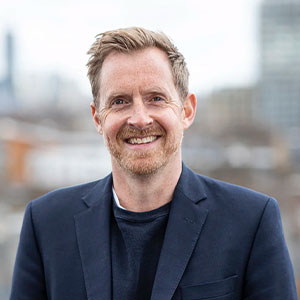
That's Sam Coniff, the author of Be More Pirate, a 2018 bestseller exploring cultural, social, and business insights embodied by those rebellious sellers of yore. An entrepreneur and social scientist by trade, Sam built his career as the founder of an award-winning creative agency called Don't Panic, which focused on social change campaigns. In 2021, he created The Uncertainty Experts Project, which he developed into his next book, The Uncertainty Toolkit: How to Worry Less and Do More, which will hit the shelves in January, 2026. Recently, Sam was a keynote speaker at the CBRE Institute's 2025 EMEA Symposium in London. And we sat down before that appearance to cast a London eye on his favorite subject. Coming up, a conversation about uncertainty and pirates as role models for innovation. I'm Spencer Levy, and that's right now on The Weekly Take.
Spencer Levy
Welcome to The Weekly Take and we are here in London once again and we are privileged to have Sam Conniff, author of Be More Pirate and the upcoming book, The Uncertainty Toolkit. Sam, welcome to the show.
Sam Conniff
Spencer, thank you very much for having me on.
Spencer Levy
Oh, well, you earned it, man, because your book is great.
Sam Conniff
Be More Pirate came from a long-held desire that I had to bring about change. And after a career in innovation and change, I just felt so frustrated by the role models that we’re given and the models that we've seen and their inability to come up with something new. And I have a longstanding passion for pirates, and so do many people. We talk about rebels and punks and rogues, but very few people know their true history. And the true history is what I get into in the book, that 300 years ago there were a group of Innovators who fundamentally transformed the world in ways that we don't recognize them for because their history was rewritten by those who they challenged. But if you want to think about workplace innovation, if you want to think about democracy, if you want to think about notions of storytelling, you will find the earliest seeds of these ideas on board pirate ships. So I've reached into the history books, found the most reliable sources of these characters and innovators, and then aligned them with modern day stories and a series of tools and reflections so that people can unlock not just their inner pirate but their more effective decision maker and problem solver.
Spencer Levy
Great. And if you wouldn't mind just put the connection between the Be More Pirate Book and your Uncertainty Toolkit, please.
Sam Conniff
So Be More Pirate fundamentally was probably a book written for me. I didn't expect it to have the level of success that it did, and in fact I had to do a series of interviews with CEOs, managers, leaders around the world who got in touch with me to tell me how effective it had been. However the challenge was, when you've encouraged someone to be a really bold, rule-breaking pirate stepping into the unknown, you have a new set of challenges, and you need a new toolkit for navigating in the unknown. So Be More Pirate helps people step off the edge of their map and I created The Uncertainty Toolkit for learning how to stay there and make the most of the unknown which scares so many people.
Spencer Levy
By the way, this is an observation. You use the analogy stepping off the map. Isn't that like the old school, the world ends somewhere?
Sam Conniff
Yeah, yeah.
Spencer Levy
At world's end, we fall off the maps?
Sam Conniff
Yes.
Spencer Levy
Maybe that's an old pirate concept, I don't know. But nevertheless, it's an old sailing concept.
Sam Conniff
Yeah, yeah, it is. There was actually a limit to what could be put onto maps by the kings because they didn't want the people going to discover the rest of the world. So it was probably really stuck in my mind. There is a limited view and now we have the same with the pirate history, a limited world view of what people could know so that they wouldn't get carried away.
Spencer Levy
Well, it goes back to what we were talking about. We're in a period today of maximum uncertainty. And maybe in the modern world, where there's just too much information, people are overwhelmed.
Sam Conniff
Yeah. Well, I think we're often doing that. We are managing our exposure to the information because it's often anxiety causing. It's thought that the number one driver of all anxiety disorder is uncertainty. So we have to manage it and limit it, but we have to then manage our exposure to it because avoidance and denial are the classic human responses to the unknown. Very few of us go, great, I'll have some more uncertainty please. So you have to have a set of tools. Uncertainty, probably the kind of word of the year for the last few years and going forward. These are, according to the World Uncertainty Index, uh, an index I'm sure is very popular amongst your listeners, these are the most uncertain times in human history by a long chalk. And how we navigate the unknown, how we tackle ambiguity in our lives, is a real paradox. For some, it's a gateway to creativity and innovation and the best work of their lives. And for many, it is a doorway to anxiety.
Spencer Levy
Well, I actually believe that sometimes we overlook at the emotion of the moment versus looking at the long term, which to me appears brighter. Agree, disagree?
Sam Conniff
The work that I am very keen to do, I, I will begin by pointing to this data, and then I will try and draw people away from it, because I think there's an over-deference to data at the cost of human intuition and judgment. And yes, these have always been uncertain times, and the, the mistake that I think people make is to try to fix for uncertainty. We can, we can create some more, and, you know, we almost delude ourselves to the level of power that we have to control events. You can't fix uncertainty, nor should we really try. More often than not, it's been a driver of innovation for humanity. And your listeners, you know, go on this journey with me. If you're interested in this topic, ask someone that you're working with or that you care about what they think about uncertainty. And by a large, I can pretty much guarantee they'll give you a balanced response. It can be a bit of a pain in the neck, but you know also it's a pathway to doing something new. Then ask them how they feel about uncertainty and they will usually describe majoritively negative emotions. It makes me a bit anxious and I don't really like it and it interrupts my sleep, I go on a circular thinking. I would like to suggest that about 50-50 balanced response, how you think about it, about 80 to 85% of your responses, how you feel about it will be the emotions. Now this takes us somewhere very interesting because we're smart. So the problem with the smart, the curse of the clever is that they make things more complicated.
Spencer Levy
The curse of the clever, that's a great quote. Keep going.
Sam Conniff
And so the danger is how do you then make things simpler? No matter how good your Gantt chart is or your OKRs or your KPIs, someone on the team is sabotaging. And where does that come from? That's not usually a cognitive pursuit. It's an emotional state. So we started to look at the data. Once we've got 6,000 responses, we looked at the emotional states people gave us when we said, how do you feel about uncertainty? And all of these negative responses fell into three clusters. And only three, we're now at 30,000 data points and no one has described an emotional state that sits outside these three. The first is uncertainty makes me anxious and fretful and worried. Okay, we call that fear. That's the base emotion. The second is uncertainty makes me just a bit circular and a bit confused and a little bit frustrated. Okay, we call it fog.
Spencer Levy
Fog.
Sam Conniff
Fog. The dissonance of the mind presented with a paradox. The third one, the most tricky. Uncertainty just makes me feel a bit stuck like I've lost my mojo, listless, like I'm languishing. A bit meh.
Spencer Levy
Lost.
Sam Conniff
Yeah. We call that stasis.
Spencer Levy
Stasis.
Sam Conniff
That horrible feeling of being stuck. Fear, fog, and stasis. These seem to be the three less easy to admit, perhaps hard to articulate emotional states that are caused simultaneously that you're trying to make a plan for uncertainty and convince yourself that it's good. And we like the vision and we like, okay, okay, here's the Gantt chart, we all agreed, yeah, let's head out on our 90-day plan. Why is everyone sabotaging? What's happening? Why does 71% of transformations fail? Because of the emotional journey that we go on. It's a psychobiological state and we need to be aware of the cognitive journey of uncertainty and the problems that it presents us with and how that can be really incredibly enabling for the mind and the emotional state which throws us into these very uncomfortable places.
Spencer Levy
What we're talking about here is organizational uncertainty, and, but there's an, there’s an individual component here and an organizational component, or a broader component. But there's some people, while I think it's hard to dispute if you feel like you're in control you're going to feel better, but they're some people who choose not to be in control. They choose somebody else to be in control and to take those orders is probably too strong a word, but something like that. How do you see it?
Sam Conniff
Well, when we're feeling adrift in the unknown, we tend to reach for whatever certainty we can. So if that's being told what to do, then great. You know, people will do that. If that's, uhh, buying a narrative of the things that were better 20 years ago, then, great. This has been the playbook of political extremes throughout history. We'll sow the seeds of uncertainty so that we can provide some full certainty and people will go with this. Uh, in moments of uncertainty, this is really well studied, we are more likely to go for extremist tendencies. We're more likely to be pulled into polarized thinking. Our ability for individual critical thought decreases. Worry, originally, is a safety mechanism. It keeps us alive. But our worry raked.
Spencer Levy
Fight or flight. And worry is flight.
Sam Conniff
It brings us back to nervous systems. It absolutely does. But we had these four pursuits to stay alive 300,000 years ago on the savanna. Social groups, fundamental to survival. Sustenance, fundamental to survival. Shelter, and then uncertainty. The first three of all arguably got easier. Social groups staying alive, finding somewhere warm and getting something to eat. The triggers of uncertainty are the ones that have gone the other way. The endless news cycle, the sirens in the street, the number of meetings that you're called to, the amount of time, the information that you are relying on changes. All of those trigger the same responses to uncertainty that a threat would have done on a day-to-day basis.
Spencer Levy
Interestingly one of the things you talk about in your book Be More Pirate is, and I am gonna get the exact quote here, maybe just to prove I read your book.
Sam Conniff
Thank you.
Spencer Levy
You bet. It was a good book, man I mean really good book.
Sam Conniff
Oh, really.
Spencer Levy
But you made a point here about how open office was a really bad idea. I think the quote had to do with open office was going to make you more productive is not true. So let's go to those two things here: open office, return to work. It's pretty much gospel in our business that being in the office is better than not being in office.
Sam Conniff
Yeah.
Spencer Levy
What's your point of view?
Sam Conniff
Okay, so let's start with gospel and the truth. One of the 101s of uncertainty, actually it's an overlap of Be More Pirate and Uncertainty. This is where the work intersected for me. Be More Pirate took off in a way that I did not expect and it took me into organizations around the world and they were struggling with the points that I was making. Why do we say one thing around here, but we do another? The data that I was pointing to was a workforce survey, all of whom said they felt less productive because of the level of distraction that was around them and the inability to focus. Yet that's still the overwhelming story that we have. So I developed a workshop. And when I really thought about that, I realized what I'm actually trying to get people to do is to tell the truth. So the first question I get to was to ask people next to them to ask the most difficult question they can. Thinking, you know, this is what this is gonna get us to. Why do we have this psychotomy of dishonesty at work? I give them three minutes, turn to the person next to us. You know, in pursuit of deepening connection, ask the most difficult question. You know, just go for something eye-watering, awkward. Mission granted. By and large, mostly, about 75% of the room will just sit and apologize and laugh and not deliver the brief. So you get the people who have asked the difficult questions, put their hands up, and most of those will be about sex or money. And so then you kind of get down to about five people in the room who've asked the difficult questions. Is this gospel truth that we think it is truly the truth? Or are we relying on data that serves us and our part of the industry? And those questions are very hard to get to. So the point was, I was trying to get people to feel what it's like to hold yourself back. And how many times have you sat in a room not saying what was on your mind. How many times have you seen the timing plan not turn to your colleagues and say, well, this is insanity? And we all know that's a lot of the time. So I went deeper on that and asked how many times have you said yes when you meant no? And you can imagine the number of people who said it quite often. But where this all comes back to, and I know you give me two specifics, but I'm going with the, the generalized reason for this, is when asked, have you recently said yes when you meant no, did you then follow through on what you've agreed to? Or did you go away and sabotage? 65% of people say I went away and sabotaged it. So I have this notion, right, that we go around from office to office and everyone says creativity is probably the number one skill that we need. Yet the feeling we're all walking around with is conformity. That's the thing that we needed to, to succeed and go further. So when I hear these universal gospel truths, I'm very interested to go pushing on them. And the point that we'll get to today is what pirates then showed me was by the end of the sessions that I run or by the book and someone's written their own rules and that sense of agency emerges and they have granted themselves permission to take into account and this was the original story of pirates, right? They're a story of accountability. Once they've stepped outside the unfair rules of the time, written some new rules of their own, you get quite passionate about your own rules. You get really into them. You get quite surprisingly responsible about your rules. Teams become more efficient in my experience. And so with this new... alive and awakened sense of agency, teams were taking off, efficiency was flying, innovation returns. And so what I got people to do was contrast that feeling. That feeling at the beginning in the session where I asked you to, you know, say something difficult and that feeling of holding yourself back versus the feeling of putting your idea forward and acting on it. And that's what took me into the psychobiological realm because it's the emotions that hold us back. The challenging of gospel truths, I think, is the really important bit, and that's why I think the conversation falls down a little bit on the return to work. And I’ve been..
Spencer Levy
Courage is what you're really describing here, and not to get real personal here, but I had my moment of greatest professional courage in my mid-40s, and I finally got to the point where I'm like, you know what, there's a better way to speak in public. There's just a better way. I said, the way you normally see these presentations, you know, what I'm talking about, with lots of slides, charts, numbers, it's like, I'm losing my audience here. Let's talk to them in simple terms about the same concepts in ways they're gonna remember. And I just went for it. I said, two things happened after this presentation. I'm either getting promoted or I'm getting fired. And here I am, I'm still sitting here, right? But the point is, is that it took real courage. I was scared to death. And by the way, I’m still scared to death every time I go on stage. And you know why? It makes me better. What do you think?
Sam Conniff
I like this very much. I often talk about fear, because I think it's the flip of the same thing, because courage is easy to speak about, and we all have a story of us being brave that we like to tell. Yours is a good one. I think it’s necessary for leaders at this present state when fear is so present, and it is informing so many of our conscious or subconscious decisions to know where you are in relation to your fears. I think it is essential for leaders to know what they are in relation to their own fears, because those fears will be influencing them. And then how we handle our relationship with those fears. Will give us the best clue as to how they're influencing our decisions. So courage, yes, absolutely. And in fact, one of the five measures that we take in the uncertainty system, one, always a lovely one, because we were talking about agency, is called self-efficacy. The definition of which is your ability to chart a place into the unknown and then believe in yourself to take the steps to get there, which is almost like the evolution of agency.
Spencer Levy
It's almost self-actualization, not quite there.
Sam Conniff
Almost, yes, getting there
Spencer Levy
It's like one half step below that.
Sam Conniff
It's getting there.
Spencer Levy
Yeah.
Sam Conniff
And then we take a bravery score. And the bravery score is a behavioral score and is one of the ones that we see shift demonstrably over the course. And it's wonderful to see, but I am convinced the reason we get people there is because we do the work first. You know, I said these three states, fear, fog, and stasis, an acronym I'm very proud of. It's because you don't get very far in the unknown unless you can stop the fear response. So it's in part bravery, but it's in part emotional regulation. It's in part awareness.
Spencer Levy
And, uh you talk about emotional regulation in fact that may be a term you actually use I forget the precise term you use but emotional regulations and I go back to a quote from a famous singer Stevie Nicks yes Stevie Nicks was one of the lead singers of Fleetwood Mac and it's old-school music day today by the way but Stevie Nicks famously was asked are you ever scared when you get on stage? And she said, yes, every single time, because quote “that's where the magic is.” So I think you and I are in the same place.
Sam Conniff
Yep.
Spencer Levy
I'm not paralyzed by fear. I'm motivated by fear.
Sam Conniff
Yes.
Spencer Levy
Is that kind of where you're at?
Sam Conniff
Well we looked for the opposite states, right? If you're going to identify the fact that in uncertainty, most people are scared, it's very simple to go, right, give me something that makes me brave. Feel the fear and do it anyway. I worry about that because I think if you're genuinely scared, and depending on your circumstances, depending on vulnerabilities at work, depending on cultural background or, or, or, your level of debt, there's good reason to be bloody scared. So just feeling the fear anyway I think is highly anxiety-inducing and possibly even burnout facing. So, I think there's a depth that we can get to about why, you know, fear is a very healthy emotion. It gets a bad press, right? It's a necessary emotion, and it drives us to action. Sometimes that action is good, sometimes not. So I think the interesting bit is the nuance between it. What is your response to the fears that you have and your level of awareness around them? That's, I think, the bit that makes it interesting. And can you use those as a motivating force to good and positive action? That's, that’s why it's there, deep down at a level.
Spencer Levy
I had a debate on this show with another well-known social scientist Adam Grant and Adam Grant said “you know what fear will get you killed” and he used the example of mountain climbing I get a certain point on a mountain stop climbing and then I said, you know who one of my favorite books is Grit by Angela Duckworth and I think you take those two ends of the spectrum one is Stop climbing that mountain. The other is suck it up and keep climbing that mountain.
Sam Conniff
Yeah.
Spencer Levy
How do you decide?
Sam Conniff
Well, you can't, we can by and large trust ourselves at a very deep level. The more experienced we get, the more you can, right? And the final point of what I'll talk about today is intuition. There's been so much work done around uncertainty and from Harvard Business Review to the Decision-Making Uncertainty Center, intuition often come where you don't have the information that you need, you have your intuition. But there are times that you can rely on it. If you're in a heightened emotional state, if the decision is probability, if you're hungover, if you're in entirely new circumstances. All of these things will throw off our intuition, or our gut instinct, our ability to intuit the right thing. And at that point, yeah, if you're in a deep place of fear, that's probably gonna throw you. So this awareness, I think, is a fundamental component of it. Where are you? And there is lots of emerging data. Angela Duckworth talks about this. The skill of interoception is the eighth human sense and it's the least well-known. We know sight, touch, taste, smell. But interoception is what turns your internal signals and emotions into data for you to make better decisions. And it's been studied increasingly.
Spencer Levy [
So as opposed to perception, it's internal perception.
Sam Conniff
Precisely, yeah, and so really highly attuned one of the first studies that was published in nature so reliable science observe all three traders and The the most successful financially with the longest tenure all had the highest rates of interoception and a very baseline of interoception is if you can close your eyes can you feel your heartbeat? So, you know, you're aware of what these internal signals are telling you. Can I trust that no, you know, has my body started to go hot? You know, all of these points of regulation. Because the body's processing data at a rate the brain can't even catch up with. And in this world of, you mentioned the, you know, the AI threat, the place that we'll not be outpaced for a long time yet, most of the LLMs are based on our cognitive processes, yeah? There's nothing that exists based on the incredible capacity we have of processing information that stands in our body that we often overlook or misunderstand.
Spencer Levy
And that's where storytelling comes in, right? And use storytelling at great length in your book, Become More Pirate.
Sam Conniff
Yep
Spencer Levy
We had on this show, she was terrific, Esther Choi, she wrote a book called, ba-dum-bum, Storytelling. And what it's about is, in the corporate context, be able to tell the story in a way that is persuasive, rather than say, here's the data. And her famous phrase–famous, the phrase that I liked the most, was “proving isn't persuasion.” Tell me about how storytelling becomes persuasion?
Sam Conniff
Well, I like that very much. Proving is not persuasion. We launched The Uncertainty Experts to the world. I didn't quite know what it was going to be. I managed to get some innovation funding from Netflix. They were looking at documentary and the overlap of documentary and learning outcomes. And I got to work with some Netflix executives for 18 months and they gave me some money that allowed me to tell these stories well. The science is rock solid and I've got scientists from MIT, UCL, who've all backed this because the emergent science of uncertainty is so exciting and there's lots of research behind it. And it's the combination. Of the science of story that has a therapeutic level effect. Our increase in unsurgeoned torrents as measured as an average across 30,000 participants is higher than the average rates of online CBT. We’ve done studies, with control groups, taking out aspects. So we took out the story, here's just the information. The fool's flat on the floor. But you know the bit that really gels it together is the reflection. So you meet this unusual character, here's this charming and articulate ex-gang leader. I'm leaning in, this is quite interesting. Gosh, what good advice he's given me for navigating fear, am I okay to learn from this? Now here's the science of what's going on in his brain and body, oh that's useful, now the other part of my brain is reassured. And now here I'm being asked a question. And this reflection moment is awkward, but it's helping me pull the story together with the science and align it with my own lived experience.
Spencer Levy
If you pull it into your experience and quote you get it – and I like to simplify what is unbelievably great social scientists work here – but it comes down to knowing through feeling that it's right.
Sam Conniff
What I'd actually say is it's the word, so we've got these three states, right? Fear, fog, and stasis. What's the useful place you can get people to? Fear doesn't go to bravery immediately, and if it does, it's sometimes dangerous. Fear does go to action. If you can emotionally regulate. The place of fog is frustrating and confusing. We don't like being there very long. But you know what? If you can stay there, it does lead to agility. And we are in a world where a fixed mindset is not what we need. So, and this is very well proven. In fact, there are a few states that lead to neuroplasticity. As well as uncertainty. And the final state of stasis, this really answers the question. We, we thought, well, is it emotions and feeling? Is it trust? What gets people out of being stuck? This is the magic, the final stage. And the answer was connection. When people feel connected, and that is brain and body, when you feel connected to yourself, when you feel connected to your mission, whether that's your commercial goals or your social objectives, whether you feel connected to other people, sometimes connected to nature, whatever the thing is. Then we start to move again.
Spencer Levy
What are the solutions to make you feeling more interconnected? What are some of the solutions to more intro perspective? What are some of the solutions? And again, this is a real estate crowd. So of any real estate aspects to that, I would love your point of view.
Sam Conniff
I'd love to know the shared values in the room. You know, values drive our sense of purpose and they often drive our sense of connection. When you have a shared sense of values, if it's in an intimate or love relationship, you know, if you don't have overlapping values, it's not gonna last and work, that's, that’s well documented. And in this shifting time economically, I think there is a reappraisal of values and what we're here for. You know, we have a sense that we've potentially overshot on some of our systems and priorities that we put into place, but we're not entirely sure what we're replacing them with. You know if there is a sense that 20th century capitalism isn't gonna be sustainable under whatever measures or the dominance of Western democracy, what comes next? And there's a very interesting, I'm not post-hope, I'm not apocalyptic, I'm not even pessimistic. I have studied history and I do have a sense that we're coming to the end of some systems and there is a lack of, or even if I were, if I were to be critical, and I spent a lot of time in Westminster politics in the UK and a lot of time with C-suite board members, there's a vacuum of imagination about what comes next that looks anywhere remotely different from what we've already had. And I think this is a symptom of uncertainty. We are tending to just hope or believe that we will continuing to address the same problems with the same solutions. Einstein's definition of madness. So I think to answer the question, what, what should come next, whether it's property or whatever sector, I think without the confidence, perspective, bravery, to have something more imaginative than a repeat of what we've already had, I think is the, is the missing component. And I don't see it. You see it in small pockets on the, on on the fringes as we talk about systems collapsing, where there might be ideas that could possibly replace that which we've had. But they're not large scale debates. It's largely a fear-based conversation. Trying to keep up with the pace of change and I'm just trying to think of a writ large idea that's suggested about how we might replace systems that on the whole are considered to be either problematic or seem to be running out of steam.
Spencer Levy
Well, I'm going to simplify this a little bit and just give you some things that, based on your book, fear, as you've, I think, put it so directly, that's the challenge we have today, that people are scared.
Sam Conniff
Agreed.
Spencer Levy
And if people are scared, they're going to make less collectivist decisions.
Sam Conniff
Yep. So there's a piece of data. I started asking about 18 months ago I was presented with a thousand management consultants, and that's a scary thought. Here are these guys in a position to drive innovative thinking, to, to lead change within organizations and hopefully leave that organization better as a result. And my question was around uncertainty because I kept seeing people make bad decisions almost intentionally. So the question was in a scenario of uncertainty would you choose to be seen as decisive even if you knew it would lead to a negative outcome? So a rushed decision, the forced decision, we've run out of time, whatever it is. Or would you choose to tolerate these things indecisive if eventually it would lead to positive outcome? And I left negative and positive to the audience's mind, but let's assume money, time, stress. The outcome was with the universal data 70% would prefer to be seen as decisive, even though it would cost the company. Which speaks, I think, to your point. And when we segmented the data to SLT or above, it went up to 90%. And I don't think that's necessarily even a criticism. I think it's a useful observation that the people that we have in positions of leadership feel under so much pressure to maintain the status of decision-making and pace that we will do that at long-term cost.
Spencer Levy
We're just about out of time, but I did want to touch on one or two more concepts. First of all, I thought it was really cool when I was reading the quotes from the pirates themselves. So this is a quote from Blackbeard. “It is a true being indeed for a man to have a hand in determining his own fate.” Think about that for a second. When you think about pirates, you're thinking about Johnny Depp in the Pirates of the Caribbean and speaking like Keith Richards and slurring his speech? This is about as straightforward of a direct statement. And, wait by the way, there's dozens of them in this book. So one of the things that shocked me about these pirates in your book was the level of sophistication of their arguments in such a simple way. Is that a fair way to put it?
Sam Conniff
Yeah, I think it is. But I think what you're talking about is a very simple response. This is a generation whose fathers and grandfathers had all grown up doing roughly the same thing, which was either fishing or stealing at sea, right? And suddenly you've arrived in this post-imperialist moment when new levels of negotiation are taking place and the Spanish and the French are no longer the enemies. There's been this huge civil war, there's been a pandemic, there's new technology, no one really quite understands where they are. And in pursuit of some genuine new thinking, so point one, they align around specific values, freedom, fairness, things that were absolutely essential and they're willing to die for. And in that combination, a small community fighting for those values is obviously gonna lead to innovation. And so those principles are enshrined in what was known as the pirate code. You've seen this bit in the book. And what really struck me was over this lifetime that they existed for this golden age of pirates, 30 odd years or so, which was the average age at time, some of those patterns, some of those promises of fairness, of equal pay, of decision making, remained almost word for word consistent. And yet there was no way they were ever written down or copied or stored away because those documents would have been your death warrant. Imagine that now. Imagine principles that spanned geography or technology or industry that lasted 30 years that we’d spoke to one another, that we all knew we were going to live and die by. And then where would we be? It's so interesting that that level of values-based decision making, I think, underpinned their success.
Spencer Levy
The book is Be More Pirate than one that's a best seller that's already in the market. I can't wait to read The Uncertainty Toolkit, how to feel calmer, happier, and more confident in an uncertain world. Sam Conniff, thank you for joining The Weekly Take.
Sam Conniff
Spencer, thank you very much for having me.
Spencer Levy
We'll be back next week, but in the meantime, you'll find a wealth of not so buried treasure in our episode archives with recent insights into current events and issues across commercial real estate. All that's available on our website, CBRE.com/TheWeeklyTake and on every podcast platform where you find the show. We also hope you'll share this episode and stay tuned for more insights. Send us your feedback too. Love to know what's on your mind as the year draws to a close and we look ahead to 2026. Thanks for joining us. I'm Spencer Levy. Be smart. Be safe. Be well.

.jpg)


