Download Transcript
Spencer Levy
Conversion is a hot topic for developers looking to deal with things like obsolete office buildings or affordable housing. And when it comes to successfully converting a property, creativity and speed are key factors not to mention simply finding a building that's suited to the task. On this episode, the story of the largest office to residential conversion in the world, with insights and advice from the leader of this brand new New York City project.
Brian Steinwurtzel
It is extraordinary. We had a lot of doubters when we started this project.
Spencer Levy
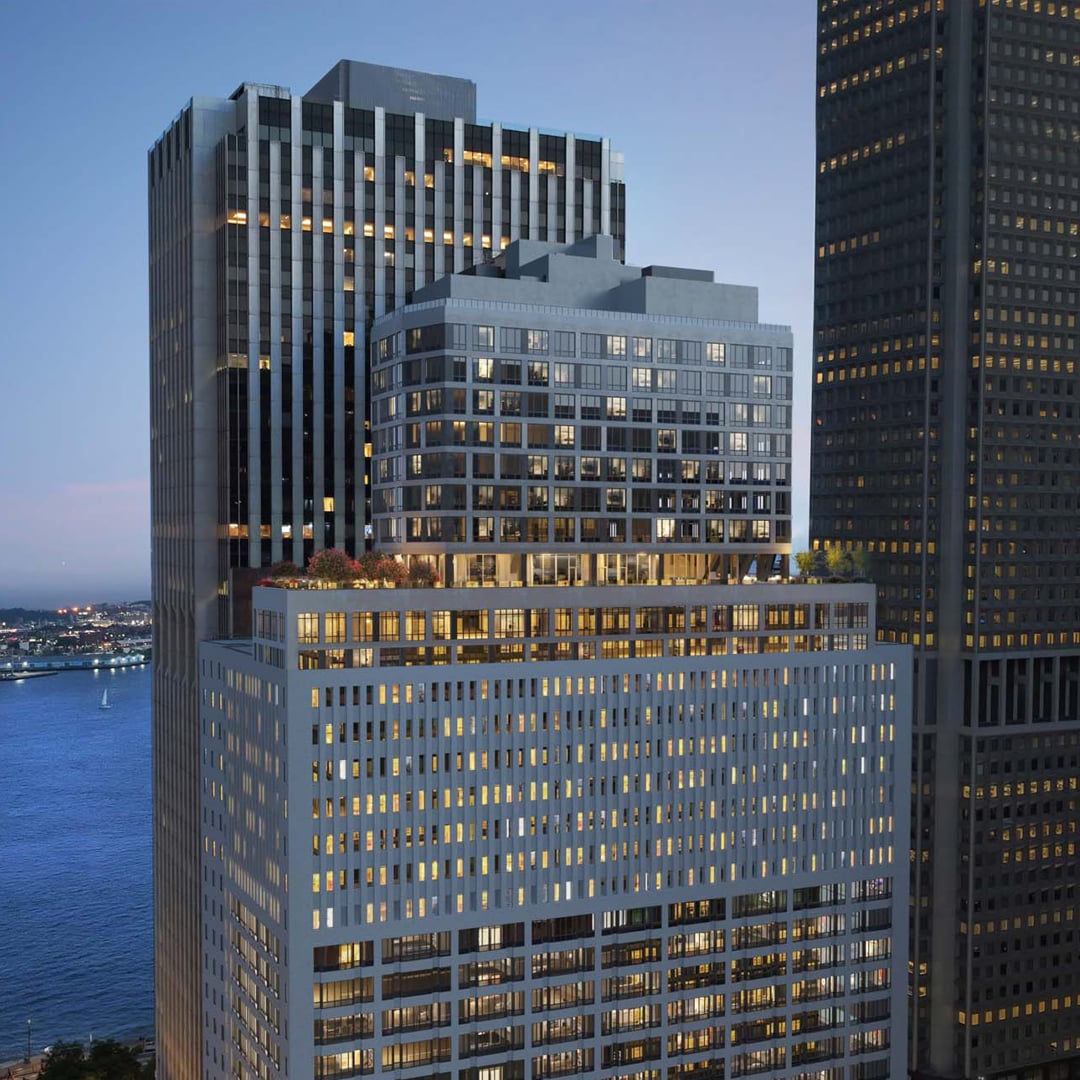
That's Bryan Steinwurtzel, co-CEO of GFP Real Estate, a multi-generational business operated by the Gural family, a big player in residential and office. Bryan is primarily responsible for overseeing GFP real estate's development of large-scale repositioning projects across New York City, including several major office to residential conversions. The GFP project we're here to focus on is at 25 Water Street in Lower Manhattan, which they're also calling SoMA, a former office tower that now has over 1,300 apartments. Coming up, a case study of contemporary conversion. I'm Spencer Levy, and that's right now on The Weekly Take.
Spencer Levy
Welcome to The Weekly Take, and we're back in Manhattan at what is truly one of the world's great development projects: 25 Water Street, known as SoMA, is literally the largest office to residential conversion in the world, and we are privileged to have the CEO of the company who did it, Brian Steinwurtzel. Brian, welcome to the show.
Brian Steinwurtzel
Thanks so much for having me. It's great to be here.
Spencer Levy
First of all, congratulations on this project. Just before we walked over here, Brian walked me through this place. Spectacular. We learned all the engineering things you had to do. And one of them that impressed me the most were the light and air holes that you cut through the building to make this workable for multis – and then you added 10 stories. Tell us about that.
Brian Steinwurtzel
Sure. So this building was a 1.1 million square foot office building. In order to turn it into a residential building, we had to carve out two light wells that were each basically the size of a very, very large New York City townhouse. So if you took Gloria Vanderbilt's mansion from the Upper East Side and you brought it down here and you turned it on its back, you could drop it into each one of these light wells. And we did that to make the floor plates efficient. And we were able to actually achieve an 85% efficiency ratio for this building, which is almost as good as the most efficient brand new buildings. But not only did we have to do that, we also had to remove most of the facade. So almost all of the brick from this building was removed and a brand new window wall was put all the way around it. And then we took all of those air rights and we built 10 stories on top. And what we ended up with was 1,320 apartments, one of the largest residential buildings in New York City.
Spencer Levy
Eighty-five percent efficiency. What that means for our listeners is that 85 percent of this building is being let to a tenant. The rest is common areas – the gym, the elevators – but that's optimal efficiency for a new build as well.
Brian Steinwurtzel
Yeah, and that's exactly what we want to do with product, not only residential, but office, because we want to create as many apartments as possible. New York City is experiencing a significant housing shortage. We are short approximately 500,000 housing units in New York city, and we need to use every single square foot as efficiently as possible to create many apartments, as possible
Spencer Levy
In terms of the apartments here, you have over 1,300 units. I understand it's 75% market, 25% rent restricted. What's the proper term for that?
Brian Steinwurtzel
Affordable apartments.
Spencer Levy
Tell us how that came together because I mean when you first bought it you were going to do all market then you switched. Tell us what happened.
Brian Steinwurtzel
That's exactly right. During the pandemic, we recognized that there was significant distress in the office market. And what we spent time doing is studying buildings that we thought would be better utilized as residential buildings. And this was one of the prime candidates for us. And we were fortunate that we were able to acquire this building right at the end of 2022 and filed to turn it into a residential building, planning to do it 100% fair market. What happened is during 2023 and 2024, the state of New York decided to create a program called 467M, which is an affordable housing program – basically an agreement that the owner makes to turn 25% of the apartments into affordable housing in exchange for a tax abatement. And so we are the first building to enter that program, and we are the first building to be approved and to actually finish the building and officially go into the program.
Spencer Levy
And the tax abatement is significant. I know of a lot of projects that are being converted. Really didn't work until you got the tax abatement or some other type of historic tax credit. But correct me if I'm wrong, this one would have worked without that.
Brian Steinwurtzel
Yes, we planned on this being a 100% market rate building, but we decided to opt into the program because it made financial sense and it also made sense for society. Keep in mind that each affordable housing unit on average in New York State, so we're talking upstate, downstate and in Manhattan, cost over $600,000 per unit to create. So in order to create an affordable housing unit – in order to pay for an affordable housing unit – the tax abatement that we're receiving has to be at least $600,000 per unit or else why would we do that?
Spencer Levy
You bought the building in ‘22. You were done 25 months later. Is that correct?
Brian Steinwurtzel
Yeah, so we closed in the building right at the end of 2022, and we opened the building in February of ‘25. So roughly 25 months from the time that we bought the building until we opened the building. And we were fortunate that in less than 12 months, we've already leased over 1,000 apartments.
Spencer Levy
What's remarkable, I mean, first of all congratulations on the speed of your lease up. How are we able to do it in 25 months?
Brian Steinwurtzel
Well, it is extraordinary. And we had a lot of doubters when we started this project, but we assembled a tremendous team. I had great partners, Nathan Berman in MetroLoft, Rockwood, our lenders. Everyone came together and believed in our project. And if you remember what was going on in 2022, inflation was skyrocketing, interest rates were shooting through the roof. We were in the midst of what we thought was going to be a double-dip recession. COVID was not certain to go away. And so there's a lot of people who did not believe that we could actually accomplish this goal, but our partners did. And we assembled a tremendous team, over a thousand individuals that have worked on this project to do what we did here. And we all collaborated and created a plan that we hit on. The plan had 30,000 lines, a plan that had 30 thousand steps that we had to do to basically accomplish our goal and we hit every single one of them. We actually finished early. We thought it was going to take us roughly 30 months; we finished in 25. We thought that we would burn through all of our contingency; we had contingency to spare. So we're all extraordinarily proud, but it's really primarily based on the people that came together for this project.
Spencer Levy
I told you I wouldn't trouble you with the math, but since you threw out $600,000 a unit and you have 1,300 units, is it fair to say this is over a billion dollar project?
Brian Steinwurtzel
I think that the math–I would hope that a building of this caliber, now that it's completed, would be worth somewhere in that neighborhood. But I think what it comes down to in a conversion is we look at it really on a dollar per square foot basis. So in 2022, in the complications of the transactions that we do at this scale. We roughly bought the building for a little over $150 a foot. And so when you buy a building at that price level, even when you have to do all of these things, and keep in mind that not every conversion requires you to carve light wells, to remove a facade, to build stencils on top, but the more things you have do, the lower the basis you have buy it at, and the less things that you do, higher the basis you can pay.
Spencer Levy
And so just to give everybody a sense of just a scale, $150 a foot in Manhattan. I was doing deals back in the ‘90s and we were paying around those numbers in the ‘90s, right? And at Manhattan's peak, with the exception of some of the highest end office buildings in the city – 1 Vanderbilt, Hudson Yards – before COVID, the top buildings were consistently selling for over a thousand bucks a foot.
Brian Steinwurtzel
Look, we were not certain of what would happen in 2022. But we believe in Manhattan. We believe in New York City. We believe in New York State. And we made a tremendous bet that we would recover. And we're fortunate that it feels at this moment that the bet has paid off, but there's a ton of uncertainty in the world and there will continue to be that, but we feel very good about betting on New York city.
Spencer Levy
How'd you get comfortable during that inflationary building to go big?
Brian Steinwurtzel
So I think what we've done at GFP is we built a team of people that break down very complex problems into very small pieces. And so when you break them down into small pieces, you realize that you can solve each of these. Believe me, we spend as much time thinking about all the things that can go wrong as we do about what we need to do to go right. And in this project, we were fortunate that we felt at this basis, we had a lot of leeway to take on the risks that were happening in that moment.
Spencer Levy
Tell us a little bit about the amenitization of the building, the gym, all the things that you get by becoming a tenant at SOMA.
Brian Steinwurtzel
So with over 1,300 apartments, we believe there will be approximately 2,000 people living in this building. And so when we thought about what do we want a building with 2,000 people to feel like, we thought a lot about community. And we said, we need to not only have great apartments that have great views, top of the line appliances and recessed lighting and all the things you'd ever want in an apartment, but that there would be areas in the building that people can gather that would also have surrounding them almost every amenity you would ever want. So in this building, we have an 18,000 square foot gym that has two pickleball courts. It has a basketball court. It has Pilates studio, yoga studio, group fitness. We have a three-lane indoor lap pool and we have an outdoor pool. We have salt rooms and steam rooms and infrared saunas and podcast rooms that we're sitting in right now, as well as music rehearsal rooms, kids play rooms and almost anything you can name. Because when we were designing this building. We were asking everyone that we ran into in New York City, what would they want in a building? And we tried to pretty much put it all in here. So the Super Bowl, it was a great night here at SoMA.
Spencer Levy
Except if you were a Jets fan.
Brian Steinwurtzel
And probably a Patriots fan, but in the game zone, we had a huge gathering of people watching the game. There were also two bowling alleys that you could bowl if you didn't wanna watch some of the commercials or two golf simulators or pool tables and ping pong tables. There's an arcade, karaoke room. And what came to fruition in that room was a dream that we had when we were planning this, that we could have a large gathering of people who probably don't know each other that well, but would feel comfortable being together to celebrate an American pastime and have a lot of fun doing it.
Spencer Levy
I used to work down here – 1 New York plaza right across the street. This was in the mid-’90s and I think at 5.01 p.m. I probably could have laid down in the middle of the street right outside and not gotten run over until the morning because it was nothing going on down here. Fraunces Tavern may have been the only retail establishment, but downtown right where we are right now has completely changed, certainly in the last 30 years since I was working down here. But tell me about why downtown Manhattan? And how would you classify this part of downtown Manhattan as so attractive to tenants?
Brian Steinwurtzel
So I lived down here in 2004. I completely agree with you. I think you could have laid down in the middle of the street and been very safe and there was no way you were getting food after 7 p.m., unless perhaps it was at Fraunces Tavern or maybe Adrienne's on Stone Street. But what's happened is since that time, there are over 30,000 people, I think there are soon to be 40,000 people living in this neighborhood. There's so much to do. Battery Park has been renovated completely. The East Side will soon look like the West Side in terms of its bike lanes and running paths and parks. And these buildings have brought such a vibrancy into the community. So on a weekend you will see bikers, runners, babies and strollers being pushed around. We have people that have this as pied-a-terres. We have young family and we have a lot of people that've just moved to New York City for their job. And it is an extremely active place. And I think it just continues to grow with itself. We have 2,500 units that have either been delivered or are about to be delivered in the next 24 months, and we have another 4,000 units plus planned to be delivered over the next five to 10 years. So I think this neighborhood–
Spencer Levy
4,000 units that are going to be delivered in this neighborhood?
Brian Steinwurtzel
Yeah, rough vicinity.
Spencer Levy
We're not in Tribeca. Where are we exactly? What would you call this neighborhood?
Brian Steinwurtzel
People refer to this as FiDi or Downtown, but it's become a neighborhood that people I don't think would have imagined. And I'm curious to see as it grows further whether the east side of downtown gets its own name and the West side gets its name because it is changing daily and each of these pockets, these neighborhood pockets are creating their own personality.
Spencer Levy
The big picture here is the trend of converting office to multifamily, or another use, but typically multifamily. And it's been so hard. Some cities I've been to–I went to Boston recently, I only saw one building in the whole city being converted. Why is it so hard?
Brian Steinwurtzel
It is very difficult. It's much easier to build a brand new building than it is to convert an office building. And there are so many unknowns in these buildings. And there's so many issues that you run into. They're certainly not purpose built to be residential building. And so they each become a custom project. And depending on the risk tolerance of the developer, they can take on a life of their own. We're fortunate that we have a team that has a lot of experience. So when we run into unknown conditions, we know how to handle them. But there are a lot of other groups that have not been as fortunate as we have and have run into tremendous trouble in their projects. Look, the pandemic was a catalyst for this to happen because office building struggled significantly. And so developers like us were able to purchase assets for a low enough basis where we could pencil the numbers. The state and the city did a great job creating a program that made financial sense. And most city and state programs really have binary outcomes. They either make sense and every developer will opt into them, or they don't make sense and no one will opt in to them. And we have examples today where there are programs where no one is opting into them. And we've others like this program, the 467M program, where pretty much everyone is opting into them. So I think those two things in combination, along with the New York City Code, which allows office-residential conversions as of right, we're really the primary contributors for this happening. If the office market skyrockets from here, and it's doing very well, there will be a lot less conversions. The 467M is having one of its phases phase out on June 30th of this year, and that will reduce the number of conversions. And if there's any changes to the way that zoning or code is done here, then it will limit the number conversions. Right now it feels like we have the wind at our back, but there are certainly obstacles that are coming up that may tip the scales back to what we were seeing in the 20-teens when very few buildings were converted.
Spencer Levy
Obstacles or opportunities. And this is where I'm going because most of your portfolio correct me if I'm wrong approximately ninety percent is traditional office. How's it going as office? And how many of those are you thinking about converting?
Brian Steinwurtzel
Yeah, so the other division at GFP is our legacy office portfolio. My uncle runs that. We're in our 75th year of business this year, and that is going really well. So in that portfolio, pre-pandemic – and we're getting closer to approaching that now – we were 99% leased and our renewal rate was 90%. So the office market's doing well. It is still recovering in some areas. The better the location or the better the building, the more likely it's going to be fully leased. But I think the story is a good one for office. I think that people realize that being together is more productive and that companies want to create an environment where their employees are happy. So the spaces are beautiful, the office buildings are being more monetized, and we're seeing more and more people that are choosing to go to work. So it's not just a Tuesday-Wednesday-Thursday experience is now becoming a Monday-Tuesday-Wednesday, and Thursday, and we may even get into Friday soon again.
Spencer Levy
When we look beyond the amenities of this building – I talked a little bit about the neighborhood – there's great infrastructure down here too. I mean, the FDR drive–you can literally throw a baseball at it, which is right across the street, but you also have great subway access here too, not only to World Trade Center which is a few blocks away, but also to Grand Central Station and to Penn, so it's unusual for people who don't know the shape of Manhattan, I'm going to now draw a little picture for you. It gets very skinny right where we are, and that actually helps the infrastructure because you can get to both the west side and the east side pretty easily. Is that part of the story?
Brian Steinwurtzel
Absolutely. I mean, you can walk a block and hit two subway lines, three blocks and hit six subway lines and eight blocks and hit pretty much every subway line. Downtown Manhattan has probably the best access to transportation infrastructure. Plus, what's happened down here is Brooklyn has become extremely popular and Jersey City have become extremely popular. And downtown Manhattan is actually right between Brooklyn, Midtown and Jersey city. It's really at, like, a nexus, if you will. So not only for work purposes, but also for social purposes, for going out and doing different things, experiencing the culture of New York – this is really the heart of where you wanna be.
Spencer Levy
How do you find a building and say, you know what, this one makes sense, this one's gonna be tough. What makes the bones of a good conversion story?
Brian Steinwurtzel
I will say that our firm is focused on the more challenging projects that are at larger scale. So if it's easy, we may not be the right ones for it because that building will probably trade for a very high dollar amount. And so the margin for error is very small, right? So for us, a better candidate is gonna be one in which people look at it and think that it's too challenged to actually produce. But basically buildings that were built in, let's say, pre-1940 were built before air conditioning, and so they were built for cross-ventilation. And so when you have cross-ventilation, you really have to have narrower depths from facade to facade, and that actually lays out relatively well for converting to apartments. But when you get into the, you know, large 1960s, especially when you got to brutalist architecture, it's much more difficult. And I'd say that some of the projects that we’re most excited about are probably ones that are the more difficult ones. It doesn't mean we won't try for a quote-unquote vanilla conversion, but the vanilla ones are being chased by a lot of different people.
Spencer Levy
You show me a vanilla conversion and I'll grab a pint of of the Ben and Jerry's that's sitting in your little amenity room upstairs right now because I don't know if there is such a thing as a vanilla conversion. But some are easier than others, and then it's a trap for the unwary. I think that some people say, oh this is a piece of cake, this is an old hotel, how hard could it be to make this multifamily?
Brian Steinwurtzel
One of the biggest mistakes that I hear people say is they say, what's the dollar per square foot it takes to convert this building? These are all custom projects, every single one of them. So there's not gonna be like a simple formula just for every building, right? You have to approach it as they're all their own unique floor plan. They have their unique vertical transportation, facades, street lines, legal light and air or not. And so if you approach it as something where it's just a formulaic process, you will probably fail in that endeavor. I hope that these opportunities continue to be there, but the truth is for us, the more challenged are probably the more likely for us.
Spencer Levy
This building – and I'm going to math this one here – given that it was originally 20 stories and you added 10?
Brian Steinwurtzel
Yeah. It was 22 stories and we carved the two light wells and took that floor area and put it on top for an extra 10 stories.
Spencer Levy
So the plates were about 50,000 feet, which is a very big plate for every city except for Washington, D.C., where they get much bigger than that. And what I've heard of some people talking about doing in Manhattan is unlike this building, which has fairly clean light and air all the way around the building, some buildings abut right next to another building. So building a light and air hole may be your only solution, or mothballing part of the building. Have you looked at that?
Brian Steinwurtzel
Yeah, we have. So we have another project called 222 Broadway, which will open in May. That's approximately 800 units. That building is–on the base floors in the center, there is an area that is just inefficient. And it is likely–not as likely, we will just be creating storage units out of it, which is actually an amenity because a lot of–one of the things that's the most rare in New York City is you have this great apartment, but you got a lot of stuff. What are you gonna do with it? So in that building, we will basically be able to have storage units for those people. But it works in that building because the majority of the building is efficient. There just happens to be a small number of floors where that inefficiency, we're taking a negative and turning it into a positive. If that whole building had all that inefficency, it wouldn't pencil out financially.
Spencer Levy
This is a very big question, and I say it in honor of the David Bowie poster on your wall, but from the files of future-proofing, where are we going here?
Brian Steinwurtzel
Look, future proofing buildings is as much about building resilience, resilience to global warming and all the forces of nature that we have to be prepared for. So just by way of an example, we are down in the financial district, Hurricane Sandy flooded this region. This building is probably one of the most resilient buildings now in New York City.
Spencer Levy
So stop there for just a moment. I want everybody to just know what Brian just said. Hurricane Sandy was a catastrophe for downtown Manhattan. The subway stations, some of them were filled to the top with water. The damage to all of the buildings that had all of their safety systems below water level. Many of that things were destroyed. And I don't want to be melodramatic about it, but some kind of hurricane Sandy is coming again. What are we doing about it?
Brian Steinwurtzel
So when we're developing these buildings, we're trying to create a lot of different levels of resistance. So just just as far as Sandy goes, this building has–it's built onto a plaza. We have a tiger dam system that is deployable around the building to literally==
Spencer Levy
What is a tiger dam system?
Brian Steinwurtzel
It's basically a system, basically a dam that you actually fill with water to prevent water from coming in and then we have flood barriers that are actually deployable around the building as well.
Spencer Levy
When you say deployable, you mean like, when it goes down you can do that at that moment?
Brian Steinwurtzel
In the basement of this building, you have a tiger dam and we have a flood barrier system. And in the event that we are concerned about a tropical storm, hurricane, flooding event, then our personnel will take it from the basement and they will set it up around the perimeter of this building. They will put in the barriers and they inflate the dam and we will be prepared to prevent any water from infiltrating the building.
Spencer Levy
This brings up an interesting question because some of the resiliency is specific to your building. Some of the resilience is specific to downtown Manhattan. I heard a number of about a hundred billion dollars to build a seawall to protect lower Manhattan, which I don't know if that number is right, but some massive number. So is there – and again, this is not intended to be controversial, but there is a balance between the private and the public in terms of who pays for it and where does it go? So lower Manhattan versus your building, how do you think about it?
Brian Steinwurtzel
I think the only thing we can do is to develop these properties so that they're resilient to these potential problems and at the same time, volunteer our time, our expertise and our energy to helping the elected officials come up with a plan to protect the infrastructure and the city itself. So almost everyone on our team volunteers in some capacity, whether it's on a business improvement district or in committees, or in just general brainstorming sessions with elected officials around these types of issues. And look, we're very fortunate that we have a lot of talented people here in the public sector and private sector. And a lot of the plans that they're coming up with, I think, will be good ones. The question is, how do you pay for it? And usually the private sector will end up paying for it.
Spencer Levy
We mentioned affordable housing now and 25% of this building is based on the median income of the community. Walk us through that for just a moment.
Brian Steinwurtzel
I think most programs for New York have percentages of area median income that we're setting the rents at, and those area median incomes are set by the federal government. So this building in particular basically averages 80% of area media income. Most of the affordable housing here is really workforce housing, so someone who actually is working a job in New York City potentially as a teacher. You know, working sanitation, police, fire department can actually afford to rent an apartment in this building. And these are great programs. We should try to expand these programs, but we have to pay for them, right? So the challenge is that creating affordable housing in New York City is very expensive. It's only getting more expensive. And so whatever program we create has to pay for the creation of that housing or else it won't be created. And then the other thing about it is almost every new program. The affordability continues forever into the future. It's in perpetuity. But the way we pay for it right now is through these tax abatements, and those are limited. So those programs make sense when you're looking at things on day one from an NPV perspective, but when you arrive at a time where the abatement has run out and now you have to pay, as an owner, full tax, but yet you're still receiving limited income, we may run into a problem where it can't continue to pay for itself. And so creating programs that will last not only now, but all the way into perpetuity is important. Hopefully we think a little harder about that in the future.
Spencer Levy
And just a bottom line, during your construction period, you did not have to pay property taxes, and then you have approximately a 90% property tax abatement for 30 years. Is that correct?
Brian Steinwurtzel
Yeah, so the way it works is we pay property tax during construction, but when we finish construction, because the city and state want us to finish the project, they then reimburse us for 100% of the taxes during construction. And then for the next 30 years, there's a 90% abatement of real estate taxes, and then a five-year phase out. And this is what provides the dollars to actually build the affordable housing.
Spencer Levy
So, 500,000 in New York alone?
Brian Steinwurtzel
Yes.
Spencer Levy
Okay, how do we solve it?
Brian Steinwurtzel
Build more. It's as simple as that. The question is, how do we pay for that? Part of it is about making regulations easier to actually construct these projects. There's already a lot of effort to shorten the environmental review process. So for example, if we're converting an office building to residential, what kind of environmental review processes is necessary? There's already a building here. We don't really have to reconstruct it. Should it really go through the same kind of review process as if you're building a giant building? So eliminating unnecessary regulation, I think, creating financing vehicles to actually create this housing, and then just generally trying to figure out how to allow people that own buildings to transact. There's a ton of unused air rights in New York City and they're locked up because of individuals that own property that have a disincentive to actually sell them.
Spencer Levy
So I ask the question a lot of people are thinking. Why didn't you knock this building down and start again? What is the thought process of using the existing shell? Walk us through that.
Brian Steinwurtzel
The most expensive thing for a developer is time, right? So every day we have to pay our lender and our partners, our equity partners, for the money that we are using to build a project.
Spencer Levy
And at 10% that time is really expensive.
Brian Steinwurtzel
Well, 10% is just the debt. The equity is much more expensive. So time is our most expensive thing. So if we can eliminate a significant amount of time – so the time to take the building down and then the time actually rebuild all of that infrastructure – then we are saving our investors a significant amount. And it gives them even more reason to invest into the project. The other side, one of the most environmentally friendly things we can do is actually reuse the existing building. What's the point of throwing literally into a landfill all the steel, all of the concrete, all the materials that are in this building, if we can just reuse it? You know, really those two primary reasons are why we chose to keep this building here and not knock it down and rebuild it.
Spencer Levy
But that's the logic in most buildings. And I would say it's a big difference to talk about a dense urban environment like Manhattan, which is like none other in terms of its cavernous nature and in terms of the height of the buildings. It’s another thing to talk about a B mall in a secondary market that might be better off for industrial. There's some buildings where it just doesn't make sense to reuse the core shell of the building. Fair statement?
Brian Steinwurtzel
For sure. The question is, can we create incentives where appropriate to reuse parts of it and then create something outside of it? We only work in New York City, but I could certainly imagine a mall with significant amount of parking all around it and there's some way to create a center area and then reuse all the land around that mall for new building housing while reusing some of the infrastructure in the center that there might be a positive outcome for that community.
Spencer Levy
What can a local government do to make it better for the local community to build more units?
Brian Steinwurtzel
We're close with most of the elected officials in New York City, and I like most of them. I think they're doing their best, and I think that they're generally doing a good job. I think the challenge we have on policy is that we don't understand each other. And we don't take enough time to actually understand–elected officials don't actually understand why a developer is behaving this way, why we're making the decisions we're make. And we, as developers, aren't understanding as much why the elected official feels like they have to create policy that they are creating. And the problem is over the last decade, and I think it's actually started to go the other way, but for a long period of time there was very little communication and now there's more and more and communication. And I think that's a good thing. So the more we can spend time together the more We can understand each other. I think the better we will do as a society.
Spencer Levy
You know, we're talking about office to multi. Why no retail in the building?
Brian Steinwurtzel
There is. It's just retail’s like the last thing. First of all, because as we're building the building, we have to push all the materials into construction workers out of the apartment. Where are they going to go? They're going to go into the retail and the garage because those are things that we can afford to open last. But also retailers want to know that the population is there. They want to have customers when they actually build their store. So we actually have a great restaurant that hopefully will open next year on the corner. And there's a lot of other prospects that will hopefully be opening as well at the same time. Complementary retail that will serve as another amenity for the people who live here.
Spencer Levy
What's the future of conversions?
Brian Steinwurtzel
The question will be, what can we acquire office buildings for? What basis can we require them for? Are there going to be incentives? I mentioned earlier, that the 467M program falls off on June 30, 2026. And also, how difficult will be some of the new regulations that are coming online for us in terms of conversions? So if the regulations make it more difficult and more and take longer. It'll be more difficult. If the office market continues to improve, which we hope it does, there'll be less candidates for it. And if we don't actually extend the benefit of the 467M, then there will be less incentive to not only create housing out of office buildings, but also to create affordable housing out of office buildings.
Spencer Levy
I don't want to be too bottom-line about this. If the math doesn't work, it's not getting built.
Brian Steinwurtzel
Absolutely not. That is 100% correct that you're–what you just said. The challenge is that this is an extremely risky endeavor. And the folks that invest into this, whether it's lenders or equity investors, they will only do it if they can earn a return that is commensurate with the risk that they're taking. And with conversions, we are at the extreme end of the risk spectrum and they need to earn a high return or else the projects won't be done. So creating any incentive or reducing the risk, reducing the barriers that are there will help these projects come to fruition and be green-lighted in the investor room.
Spencer Levy
So the equity investors, the institutions that are backing some of these projects, they're looking for 20% plus IRRs?
Brian Steinwurtzel
I think that for a conversion from the equity investor perspective, that is in the right range of the returns that they're expecting, given the risk profile of these deals.
Spencer Levy
Well, on behalf of The Weekly Take, what a great conversation today with Brian Steinwurtzel, co-CEO of GFP Real Estate. We're here at the SoMA, located at 25 Water Street. Congratulations on the project. Thank you for coming out to the show, Brian.
Brian Steinwurtzel
Thank you for coming down.
Spencer Levy
From 25 Water Street to other impressive real estate perspectives, check out our website for more information and more conversation about what's new and now in commercial real estate. You can find that at CBRE.com/TheWeeklyTake. And you can also catch up on past episodes there or at the podcast platform where you listen. In the weeks to come, we'll return to the CBRE Symposium to check back in on the capital markets, and we'll also visit a sector we haven't browsed in a while, retail. So stay tuned and join us again soon. Thanks for listening. I'm Spencer Levy. Be smart. Be safe. Be well.
.jpg)