Report | Creating Resilience
2026 Corporate Real Estate Organizational Design Study
Four in 10 CRE departments are undergoing or considering a major team reorganization.
November 17, 2026 3 Minute Read

Corporate real estate (CRE) leaders are revisiting organizational design, staffing and performance goals to deliver on their primary mission: enabling the business.
CRE leaders expect three major external forces to reshape their teams over the next three years: AI (81%), economic pressure (67%) and M&A (48%).
Below are the major findings from CBRE Institute’s 2026 CRE Organizational Design Study.
1. CRE’s primary mission and purpose remains business enablement. Alignment is an obstacle for one in five.
Nearly every CRE leader (92%) ranks enabling the core business as their department’s top priority, which should form the foundation for team design, size and KPIs. Siloed business relationships are the most common barrier to success (19%), ahead of limited decision authority (15%) and insufficient budget (10%).
2. Four in 10 departments are rethinking team design, and roles are already changing.
In all, 43% of CRE departments are undergoing a major reorganization (10%) or exploring one as the business evolves (33%). Another 35% added new roles in the last 12 months to support CRE’s changing remit. Most teams organize by function or service line (46%) or geography (38%), usually as a matrix. Only 6% organize primarily by enterprise line of business.
3. AI is changing the skills teams need before it changes headcount.
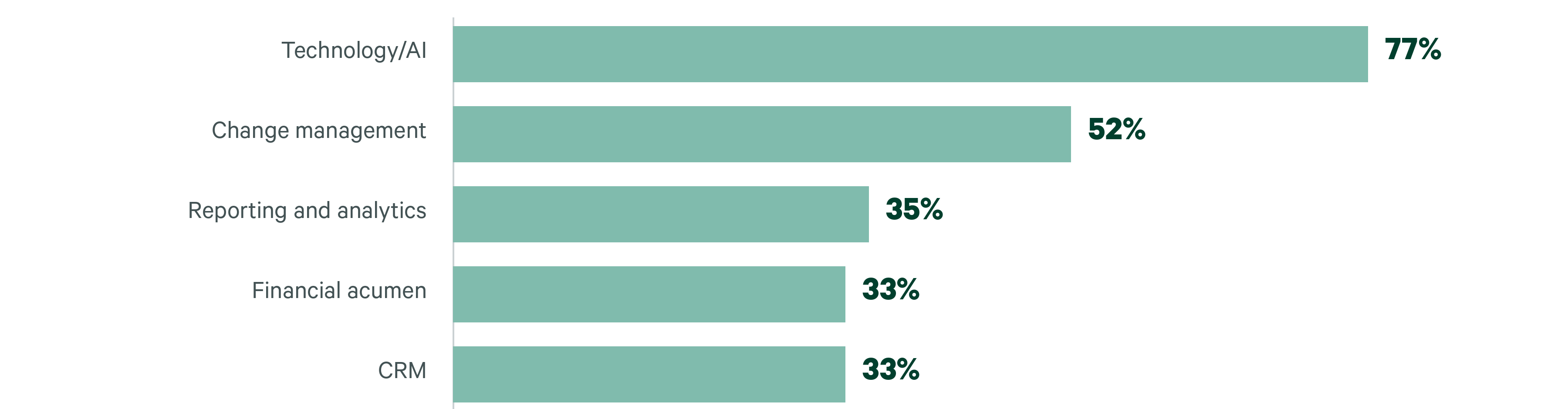
AI is the top external force CRE leaders expect to reshape their teams over the next three years (81%) and the top skill gap (77%), ahead of change management (52%). So far, 13% of departments have slowed hiring because of AI, and 6% have seen or expect a net reduction in headcount.
Figure 1: Top five new or in-demand skills for CRE teams
Share of CRE leaders naming listed skill
4. The CFO is still the most common reporting line. New or non-traditional reporting structures are emerging.
Reporting to the Chief Financial Officer (CFO) fell from 41% in the 2024 study to 27%. Reporting to the Chief Procurement Officer doubled to 10%, and 21% of departments report into other functions, such as strategy, risk or governance leadership.
5. Tactical delivery is shifting to a small set of supplier partners. One in five departments is uncertain about the model.
As the internal CRE team focuses on strategy and business enablement, tactical delivery is shifting to service providers. On average, 23% of CRE staff are internal and 77% are Tier 1 service providers. Departments typically use one to two providers for each core function (e.g., facilities, project, transaction management), and it is common for the same providers to deliver all of them. Most leaders (75%) are confident in this balance, but 21% are uncertain about their delivery model or say a fundamental rethink is overdue.
Questions CRE Leaders Are Working Through
If CRE’s mission has changed, should the organization change as well? For many leaders, the answer is yes, but the right team design depends on scope, industry and footprint.
CRE leaders and their supplier partners are weighing these questions:
- How can CRE strengthen alignment with lines of business that each have different objectives?
- Where should the line sit between the internal team’s strategic remit and Tier 1 suppliers’ delivery responsibilities?
- Who owns enterprise-wide initiatives such as M&A, major transformations or outsourcing transitions?
- What happens to the size and makeup of internal and supplier teams as AI use expands?
About this study
CBRE Institute’s biennial Organizational Design Study benchmarks how CRE departments are structured, led and resourced. For 2026, CBRE Alliance Directors interviewed the executive directors of 48 CRE departments at corporations, hospitals and governmental organizations. Their combined portfolios total nearly 2 billion sq. ft. across industry sectors and geographies.
Related Insights
-
Report | Creating Resilience
Managing Corporate Real Estate: Leading and Emerging Practices
February 10, 2026

Corporate Real Estate teams have evolved new strategies to enable the business, engage employees and enact future-proofed plans.
-

This year, our series offers a data-driven roadmap to help organizations adapt to today's hybrid workplace, covering design, leadership, technology and the future of work.
-

Explore key trends in real estate outsourcing contracts, including financial benefits, risk management, and C-suite involvement, with insights from the 2025 CBRE Institute report.