Viewpoint
Most mid-rent regulated houses out of reach for first-time buyers and middle-incomes
Who is buying the rental properties being sold by investors?
April 2, 2024

Looking for a PDF of this content?
As has been evident for several quarters now, an increasing number of rented houses are being sold by landlords to private houseowners (a process commonly referred to in the Netherlands as 'uitponden'). The reasons for this range from higher financing costs for investors to more stringent tax regimes and rent regulation, which make renting out properties less attractive. As a result, the already limited rental supply diminishes, leaving fewer options for prospective tenants.
A commonly heard argument from demissionary Minister de Jonge is that fewer rental houses, but instead more owner-occupier houses, would not pose a problem for prospective tenants. In fact, it would be better because middle-incomes can now buy these houses themselves instead of them being "withdrawn" from the housing market by investors.
First and foremost, it is important to understand that, despite Minister De Jonge's rhetoric suggesting that houses disappear when purchased by investors, this is not the case at all. After all, the property still functions as a place of residence and therefore remains part of the overall housing stock. The question that should be relevant is whether these houses, when converted to owner-occupier properties, are accessible (or more accessible) and thus affordable for households that currently struggle the most to find housing, such as the frequently mentioned first-time buyers and middle-incomes.
Despite the short-lived dip in the housing market, it remains difficult for middle-incomes1 to purchase a home. Although in 2023, 42% of houses sold below €354,000 (approximately the maximum that someone could borrow with a household income of €73,000) in the Netherlands, this percentage is considerably lower in popular housing markets. In Amsterdam and Utrecht, only 22% of the supply was accessible to (the highest) middle-incomes in 2023. And yet these municipalities experience the greatest shortages for people with key professions, who usually have a middle income. The former rental properties that are sold off could therefore potentially provide more breathing space in these overstressed owner-occupied housing markets.
Data from the Land Registry (Kadaster) shows that in 2023, 75% of the houses sold by investors to individuals throughout the Netherlands were sold below the NHG limit (€405,000). However, there are significant differences in income and average transaction prices of these former rental houses across the country. Therefore, this short-read builds on our previous research on the effect of selling-off rental houses in the 20 largest municipalities: what are the prices of these houses in different cities, and to what extent are they accessible to middle-incomes and first-time buyers in these housing markets? And consequently, more affordable?
[1] Although there is no formal definition from the government, several private and social landlords appear to roughly adhere to the income range of €48,000 to €73,000.
Smaller houses are being sold by investors, but they are not always affordable
In our study of housing ownership among private landlords, specifically regarding which houses fall under the middle-rent regulation based on energy label and property size, there is a logical and remarkable concentration of smaller houses, especially in expensive cities. When examining the value of these houses for the 20 largest municipalities in the Netherlands based on the price level of Q4 2023, a clear distribution by price range emerges:

The majority of houses (25th to 75th percentile) fall within the price range of €290,000 to €430,000. However, within the 20 largest municipalities, the average transaction prices vary significantly. For instance, there are municipalities like Enschede and Zoetermeer where the impact of the selling-off of rental houses will be minimal, and these houses have a low municipal property value in general. On the other hand, the average sale prices for regulated middle-rent houses in popular areas like Utrecht, Amsterdam, and Zaanstad exceed €400,000.
Only well-earning first-time buyers benefit from selling-off rental houses
In the municipalities where housing shortage is highest and the selling-off of rental houses to private buyers is most prevalent, the average house that is likely to be sold off due to the mid-rent regulation remains out of reach for this household of first-time buyers. The borrowing capacity of the median household aged 25-35 falls significantly short of the property value. Therefore, the prospective buyers who acquire these former rental houses will need to earn above-average incomes and/or have their own savings. Considering the rising property prices and the leveling off of salary increases, these houses will become even less affordable for the average first-time buyer without savings in the future.2
[2] Calculated with a NHG mortgage interest rate of 3.75%
Middle-incomes continue to be squeezed
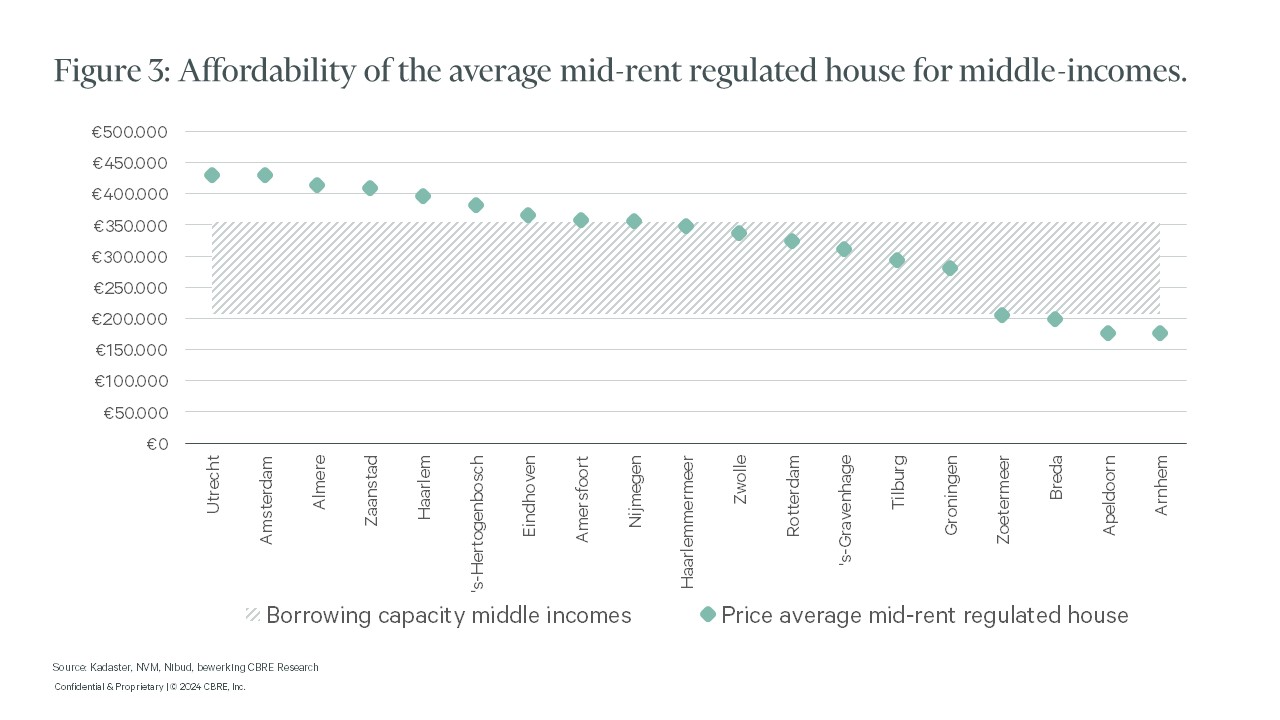
The minister's housing policy is primarily aimed at improving the position of middle-incomes in the housing market. These households earn too much for social housing and are therefore reliant on the overheated private rental and owner-occupier segments. The figure below illustrates to what extent the average mid-rent regulated house falls within the borrowing capacity of these much-discussed middle-incomes. It shows that in housing markets with the largest mismatch between supply and demand, such as Utrecht and Amsterdam, the average mid-rent regulated house is sold well above the maximum loan amount for middle-incomes. Even in cities like Rotterdam and The Hague, where houses are slightly more affordable, it is mainly the higher middle-incomes who can afford to purchase these houses. Overall, the former (affordable) rental houses in the ownership sector have not become more accessible for the majority of middle-incomes in larger cities.
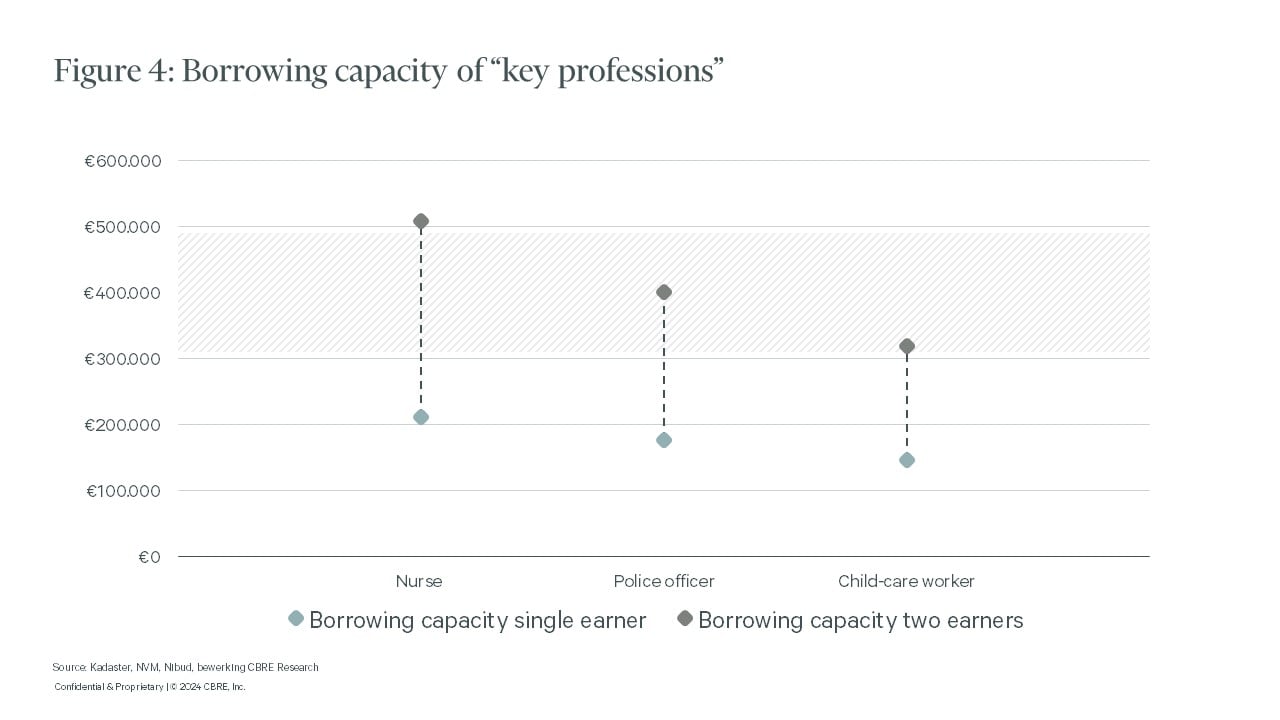
At the same time, there is significant concern, particularly in cities like Amsterdam and Utrecht, regarding the shortage of people in "key professions," such as police officers, nurses, and childcare workers. These essential societal roles generally do not come with a salary3 that is sufficient for the average mid-rent regulated house. While college-level nurses can expect an annual salary of nearly €50,000, the average childcare worker's salary is around €34,000. For single-income households, almost all regulated middle-rent houses in Amsterdam and Utrecht would be too expensive. It is only when two full-time working nurses combine their incomes that most houses become within the borrowing capacity of essential professions, although this varies across different sectors.
[3] The salary indications are based on a 36-hour working week, based on the most common job groups/salary scales in the collective labor agreements for 2024.
Monthly costs of owning a house not necessarily lower than renting due to additional expenses
Furthermore, it should be emphasized that renting is not necessarily more expensive than buying, considering the numerous additional costs associated with homeownership. In addition to the monthly mortgage payment, there are various expenses that are often overlooked. Costs for maintenance or sustainability play a significant role, and these can add up significantly, especially for older properties. Most houses that are likely to be sold-off due to the mid-rent regulation often involve energy-inefficient, older houses. If these factors are not adequately considered by individuals in their bidding, they may end up having to make substantial investments in the property in the long run. Additionally, houseowners face additional taxes such as property tax, the houseowner's levy (notional rental value) and property insurance.4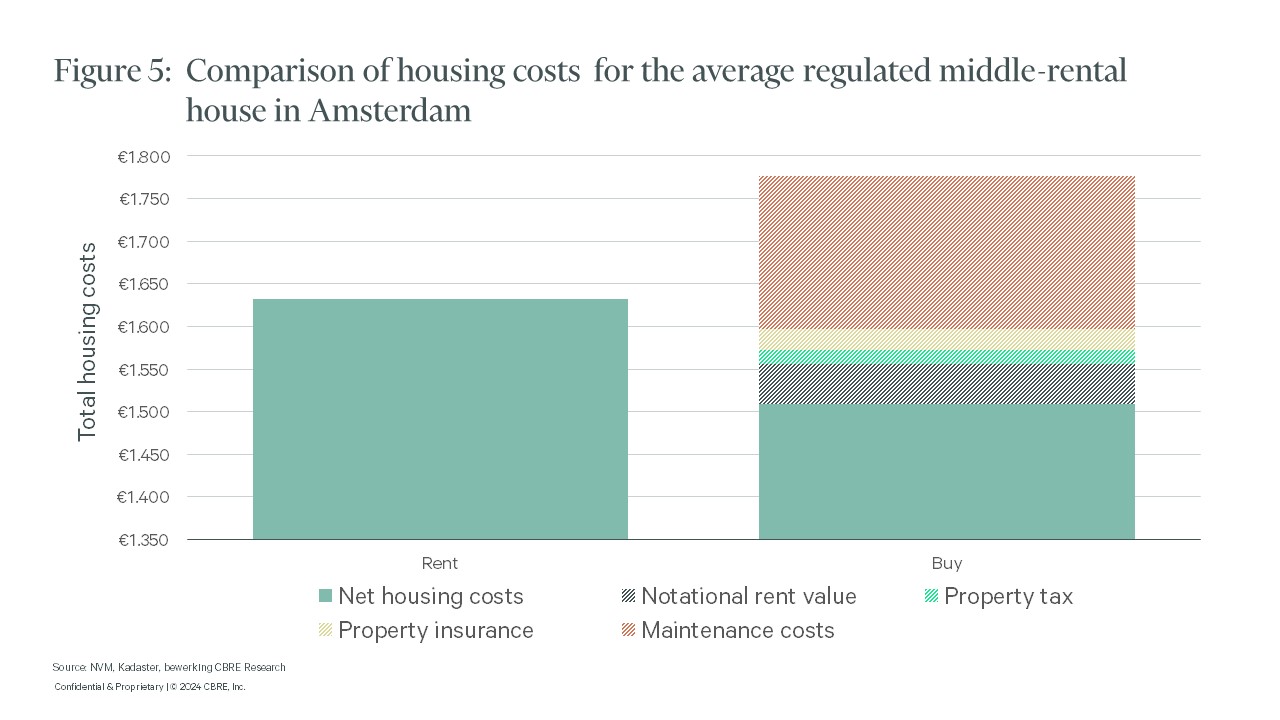
The comparison of housing costs for a potential mid-rent regulated house in Amsterdam reveals that, although the base rent is higher than the net mortgage payment under current market prices, the additional expenses associated with homeownership still result in higher housing costs. It should be noted, however, that a portion of the mortgage payment goes towards building equity in the house. Nonetheless, households still incur these costs on a monthly basis, leaving middle-incomes and first-time buyers with a high housing cost burden.
[4] For a home of 50 m2 with a mortgage interest rate of 3.86%. Costs that apply to both tenants and buyers, such as energy costs and service costs, have been omitted under the assumption of equal amounts for an owner-occupied and rental home. Any leasehold payments are not included in the comparison.
The selling-off of former rental houses currently more beneficial for already well-positioned first-time buyers
In both the rental and owner-occupier markets, with a chronic shortage of supply, the current shifts from rent-to-buy do not result in better affordable supply. Due to the additional costs of owning a house, the monthly costs may even turn out to be higher for households. The proposed housing policy redistributes the same number of houses, but in doing so, it favors - perhaps unconsciously - already privileged households. Starters, middle-incomes, and households with “key professions” that don't earn enough to buy the houses are increasingly being squeezed. They are faced with an even smaller, more competitive, and more expensive remaining rental supply. Especially in the metropolitan areas where there is a great need to retain these professional groups.
Ultimately, households will primarily be aided by increasing the housing stock, aligning supply more with demand and thereby reducing pressure on price levels. This requires an attractive investment climate, smooth planning procedures, and better cooperation between governments and market parties. But also, the allocation of rental properties to target groups such as the key professions - which is already happening a lot in new projects in Amsterdam and Utrecht - can ensure more housing for essential workers in the short term.