Intelligent Investment
Finding Revenue Beyond Rooms and F&B
By: Andrew Hartley
September 12, 2025 3 Minute Read

Hotel owners and operators have been creatively increasing revenue streams through non-traditional methods. Traditionally, room revenue, followed by food & beverage (F&B), generated the most revenue. The rooms department is typically the most profit-efficient, contributing the most to the bottom line, as it is the core of the business. However, since the pandemic, for many markets, entire segments of demand, such as groups, conferences, corporate and business travel, have permanently eroded. This loss of demand, compounded by inflationary pressures, has ultimately decreased overall revenues when adjusted for inflation.
Using the average Consumer Price Index (CPI) inflation increase from 2019 to 2024 at 4.2%, we compared 2024 performance to 2019 in 2024 dollars. The sample included 1,343 full-service hotels with data reporting in 2019 and 2024. The following table presents the 2024 performance indexed against 2019 performance.
Figure 1: 2024 % of 2019 Adjusted for Inflation (4.2%)
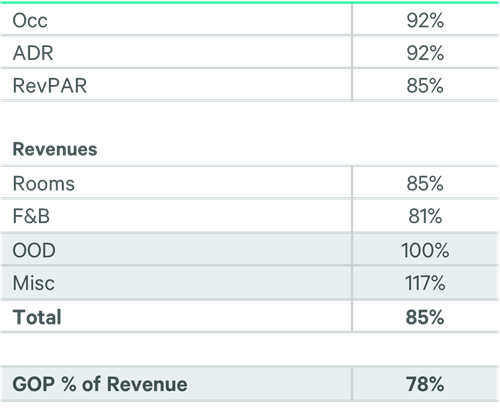
As shown, the rooms and F&B department revenues are 85% and 81%, respectively, of 2019 inflated levels, indicating permanent revenue erosion for this set. However, a green shoot appears hidden in the data as there is stable or positive revenue growth in other operated departments and miscellaneous income. Of the 1,343 statements, 1,116 properties indicated key growth in other operated departments. The following table summarizes their performance.
Figure 2: 2024 vs 2019 Adjusted for Inflation (4.2%)

The above data indicates a significant impact on leisure expenditures. Most of these hotels have realized a significant increase in revenues from guest amenities such as spa, golf, other F&B, as well as other recreation. This aligns with the general increase in leisure travel since the pandemic.
Interviews with hoteliers revealed the spa, or rather “wellness program,” has been an area where full-service and resort hotels are finding creative solutions to further monetize the amenity. “Wellness” is now the preferred term for a traditional spa offering since the program is now encompassing more than just a soaking tub and treatment rooms. Designers and operators have begun to feature experience-driven, property-wide programs with a focus on mental wellbeing. For example, a country resort may feature more scheduled group activities such as yoga sessions, hiking, camping, etc. as additional “wellness” programs. In some cases, a lakefront retreat may offer task-driven guided fishing as a “wellness package,” or a ranch resort may include horse grooming as a group bonding leisure activity. Guests increasingly desire a curated and authentic experience rather than just another excursion.
Some hoteliers have been able to capture additional revenue by tracking potential fees better. With new technology, operators have increased the speed and detection of guest damage to rooms, specifically damage from smoking or drug use in the guestroom, with more sensitive infrared and smoke detection. Automated cleaning fees are now applied at checkout. Guests who cause damage, such as cigarette smoke, are more likely to be charged a cleaning fee PRIOR to check out. This increases savings on additional cleaning costs, as well as increases fees in miscellaneous income.
These are two examples of additional revenue sources currently trending in the hotel industry, based on our discussions with operators, owners, and consultants. Other unique sources of revenue growth are out there and still yet to be determined, but hoteliers have adopted elevated amenities or increased technology to capture additional sources of income over the past two to three years. In the current climate of market uncertainty, we foresee further progress in identifying narrow avenues for increased profitability.
Andrew Hartley is Senior Vice President of CBRE Hotels Valuation and Advisory Services in New York City. To discuss your hotel’s revenues, please contact Andrew at [email protected].

