Valuer Insights
Business Insights | Data Centre Sustainability: Why Benchmarking Matters Now
September 3, 2026
Contact
Senior Manager, ESG, Valuation & Advisory Services, Hong Kong

Commercial Necessity, Not a Compliance Checkbox
While securing reliable power remains the data center’s primary consideration, these forces are converging to make sustainability performance a commercial necessity, not a compliance checkbox.- Rising efficiency expectations for AI. Markets across the region are moving quickly to set mandatory sustainability standards for data centers, starting with PUE (Power Usage Effectiveness) and WUE (Water Usage Effectiveness).[2] As regulatory requirements for sustainability performance tighten, the data center industry could face higher environmental and social risks. For existing data centers in Asia Pacific, particularly those built in the pre-AI era, obsolescence risk is accelerating faster than most investors anticipated. Older facilities built for conventional computing loads cannot accommodate the power and cooling requirements of artificial intelligence infrastructure. This poses a higher risk for aging, legacy facilities that must undergo refresh, retrofit, energy optimization, and sustainability upgrades. Operators who cannot upgrade risk losing their most valuable tenants.
- Investor and lender scrutiny. Institutional capital increasingly expects independently verified sustainability data and climate transition strategy before committing to an asset, extending its sustainability performance reporting and monitoring requirements beyond traditional mechanisms through benchmarks such as GRESB. Tenants’ site selection processes are starting to include binding sustainability requirements — and in our conversations with clients, we find most operators can confidently answer only one or two of the six core questions that major cloud and technology companies ask on energy, water, waste, climate resilience, safety and third-party credentials.
- Listing requirements. For data center operators in the IPO pipeline, investors consider how companies address sustainability and climate resilience strategies. Demonstrating robust net zero pathways, mitigating pollution, creating positive community impact, and fostering workplace safety and talent retention can lessen reputational and financial risks.
- Community resistance. Many data center projects are facing community opposition. This makes it incumbent on investors to earn the trust of local communities — a hard factor to quantify — to avoid project delays, extended development timelines and lower profit margins. [3]
Key Opportunities
Operators who invest in sustainability can gain commercial advantages. Financing costs can be tied to sustainability performance targets, incentivizing operators that improve their energy and water efficiency and reduce carbon emissions. CBRE’s analysis shows that targeted upgrades to electrical, mechanical and building control systems can deliver energy savings of between 5% and 20% per project.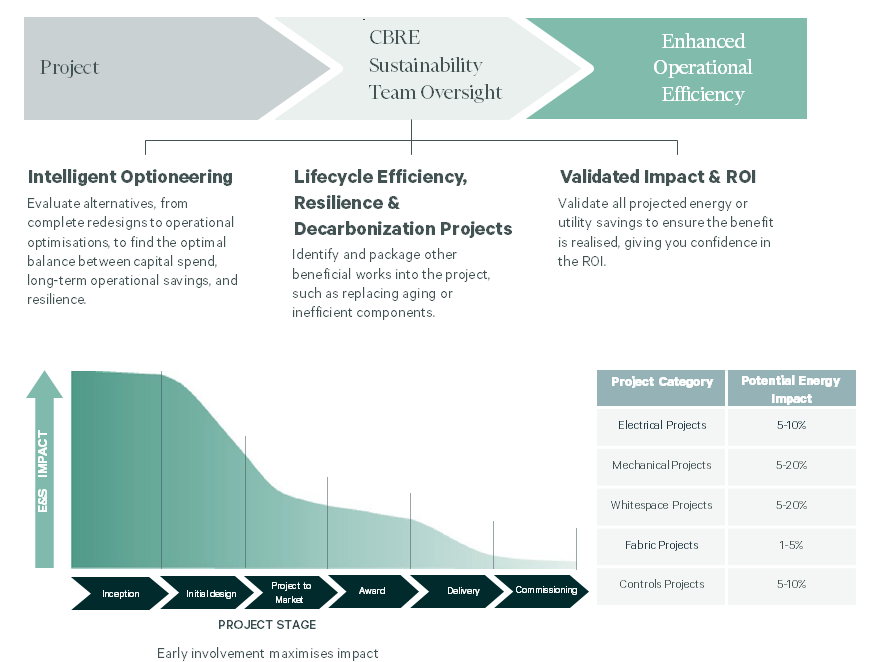
Efficiency & Decarbonization for Lifecycle Projects. Source: CBRE
Green building certifications — such as LEED, BEAM Plus, and EDGE — can accelerate planning approvals and support stronger asset valuations. Investing in local jobs, skills training and community programmes builds social trust and can help facilitate regulatory approvals.
Why Benchmarking Is Essential
Sustainability claims need to hold up under scrutiny with data, climate transition strategies and future plans backed by independent verification. General building certifications, while an important first step, do not capture what matters most in a data center context — how efficiently it uses power, how it manages water usage, how it interacts with the electricity grid. Without a consistent, independently validated standard to verify sustainability and environmental performance, operators face obstacles to securing grid connections, accessing capital and attracting tenants to their facilities.
The GRESB Data Center Assessment
Launched in July 2026, the GRESB Data Center Assessment is a purpose-built, sector-specific assessment and benchmark for data center developers and operators. Developed with the iMasons Climate Accord and tested through a pilot with more than 40 organizations globally, it provides a consistent, validated way to assess and communicate how organizations manage the material sustainability risks associated with data center development and operations.
The Assessment evaluates three dimensions: how sustainability is governed and managed within an organization; how a facility performs on energy, water, carbon and safety; and the extent to which innovative practices, such as waste heat recovery or advanced cooling technologies, are being adopted. Importantly, it accounts for the different levels of operational and procurement control that exist between data center owners, operators and their tenants — a distinction that generic frameworks often overlook.
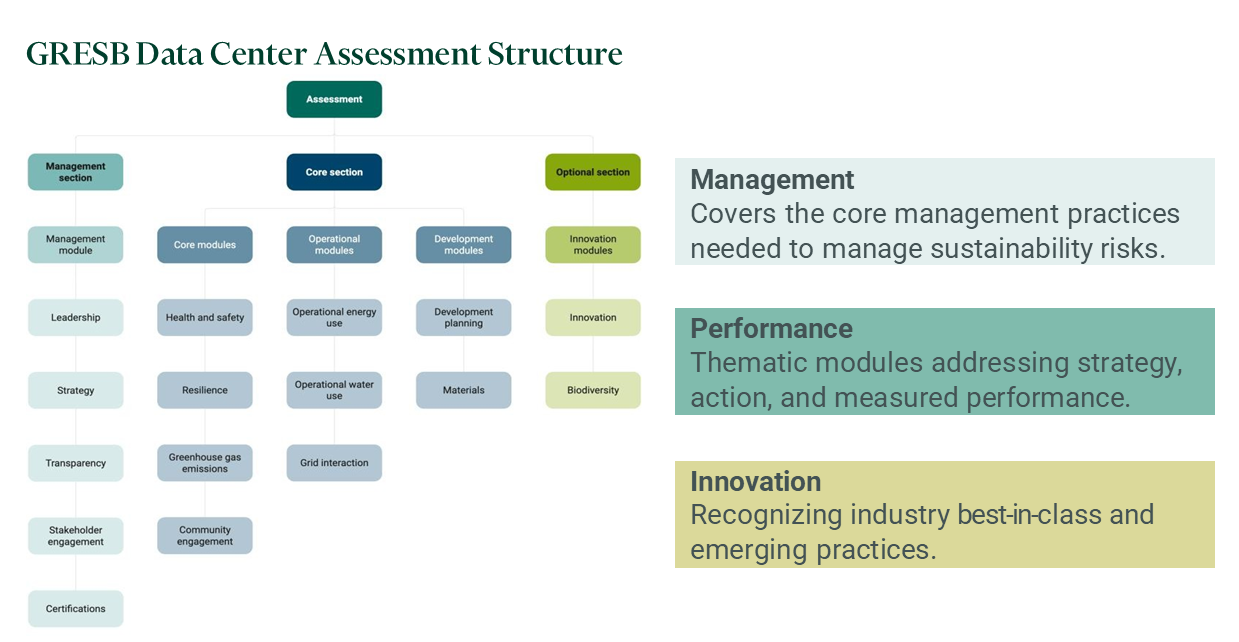
Assessment structure. Source: GRESB
Beyond a score, the Assessment supports real business decisions: securing financing, managing capital investment, engaging with insurers and lenders, attracting and retaining tenants and maximizing asset value. It demonstrates that sustainability and financial performance go hand in hand.
The Next Step
The foundation of any credible data center sustainability strategy is reliable data. Accurate, audited measurement of energy and water consumption, greenhouse gas emissions calculations, and independently verified efficiency metrics are the minimum requirement for accessing institutional capital as well as green finance through banks. By completing the GRESB assessment, operators are also better positioned to satisfy the requirements of major technology tenants.Operators with strong data foundations in place can expect to complete their first submission for a GRESB Data Center Assessment within six months. Those with less advanced data systems face a 12-to-18 month pathway.
For investors and asset managers, the question is straightforward: do your data center assets have an independently verified sustainability score, and if not, how are your institutional investors and partners comparing them against those that do?
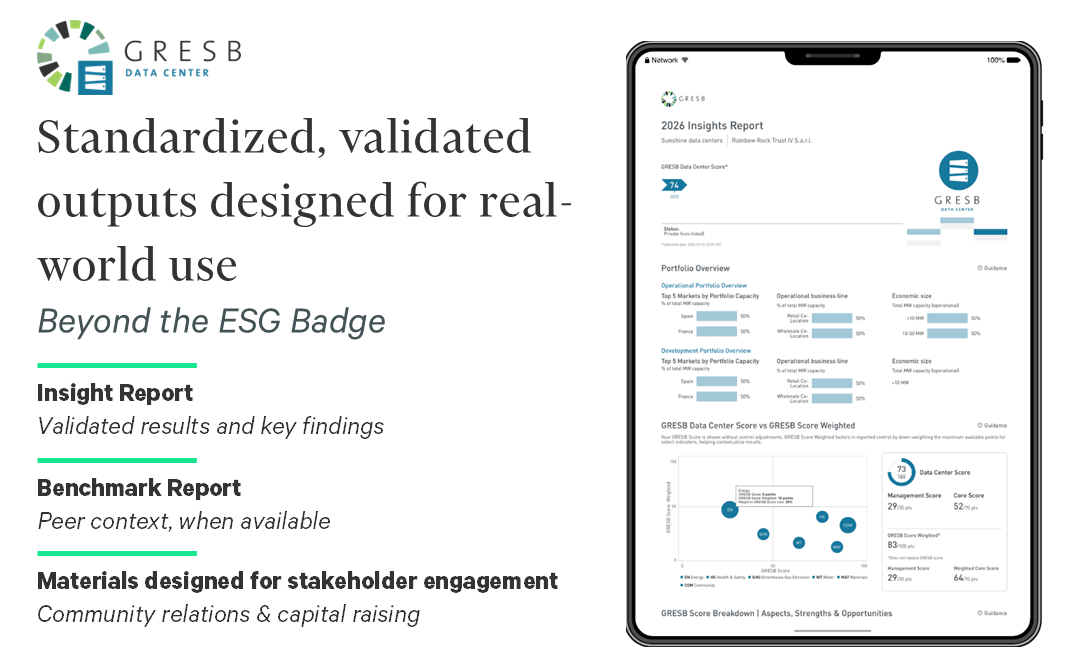
GRESB Insight Report. Source: GRESB
References
[1] PwC. (2023). PwC Asia Pacific data centers: Clean energy gap 2025 (Rep.). https://www.pwc.com/gx/en/asia-pacific/pwc-asia-pacific-data-centers-clean-energy-gap-2025.pdf
[2] Global Electronics Council. (2026). The shifting global policy landscape for sustainable data centers. https://globalelectronicscouncil.org/blog/the-shifting-global-policy-landscape-for-sustainable-data-centers/
[3] CBRE Research. (2026). 2026 Asia Pacific Data Center Trends & Outlook. CBRE. https://www.cbre.com/insights/reports/2026-asia-pacific-data-centre-trends-and-outlook