Valuer Insights
Business Insights | The Strategic Decarbonization Model for Hong Kong Real Estate
March 24, 2026

Contact
Jiwon Choi
Senior Manager, ESG, Valuation & Advisory Services, Hong Kong

Sustainability in Hong Kong real estate has evolved beyond annual ESG reports and token green features. As we move through 2026, we have entered the era of operational risk management and capital preservation. For asset managers, the question is no longer whether decarbonization is a “nice-to-have,” but whether assets risk stranding in a market increasingly shaped by tenant preferences, investor mandates, and tightening rules.
According to Hong Kong Green Building Council, Hong Kong’s buildings consume about 90% of the city’s electricity and contribute around 60% of its carbon emissions, primarily through cooling demands in a hot, humid subtropical climate. The Buildings Energy Efficiency (Amendment) Ordinance 2025, with its phased implementation—including shorter five-year audit cycles and expanded coverage starting September 2026—signals accelerating regulatory pressure alongside the city’s Climate Action Plan 2050.
Strategic decarbonization offers a pathway for asset managers to navigate this transition. The journey follows three distinct stages: Assess, Implement, and Scale.

A robust assessment goes beyond standard energy audits. It requires a Net Zero-Readiness Analysis that maps carbon performance against the 1.5°C pathway. The output of this phase isn't just a kilowatt-hour figure; it is a date: the CRREM (Carbon Risk Real Estate Monitor) Misalignment Year. This is the specific year when an asset’s carbon emissions will exceed its fair share of the global carbon budget, rendering it non-compliant with Paris Agreement targets and, increasingly, unattractive to top-tier tenants.
For an institutional fund, this assessment acts as a "Go/No-Go" gate in the due diligence process. Assets should be categorized into clear risk levels:
Identifying these risks early prevents the acquisition of a "carbon liability" and allows deal teams to factor the necessary decarbonization costs directly into the underwriting model.
According to Hong Kong Green Building Council, Hong Kong’s buildings consume about 90% of the city’s electricity and contribute around 60% of its carbon emissions, primarily through cooling demands in a hot, humid subtropical climate. The Buildings Energy Efficiency (Amendment) Ordinance 2025, with its phased implementation—including shorter five-year audit cycles and expanded coverage starting September 2026—signals accelerating regulatory pressure alongside the city’s Climate Action Plan 2050.
Strategic decarbonization offers a pathway for asset managers to navigate this transition. The journey follows three distinct stages: Assess, Implement, and Scale.
Step 1: Assess – The Reality Check
The first step is not replacing equipment; it is buying clarity.A robust assessment goes beyond standard energy audits. It requires a Net Zero-Readiness Analysis that maps carbon performance against the 1.5°C pathway. The output of this phase isn't just a kilowatt-hour figure; it is a date: the CRREM (Carbon Risk Real Estate Monitor) Misalignment Year. This is the specific year when an asset’s carbon emissions will exceed its fair share of the global carbon budget, rendering it non-compliant with Paris Agreement targets and, increasingly, unattractive to top-tier tenants.
For an institutional fund, this assessment acts as a "Go/No-Go" gate in the due diligence process. Assets should be categorized into clear risk levels:
- No Risk: Future-proof assets aligned with 2050 targets.
- Low Risk: Manageable through minor operational tweaks.
- Medium Risk: Requires defined CapEx intervention.
- High Risk (Red Flag): Critical issues where the asset requires prohibitive CapEx.
Identifying these risks early prevents the acquisition of a "carbon liability" and allows deal teams to factor the necessary decarbonization costs directly into the underwriting model.
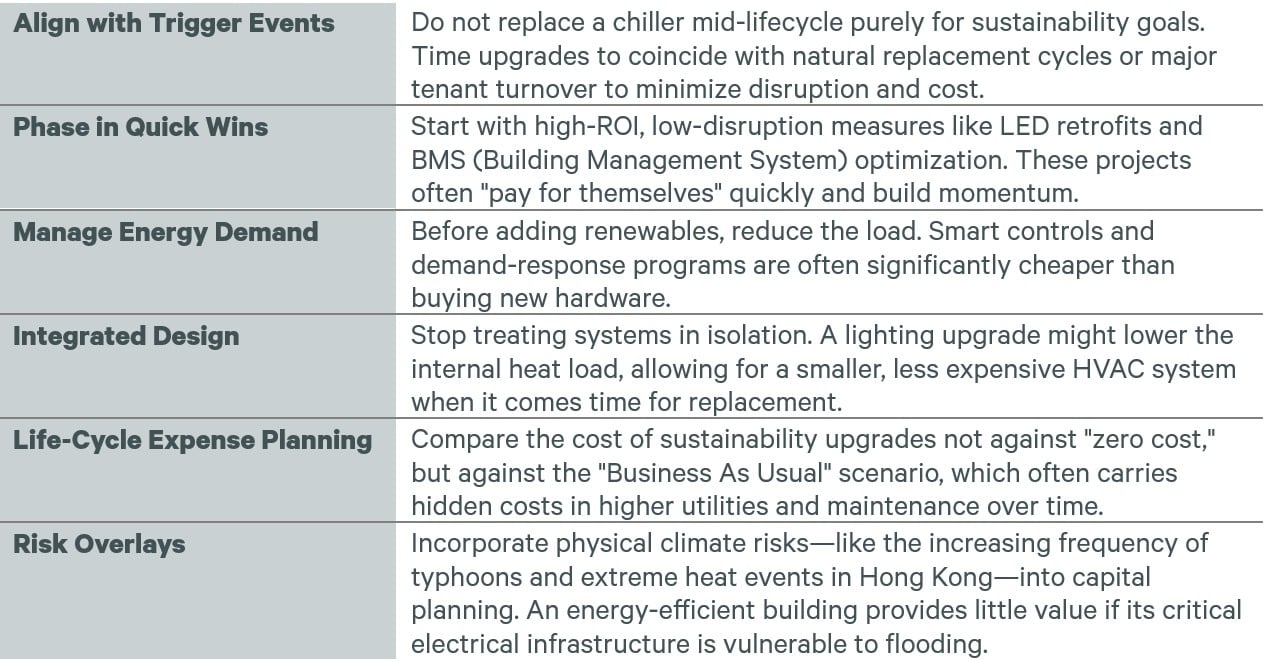
Step 2: Implement – Six Principles of Strategic Decarbonization
Once the baseline is set, we move to implementation. The goal here is to avoid the "CapEx shock" of attempting to replace all systems simultaneously. Instead, asset managers should apply Strategic Decarbonization Planning Principles to smooth the transition:
Step 3: Scale – The Net Zero Playbook
The final challenge for a portfolio manager is consistency. One asset manager might run a fully optimized building, while another struggles with basics. The solution is to move from ad-hoc projects to a Net Zero Playbook.
This serves as a Standard Operating Procedure for decarbonization. It standardizes the approach to retrofits, data collection, and tenant engagement across the portfolio. It ensures that whether an asset is in the logistics, office, or living sector, the approach to "Green Leases" or data sharing remains consistent. Standardization enables comparability of assets and helps make strategic sustainability investment decisions.
Scaling also means addressing sector-specific nuances. In logistics, for example, the conversation has shifted rapidly to EV adoption. Major third-party logistics (3PL) operators now mandate EV charging infrastructure to meet their own supply chain decarbonization targets. A logistics asset without sufficient power capacity for EV fleets is effectively becoming invisible to these top-tier tenants.
This serves as a Standard Operating Procedure for decarbonization. It standardizes the approach to retrofits, data collection, and tenant engagement across the portfolio. It ensures that whether an asset is in the logistics, office, or living sector, the approach to "Green Leases" or data sharing remains consistent. Standardization enables comparability of assets and helps make strategic sustainability investment decisions.
Scaling also means addressing sector-specific nuances. In logistics, for example, the conversation has shifted rapidly to EV adoption. Major third-party logistics (3PL) operators now mandate EV charging infrastructure to meet their own supply chain decarbonization targets. A logistics asset without sufficient power capacity for EV fleets is effectively becoming invisible to these top-tier tenants.
Science-based Standards: Implications for Hong Kong
While we execute this local strategy, global standards continue to evolve and raise the bar. The Greenhouse Gas Protocol is currently updating emissions accounting guidance for purchased electricity, heating and cooling (Scope 2). The International Organization for Standardisation (ISO) is in the process of creating a verifiable Net Zero standard. The Science Based Targets initiative (SBTi) is currently updating its Net Zero Standard and, in 2024, released the latest Buildings Sector Criteria to promote a “whole building” approach, emphasize deep emissions reductions, and impose stringent limits on fossil fuel use, pushing the importance of electrification and renewable integration.
For Hong Kong operators, this creates distinct challenges. The city’s grid—dominated by two vertically integrated utilities—offers limited options for direct renewable procurement compared to Europe or North America. Power Purchase Agreements and high-quality renewable energy certificates remain constrained, making it difficult to comply with new standards.
Consequently, energy efficiency and EUI (Energy Use Intensity) reduction become paramount. Funds with global SBTi-aligned portfolios must engineer deeper retrofits in Asia rather than relying on offsets or renewable power. This reality reinforces the need for the Assess-Implement-Scale pathway: precise measurement, strategic upgrades, and portfolio standardization.
For Hong Kong operators, this creates distinct challenges. The city’s grid—dominated by two vertically integrated utilities—offers limited options for direct renewable procurement compared to Europe or North America. Power Purchase Agreements and high-quality renewable energy certificates remain constrained, making it difficult to comply with new standards.
Consequently, energy efficiency and EUI (Energy Use Intensity) reduction become paramount. Funds with global SBTi-aligned portfolios must engineer deeper retrofits in Asia rather than relying on offsets or renewable power. This reality reinforces the need for the Assess-Implement-Scale pathway: precise measurement, strategic upgrades, and portfolio standardization.
Conclusion
Strategic decarbonization is fundamental to asset liquidity, tenant retention, and access to capital in a sustainability-conscious investment landscape. By rigorously assessing stranding risks, implementing upgrades through proven principles, and scaling via disciplined playbooks, Hong Kong funds and landlords can transform regulatory pressure into a source of enduring value.