Article | Creating Resilience
Net zero assets are increasingly critical for logistics occupiers, driven by their own corporate commitments
November 13, 2025 4 Minute Read

The European Union (EU) has a goal to transform the existing building stock into a zero emission building (ZEB) portfolio by 2050. This is underpinned by the EU’s regulatory transformation, beginning with the requirement for nearly-zero energy buildings (NZEBs) in all new construction from 2020 onward. This ambitious shift towards decarbonisation is profoundly reshaping the commercial real estate landscape, creating both opportunities and risks for investors and property owners.
The recast Energy Performance of Buildings Directive (EPBD), ratified in May 2024, represents a substantial enhancement of energy performance stipulations for new builds. This directive mandates a transition to ZEBs, commencing in 2028 for publicly owned new buildings and subsequently extending to all new constructions by 2030. The ZEB designation, as defined within the revised directive, is contingent upon the absence of on-site carbon emissions derived from fossil fuels and the demonstration of a high energy performance profile.
The revised EPBD also mandates the phased implementation of minimum energy performance standards (MEPS) for the existing building stock, contingent upon nationally determined benchmarks. This regulatory approach is intended to stimulate the renovation of the least energy-efficient buildings, specifically targeting the worst-performing 16% by 2030 and the worst-performing 26% by 2033. Buildings are classified into broad categories for the assessment of energy performance (outlined in Annex I of the revised EPBD), but the potential for significant variations in energy consumption means the application of building use sub-categories is crucial for a more nuanced and accurate evaluation. For example, the primary category "Industrial & Logistics" may be further subdivided into sub-categories such as "Warehouses," "Distribution Centers," and "Cold Storage Facilities," thereby enabling a more precise characterisation of energy demands and operational profiles.
Capital allocation strategies are adapting to a changing regulatory landscape
For investors and property owners, adaptation to the evolving regulatory landscape starts with strategic capital allocation to enhance both property valuation and market appeal while reaching the decarbonisation mandates. This includes substantial investments in comprehensive building renovations, the integration of renewable energy systems, and the deployment of electric vehicle (EV) charging infrastructure.
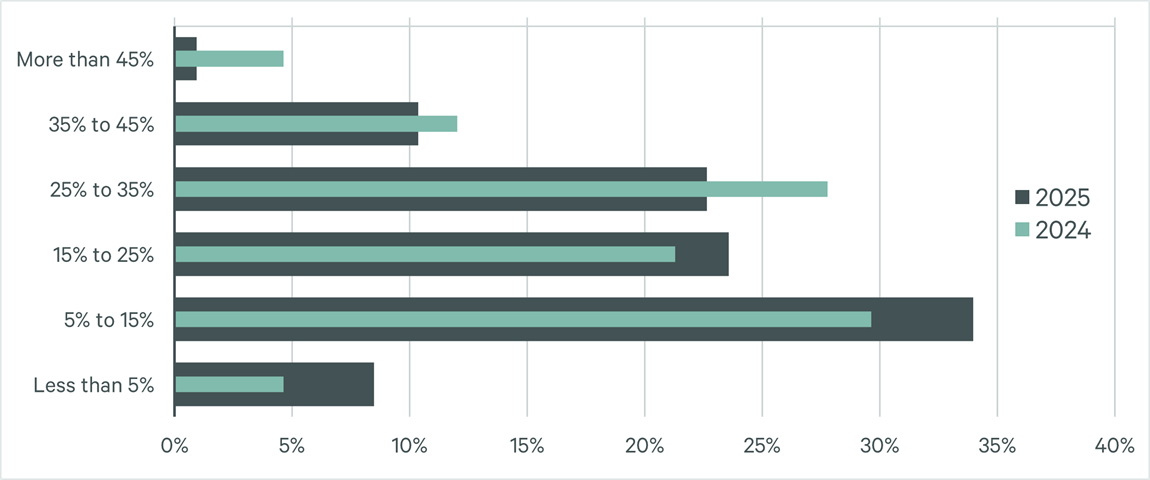
The risk of assets becoming obsolete is increasing, driven, in part, by a shift in occupier preferences towards properties with robust sustainability performance. While the CBRE 2025 Logistics Occupier Survey suggests a year-over-year decline in the proportion of occupied space that occupiers perceive as vulnerable to obsolescence by the year 2030, this doesn’t tell the whole story. This trend could be attributable to strategic occupier behaviour, wherein elevated vacancy rates are leveraged to facilitate relocation to properties that align more favourably with their corporate sustainability objectives, or a realignment of sustainability targets.
Figure 1: Percentage of occupiers’ footprint that will become obsolete by 2030 without significant investment
Source: European Logistics Occupier Survey 2025, CBRE and Analytiqa
Note: Weighted average, using the middle point from each range given. For the extremes, the internal point of the range was used.
Sustainability targets are still in focus, but delayed for logistics sector
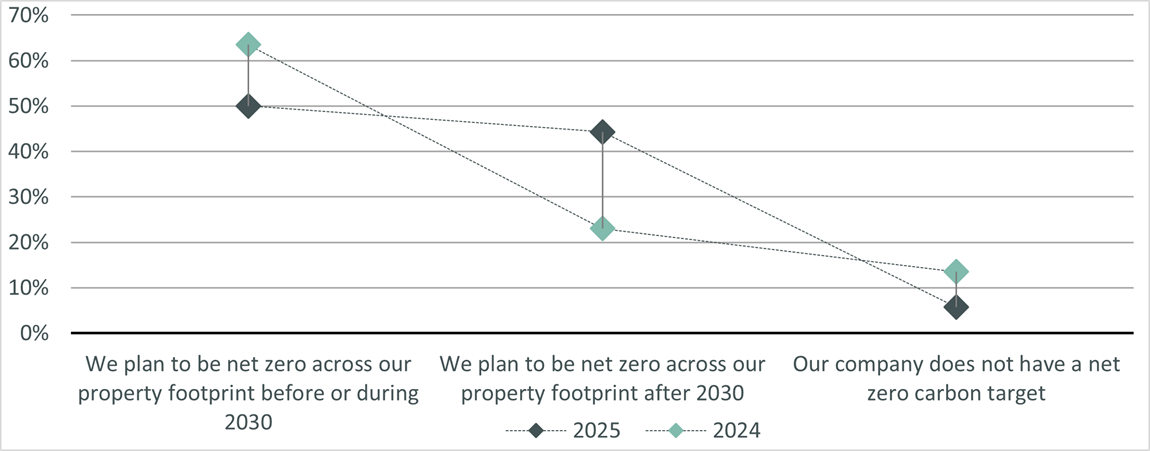
A significant proportion of occupiers (50%) expressed intentions to achieve net zero emissions by 2030, with the logistics sector notably indicating a postponement of these targets relative to the previous year. This shift may be indicative of a heightened awareness of the substantial capital expenditure required to achieve net zero goals, particularly considering regulatory pressures. Consequently, occupiers are increasingly engaged in the development of more detailed and pragmatic climate transition plans, with 37% of respondents reporting the completion of fully costed portfolio transition strategies.
Furthermore, corporations are facing the complex challenges of adhering to rigorous climate action mandates established by regulatory entities while also fulfilling voluntary interim emissions reduction goals.
Figure 2: Percentage of occupiers based on the timings of their net zero carbon targets
Source: European Logistics Occupier Survey 2025, CBRE and Analytiqa
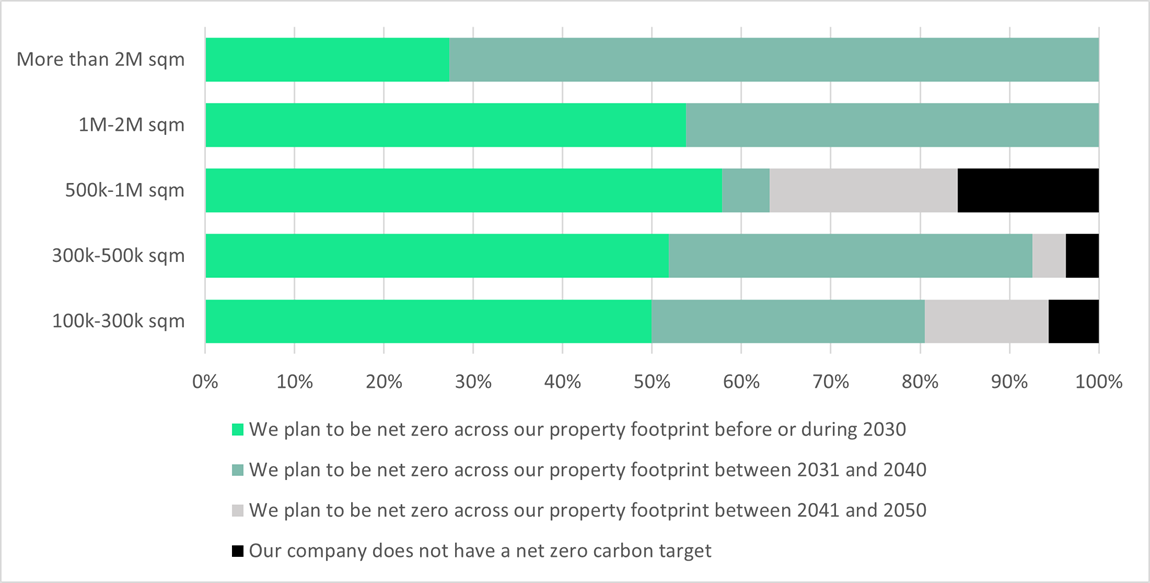
Despite this observed delay, a greater proportion of surveyed respondents now report formally adopted carbon targets. A positive correlation is evident between organisational size and commitment to certain timelines. Specifically, all respondents occupying over 1m sq mof logistics space within Europe have established net zero goals with a target date of 2040 or earlier.
Figure 3: When has your company stated it will achieve Net Zero for its property portfolio? (select one):
Source: European Logistics Occupier Survey 2025, CBRE and Analytiqa
Note: net zero targets covering operations and/or Scope 1 & 2 emissions often include the property portfolio.
Green Leases foster collaboration in the built environment
For occupiers to deliver on their corporate net zero commitments, a collaborative framework guiding actions of property owners and relevant service providers is needed. Green Leases can facilitate such collaboration, specifically through the codification of operational protocols designed to enhance energy efficiency and promote carbon reduction within building operations. The structural composition of a Green Lease is diverse; it may manifest as a comprehensive, independent document or, alternatively, as a discrete section integrated within a broader master lease agreement. In essence, a Green Lease typically delineates the parameters of data, energy management, electrification, transportation, zero waste and circularity, among other ways to optimise the sustainable performance of leased properties, contributing to objectives of both property owners and occupiers.
A notable 37% of respondents reported formalised green lease clauses across their logistics portfolios, suggesting an emerging trend towards standardised sustainability considerations within the sector.
Figure 4: Green Lease implementation across sectors

Source: European Logistics Occupier Survey 2025, CBRE and Analytiqa
Net zero facilities command premiums
The alignment of stakeholder interests and timeframes presents a critical challenge for occupiers, arising from potential discordance between their objectives and those of property owners. Such misalignment may impede occupiers' capacity to achieve their sustainability objectives, particularly in markets where suitable real estate options are scarce and could contribute to accelerated obsolescence concerns for certain property owners and investors.
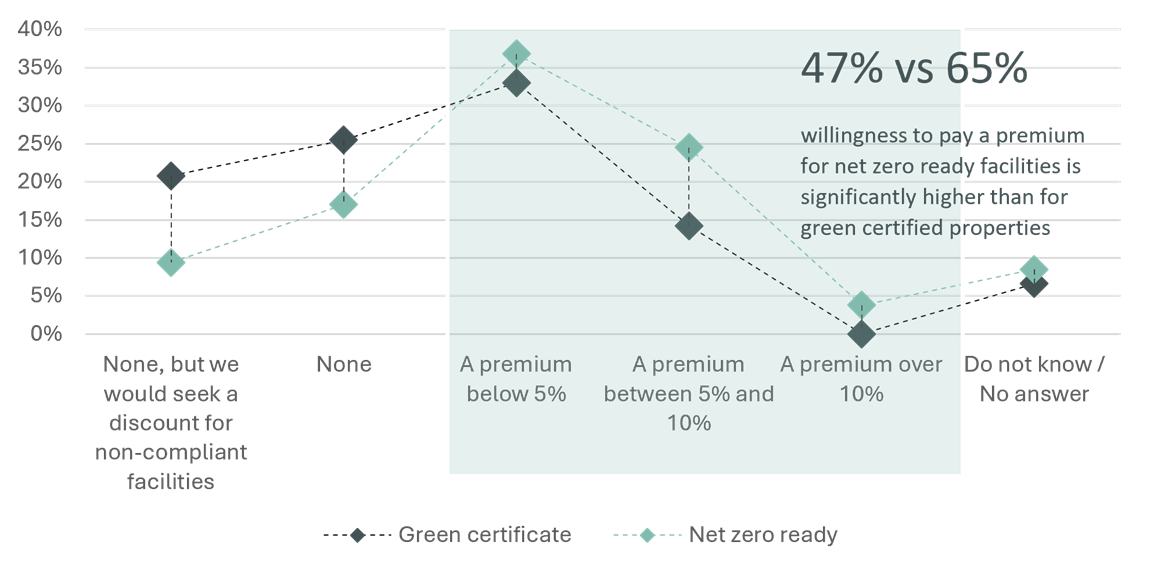
Survey findings highlight a marked increase in the significance of sustainability ratings and building power supply as determinants in occupier building selection criteria since 2023. This trend diverges from observed delays in the implementation of sustainability targets and is further validated by occupiers' willingness to pay rental premiums for assets aligned with their strategic objectives. Building upon prior surveys, the data indicates sustainability certification is a baseline expectation among occupiers. This shift is evidenced by a diminishing propensity to pay rental premiums for certified properties, coupled with a corresponding increase in the proportion of respondents seeking rental discounts for non-certified buildings.
Conversely, a heightened demand is observed for net zero facilities. A significant segment of respondents expressed a predisposition to pay a premium for properties characterised by the absence of fossil fuel energy dependency and the utilization of renewable energy sources. This preference may be partially attributed to the potential for operational cost reductions associated with such infrastructure.
Figure 5: Rent premium over market rent for a green certified facility vs a net zero facility
Source: European Logistics Occupier Survey 2025, CBRE and Analytiqa
Going forward
The EU’s focus on building decarbonisation through regulation is a transformation that necessitates strategic investments in energy efficiency, renewable energy, and EV infrastructure.
While the logistics sector shows a nuanced response, with some occupiers delaying net zero targets, a clear trend towards formalising and driving progress on sustainability goals is evident. Green leases serve as a key collaborative tool to facilitate cooperation between owners and occupiers to realize these goals.
The increasing demand for net zero facilities and the shift in occupier preferences, with a willingness to pay premiums for properties with strong credentials, underscores the growing importance of sustainability as a core market driver. Ultimately, the alignment of stakeholder interests and a proactive approach to decarbonisation will be crucial for mitigating obsolescence risk and ensuring long-term value creation in the evolving European commercial real estate market.
For the full analysis, explore our 2025 European Logistics Occupier Survey.
Contacts



Related Insights

CBRE's fifth edition of the European Logistics Occupier Survey engaged over 100 of Europe's largest logistics occupiers from various sectors, providing valuable...