Creating Resilience
North-South Freight Gains Ground in North American Logistics
November 16, 2026 4 Minute Read
Key Insights
- Growing cross-border trade, new rail connections and border infrastructure investment are linking Mexican production centers more directly to U.S. and Canadian markets. These routes are joining established East-West lanes to form a network that gives shippers more ways to move goods across the continent.
- Dallas-Fort Worth, Chicago and Kansas City are attractive markets for distribution due to their location at the nexus of major highway, rail and intermodal systems. This enables occupiers to reach several freight corridors and large population centers, as well as adjust how they move goods when sourcing, costs and trade conditions change.
- Canadian Pacific Kansas City’s (CPKC) single-line railway and the second span of the Patrick J. Ottensmeyer International Railway Bridge in Laredo, TX, have expanded cross-border capacity. While several markets along these corridors are experiencing industrial demand growth, Kansas City has shown the clearest evidence of demand associated with expanding North-South rail connectivity.
- The preferences available through the United States-Mexico-Canada Agreement (USMCA) support North American sourcing. However, the USMCA is now subject to annual policy reviews and its future is uncertain. This, coupled with overlapping tariffs, is slowing some occupiers’ long-term decisions.
- For occupiers and investors, access to multiple gateways, transportation modes and freight corridors can provide greater flexibility as trade patterns, transportation costs and sourcing strategies evolve.
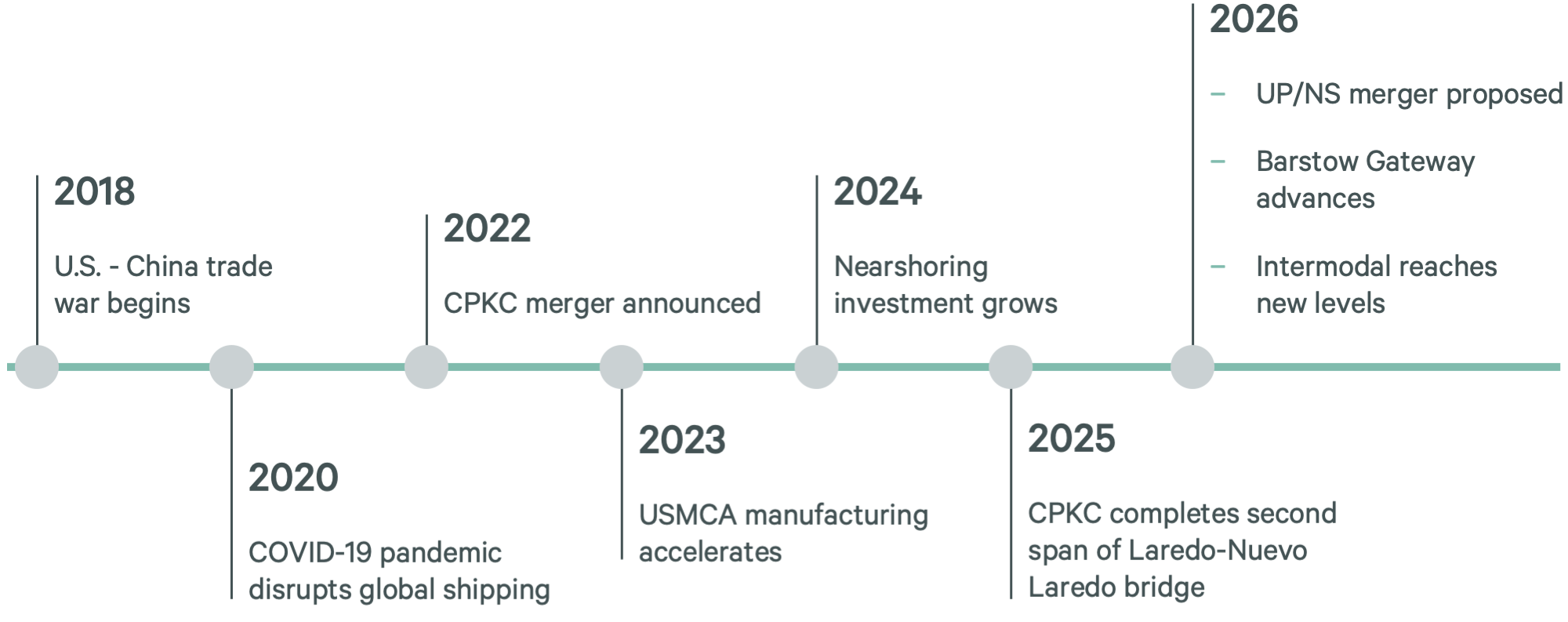
Figure 1: Timeline of Key Events Shaping North American Supply Chains (2018–2026)
U.S.-Mexico Trade Is Expanding North-South Supply Chains
West Coast ports remain a major gateway for imports, with goods moving inland by truck or rail. However, cross-border trade growth and infrastructure investment are expanding the number of North-South routes available to shippers, even as trade policy uncertainty stands to hinder projects along this freight network in the medium term.
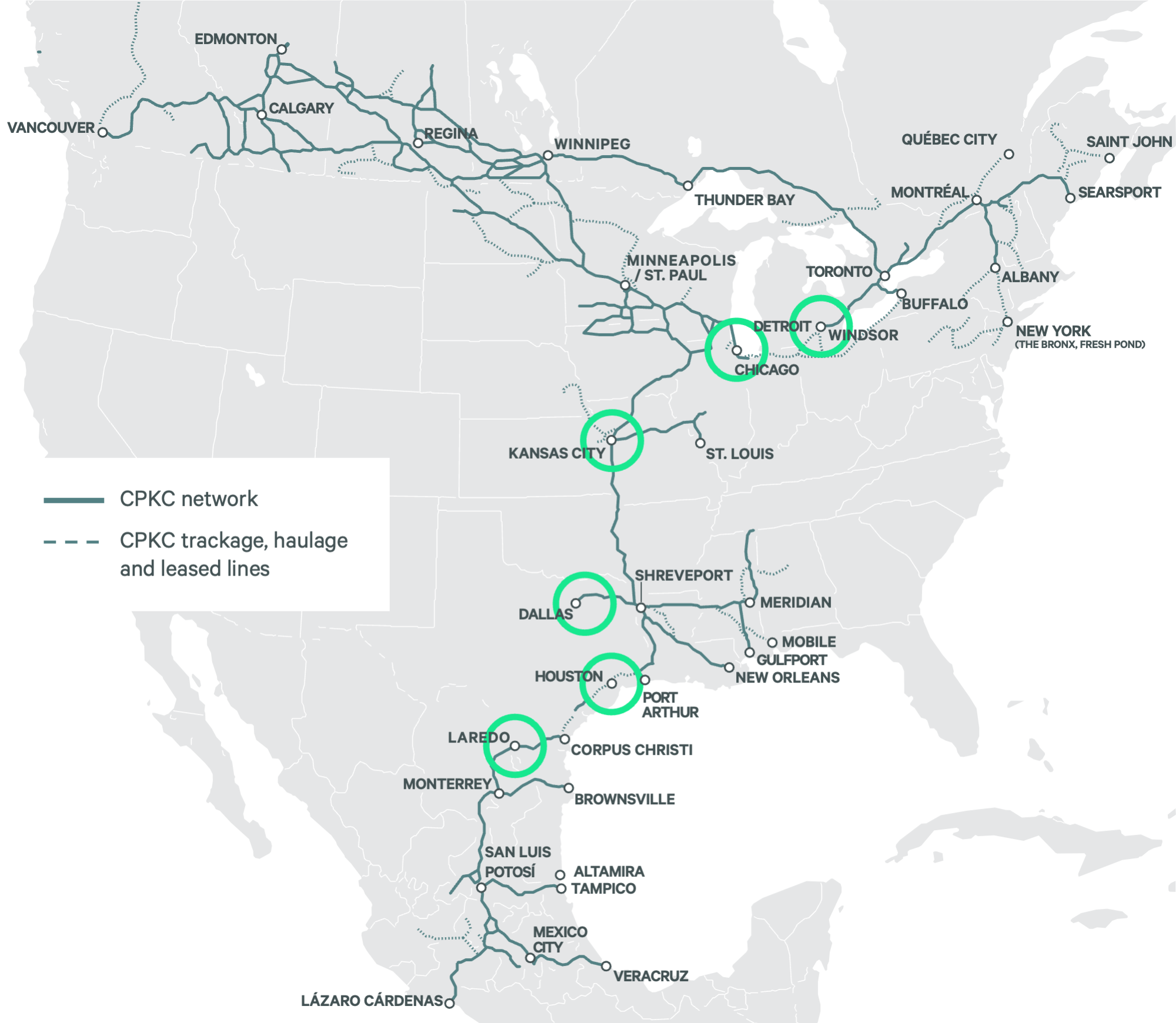
Mexico’s integral role in U.S. trade is driving investment in North-South supply chains. U.S.-Mexico goods trade totaled approximately $493.7 billion in the first half of 2026, with imports from Mexico reaching $298.2 billion or 17.1% of total U.S. goods imports, according to the U.S. Census Bureau. At the same time, the creation of the Canadian Pacific Kansas City (CPKC) railway and continued investment in cross-border infrastructure have strengthened connections between Mexican production centers and major U.S. and Canadian logistics markets.
Rather than replacing established trade lanes, these North-South routes are more integrated with the existing freight network, connecting ports, border crossings, rail lines and inland distribution hubs in all directions. As a result, markets at the intersection of these networks are seeing increased demand for industrial real estate.
Trade policy will dictate how fast North-South supply chains develop in the next few years. The United States-Mexico-Canada Agreement’s preferential treatment for qualifying goods pulls sourcing toward North America, but companies may hesitate to sign long-term industrial leases given frequent trade policy reviews and overlapping tariffs. That uncertainty could hold back new investment, slowing manufacturing and logistics projects along North-South supply chain routes.
Even so, the long-term outlook for real estate remains strong. Mexico’s trade relationship with the U.S. is extensive and deeply integrated, making it difficult to unwind established supply chains. The growing North-South freight network stands to increase the amount of goods moving across the border and accelerate demand for industrial and logistics space once trade policy stabilizes.
Why it matters: The expansion of North-South freight networks reflects a long-term shift that will take time to develop. Policy stability, freight growth and infrastructure usage will help determine how quickly additional trade and capital investment drive increased demand for industrial real estate.
Figure 2: Canadian Pacific Kansas City Railway Route
Freight Flows Reach More North American Ports
Recent port activity shows that shippers are using a wider range of North American gateways to move goods across the continent, although recent trends do not indicate a widespread shift away from established U.S. ports.
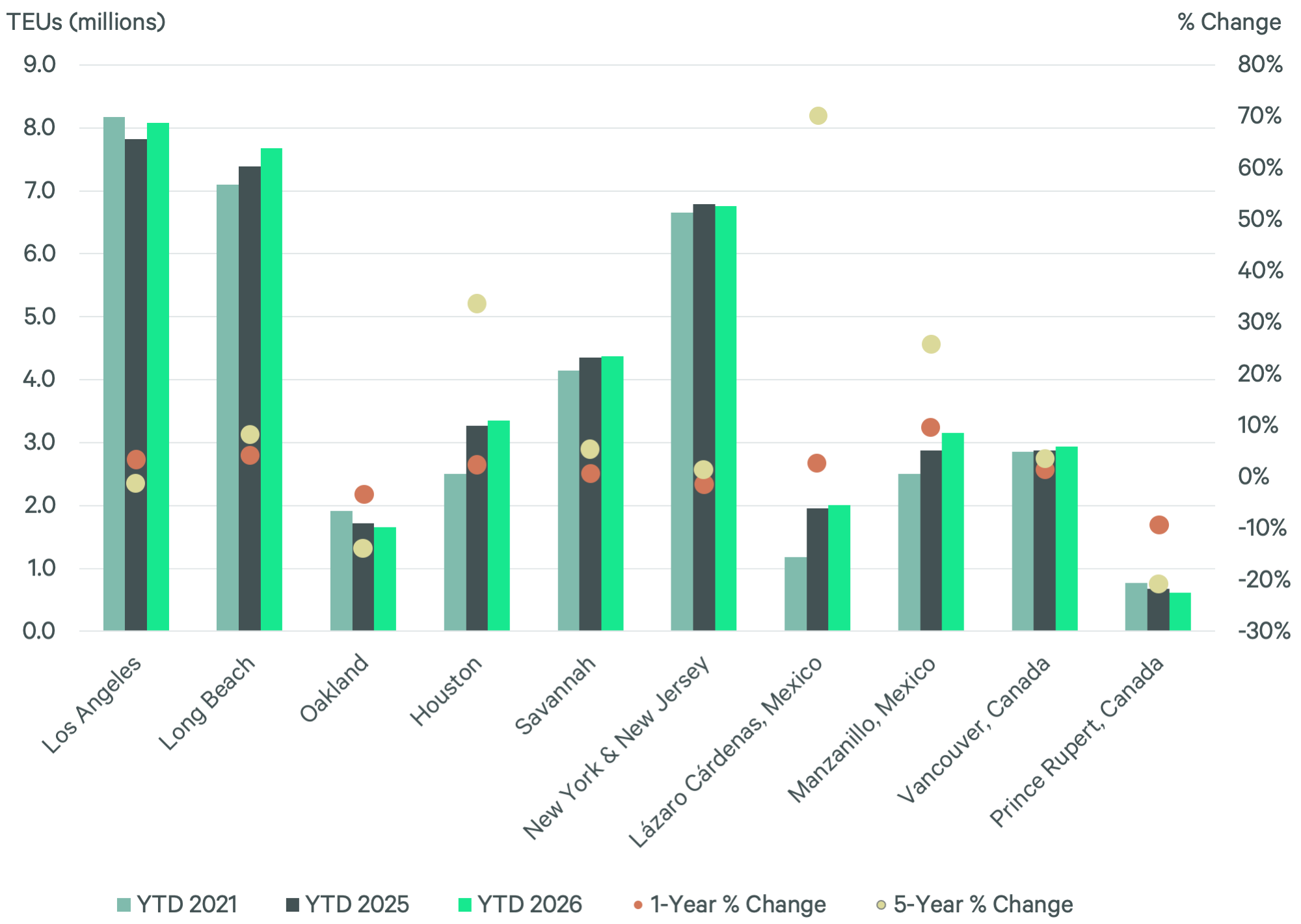
In the first three quarters of 2026, the ports of Los Angeles and Long Beach handled approximately 8.1 and 7.7 million twenty-foot equivalent units (TEUs), respectively. Both ports saw year-over-year volume growth, while Long Beach’s volume was also 8.2% above the same period in 2021. These figures reinforce Southern California’s continued importance to trans-Pacific trade.
Several alternative gateways continue to play an important role in North American freight networks, with some recording significant volume growth through Q3 2026 compared with the same period in 2021. The Port of Lázaro Cárdenas in Mexico handled approximately 2 million TEUs, up by 69.9%, while the Port of Manzanillo on Mexico’s Pacific Coast handled 3.2 million, up by 25.7%. Port Houston handled 3.3 million TEUs, up by 33.6%.
Container volume trends varied across the remaining ports. Volumes in Savannah and Vancouver increased both year-over-year and from the same period in 2021 but declined in Oakland and Prince Rupert over both periods. These patterns point to diversification rather than displacement, with established gateways maintaining their importance as additional ports expand the range of freight routing options across North America.
Why it matters: Gateway diversification is expanding routing options without diminishing the role of established U.S. ports. A broader network can provide occupiers with additional flexibility when transportation costs, capacity constraints or trade conditions change.
Figure 3: Cargo Container Volumes by Port, YTD 2021, 2025 & 2026
Industrial Demand Builds at Key Freight Connections
Industrial real estate demand has historically been influenced by population growth, building characteristics, cost containment and access to transportation infrastructure. However, occupiers today are increasingly evaluating speed to market and operational continuity when selecting a location.
This shift has made freight connectivity more important for occupiers as they seek greater transportation flexibility. Instead of relying on a single gateway or transportation mode, companies are positioning inventory in markets that provide access to multiple freight corridors. Doing so allows their supply chains to adapt more efficiently as sourcing strategies, transportation costs and consumer demand evolve.
Markets like Dallas-Fort Worth and Chicago are taking advantage of this new strategy. Dallas-Fort Worth’s central location checks off traditional occupier needs and enables them to deploy multiple gateway supply chain strategies. Chicago offers many of the same advantages, along with additional rail capabilities, extensive intermodal infrastructure and access to major population centers.
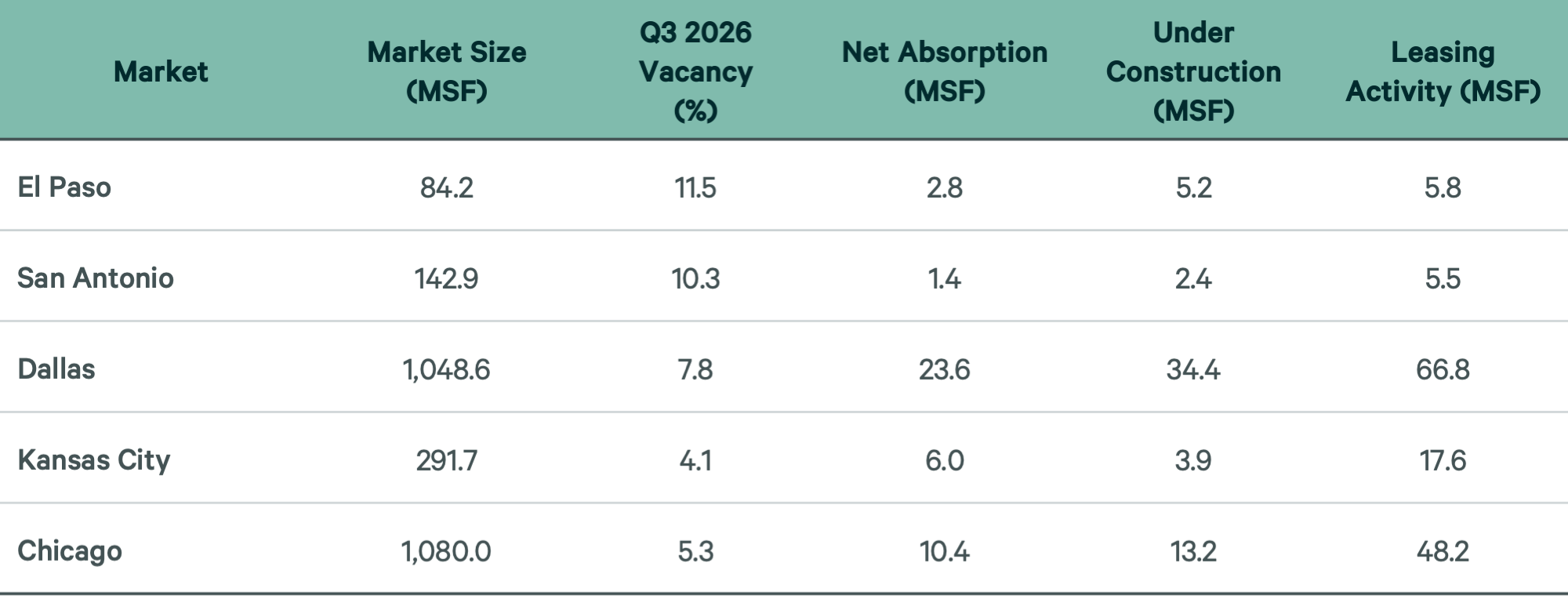
Emerging markets are also benefiting. Kansas City’s industrial vacancy rate of 4.1% in Q3 2026 was the lowest among the five corridor markets (Figure 4), suggesting that demand continues to outpace new supply. El Paso’s 2.8 million sq. ft. of net absorption through Q3 2026 reflects the market’s growing role in cross-border manufacturing and distribution, while San Antonio continues to strengthen its position as an important connection between South Texas and the rest of the state.
Why it matters: The strongest logistics markets are increasingly those where major freight networks intersect. Market scale, transportation connectivity, available capacity and sustained industrial real estate demand will determine which markets will benefit the most as the North-South trade network evolves.
Figure 4: North-South Trade Corridor Market Data, YTD Q3 2026
New Rail Connections Give Shippers More Options
Rail investment is expanding shippers’ transportation options along the North-South and East-West routes.
CPKC established the first single-line rail network connecting Canada, the U.S. and Mexico. Additionally, the completion of the second span of the Patrick J. Ottensmeyer International Railway Bridge in Laredo, TX, more than doubled CPKC's cross-border capacity. Lastly, recent upgrades to the Southeast Mexico Express—a joint rail service operated by CPKC and CSX Corporation—have strengthened connections between Mexico and the Southeast.
Meanwhile, the East-West network continues to grow. BNSF and CSX added coast-to-coast intermodal services, BNSF is advancing the Barstow International Gateway in California and the proposed Union Pacific-Norfolk Southern merger, if approved, would create a single coast-to-coast rail network. Together, these investments create a freight system with several strong routes rather than one dominant corridor.
As trucking availability tightens and operating costs rise, intermodal rail may become more competitive for longer-distance shipments with predictable schedules. For industrial occupiers, improved access to rail and intermodal terminals could add flexibility to their distribution networks, but this depends on reliable service and alternative transportation modes.
It's too early to determine how much these rail connections will impact companies’ location decisions. CPKC's network now links Mexico directly to the Midwest, yet real estate demand associated with these rail connections remains limited to a few key Midwest hubs, primarily concentrated in Kansas City. A broader impact would become clearer if freight activity increases and more businesses tied to U.S.-Mexico trade begin setting up operations in other Midwest cities.
Why it matters: More rail routes give occupiers greater flexibility in site selection, which could gradually drive industrial real estate demand beyond established port and border markets. For now, investors and developers should watch for rising rail volumes and Mexico-linked leasing in inland markets as a signal.
What Changing Freight Patterns Mean for Occupiers and Investors
Over the next several years, the growth of North-South supply chains will depend on trade-policy decisions, Mexico’s ability to absorb more manufacturing investment and the expansion of Mexico-linked rail volumes into more Midwest markets. More policy certainty and rising rail use would likely accelerate investment, while continued uncertainty would slow but not halt network expansion.
For occupiers, the coming wave of lease expirations is an opportunity to position stand-alone facilities as part of a network. Prioritizing facilities with access to multiple transportation modes and corridors can make it easier to respond to changing costs and sourcing patterns without costly relocations.
For investors, the goal is to build portfolios that can perform well as freight flows shift rather than rely on a single corridor. Investors interested in emerging markets can minimize risk by developing in phases and closely tracking rail service, cross-border leasing trends and trade conditions. At the asset level, transportation access, rail connectivity and freight-handling capabilities could become more valuable to certain users, although their impact on rents and tenant retention is not yet clear.
Ultimately, the ability of occupiers and investors to adapt to changing freight patterns will help determine which industrial markets and assets are best positioned for long-term growth.