Intelligent Investment
Smarter Space, Not More Space: How AI is reshaping return‑to‑office planning
April 22, 2026 4 Minute Read

Contact us to Learn More
As organizations accelerate return-to-office strategies, many face a familiar tension: how to accommodate more people while keeping real estate costs under control. Headcount growth, hybrid working patterns and evolving team structures are putting pressure on portfolios that were never designed for today's ways of working.
For occupiers, the challenge isn't simply about adding desks. It's about making smarter use of existing space, testing options quickly and aligning decisions to both business needs and cost constraints — often in real time.
This is where data-driven space planning can unlock immediate value.
Using AI to Turn Complexity into Clarity
CBRE supports occupiers with advanced scenario planning that allows teams to see the impact of space decisions before they are made. Using Ellis AI, CBRE's enterprise AI platform, teams combine portfolio data, workplace strategy and real-time modelling to help clients evaluate multiple options — quickly, collaboratively and with confidence.
One example comes from a global manufacturing client navigating post-COVID return-to-office requirements. The brief was clear: fit more employees into existing office space without expanding the overall footprint.
CBRE's Approach to Visualizing Data
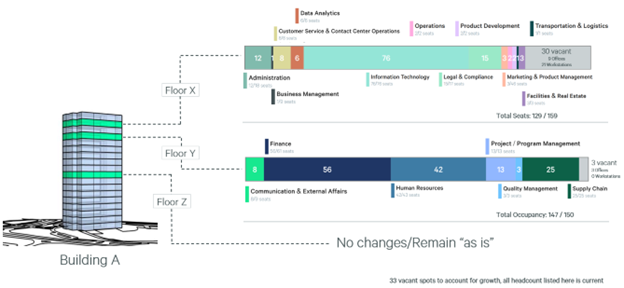
CBRE deployed Occupancy Optimizer, a proprietary AI-enabled tool designed to model space scenarios and stacking plans in real time. Ahead of a live working session, CBRE consultants built a baseline plan with team and building data that addressed the majority of the client's needs.
During a collaborative workshop, CBRE and the client then fine-tuned the plan in under an hour:
- Testing multiple layout and stacking scenarios in real time
- Adjusting assumptions instantly based on live feedback, using the tool's drag-and-drop features
- Refining the solution iteratively until the right balance of capacity, experience and cost was achieved
Because the tool delivers immediate visual outputs, the client was able to move from discussion to decision in a single session — removing weeks from a traditional planning process.
The Outcome
The final solution enabled the client to:
- Accommodate 100% of employees within the existing building
- Add one additional floor without expanding the overall footprint
- Avoid significant capital expenditure and ongoing occupancy costs
- Establish a repeatable planning approach for future change
Just as importantly, the process gave stakeholders confidence in the outcome, supported by data rather than assumptions.
Why it Matters for Occupiers
As portfolios evolve, the ability to model, test and optimize space quickly is becoming a critical capability. AI-enabled planning allows occupiers to respond to change with agility — whether that's return-to-office, growth, consolidation or cost optimization.
CBRE combines technology, insight and advisory expertise to help clients make smarter real estate decisions — turning workplace complexity into clear, actionable solutions.
Related Services
- Manage Properties & Portfolios
Occupancy Management
Leverage occupancy data to empower, anticipate and unlock opportunities within your portfolio.
- Technology
Artificial Intelligence
Discover how CBRE is revolutionizing commercial real estate with AI.