Creating Resilience
The Insurance Industry’s Changing Dynamics and Implications for Corporate Real Estate Organization Design Trends
Financial Services Spotlight
November 20, 2024 4 Minute Read

Helene. Milton.
These are not today’s most popular children’s names, but amid the recent “once in 100 years” hurricanes, these names will not soon be forgotten. Images of the destruction and disruption to lives and businesses reveal the moments when people need the assistance of their community—and their insurance carriers—the most.
In addition to the increased frequency and severity of hurricanes, insurers are increasingly focused on other major forces of industry disruption, including:
- Other climate change-related natural disasters
- Inflation and escalating cost of claims
- Artificial intelligence’s potential disruption to underwriting, actuarial science and customer service
Insurance in the Spotlight: When most people think of the Financial Services sector, the major retail, commercial and investment banks whose logos dominate skylines and streetcorners are often top of mind. However, the diversity of enterprises in the sector encompasses a much broader range of entities, including global and regional insurance carriers. These insurers play a crucial role in global financial markets, providing insurance and investment products and services tailored to unique individual and commercial customer needs. While they share some characteristics with traditional banking institutions, insurance firms have operational complexities shaped by the specific demands of their clientele, the nature of their offerings and the talent and infrastructure required.
Figure 1: CRE Goals and Initiatives

Amid today’s transformative trends, insurance carriers are reevaluating their operating models and financial performance. For Real Estate and Facilities (CRE&F) leaders, this translates into two primary objectives: enabling business operations and driving cost control. CBRE’s recent CRE Organizational Design Study underscores the paramount importance of enhanced business functionality and cost-saving opportunities. While these concerns resonate across all sectors, including Financial and Professional Services (FPS), understanding how Insurance sector CRE&F teams address these themes offers some interesting perspective.
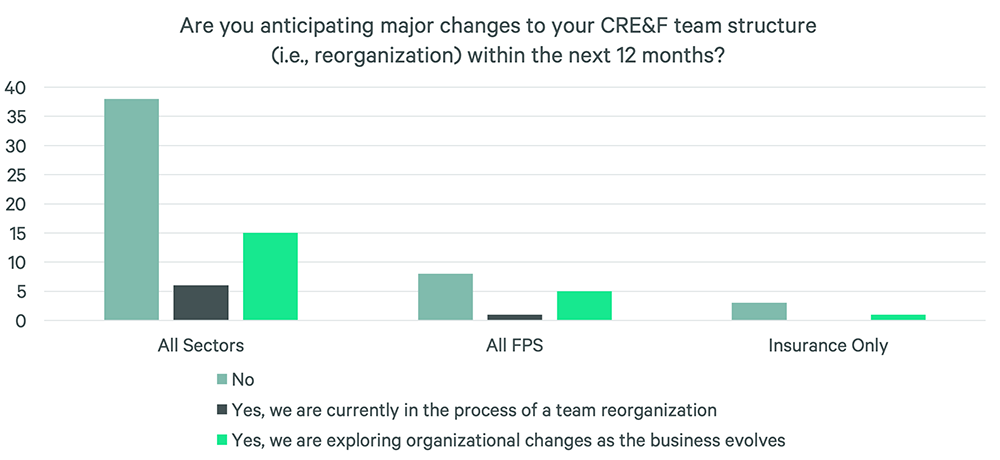
Approaching Change with Cautious Urgency: Measuring risk is a core competency of insurance companies. As such, they tend to take a measured approach to change and move cautiously. Yet currently, about one-third of insurance CRE&F teams are actively considering changes to their operating model, trending proportionally to FPS peers and across all industry sectors. While mid-size carriers exhibit a greater urgency to adapt their business models to current trends, larger carriers tend to adopt a more deliberate approach to change.
Figure 2: Reorganization Trends
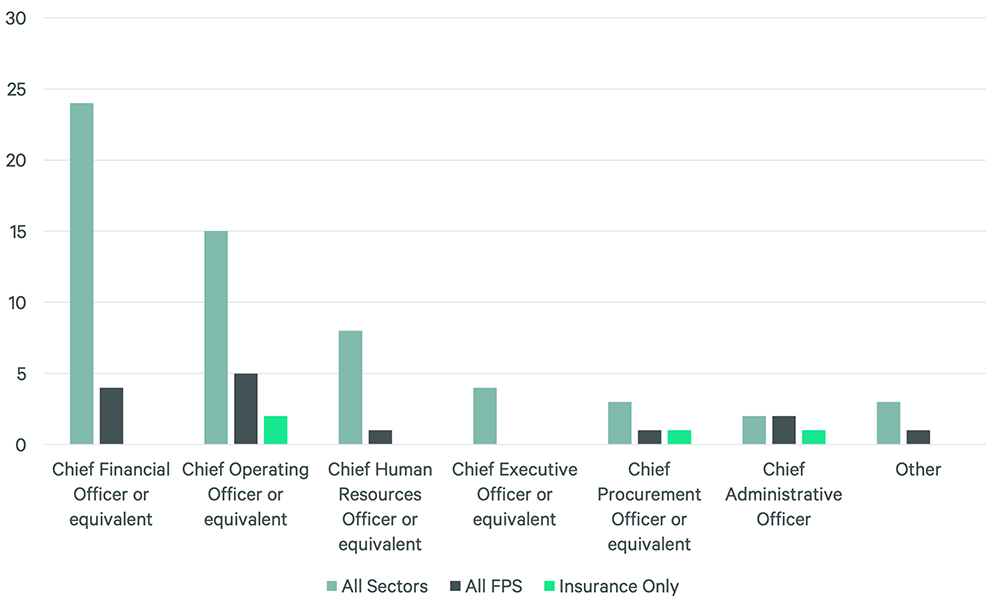
Reporting Alignment Drives Focus and Priorities: The old saying “where you stand depends on where you sit” is certainly true when it comes to where CRE&F organizations report in the corporate structure. Traditionally, CRE&F departments reported to CFOs, as real estate represents a major line item on the income statement. CBRE’s research confirms that 41% of both all survey respondents and FPS respondents report to CFOs, while 29% of respondents report to the COO. However, none of the insurance respondents in CBRE’s research reported to CFOs, perhaps an anomaly. While it is difficult to draw any hard conclusions from this, reporting to the COO or CAO suggests a growing emphasis on close partnership between the business and the real estate team and portfolio.
Figure 3: Internal CRE Team Reporting Structure
Maximizing Efficiency and Economies of Scale: As insurance firms seek economies of scale, particularly with portfolios under 10 million sq. ft., we recognize a difference in the leverage and size of the CRE&F departments. FPS respondents with portfolios of less than 10 million sq. ft. averaged approximately 43,000 sq. ft. per full-time employee (FTE) in the CRE&F organization (internal and Tier 1 service provider combined), whereas the insurance respondents averaged roughly 32,000 sq. ft. per FTE. Considering the asset types that insurance companies occupy—predominantly office and campus facilities, without large, distributed retail portfolios—they and their primary service providers have greater opportunities to self-perform CRE&F services than do other FPS companies. Self-performance enhances service quality and consistency while reducing costs and risk. The efficiency achieved is far greater than any concern over headcount-gearing ratio metrics that do not consider the full supply chain.
Sustainability as a Corporate Imperative: Climate threats are an existential risk to insurance companies, and the entire sector has made very public commitments to limiting climate change for the good of their business, as well as the customers and communities they serve. Many CRE&F leaders in insurance companies are in lockstep with their peers in FPS firms to meaningfully contribute to achieving corporate carbon-neutrality commitments and net zero goals. While the data above (in Figure 1) may downplay the importance of reducing carbon emissions, we know that achieving lower carbon emissions is in fact a core tenet of enabling the business. Moreover, we believe this is particularly vital to insurers given the intrinsic linkage between the business outlook and the future impacts of climate.
The insurance industry is at a critical moment with converging drivers mandating transformation. The sector’s CRE&F leaders are called upon to be a vital strategic partner to the C-suite as they contemplate the role and structure of the workspace to achieve business success. A heightened criticality of strategic vision and alignment with the enterprise will be the hallmark of successful CRE&F teams.
Related Insights
-

More than ever, Corporate Real Estate leaders are redesigning their departments to accommodate an expanded set of priorities and responsibilities.
Related Services
- Transform Business Outcomes
Real Estate Outsourcing Services
Guide transformational outcomes to create tangible value across your portfolio.
- Industry
Banking and Financial Services
Find out how our experts can help you achieve your real estate and property management goals around the world.
Contacts
Mike Hart
President, Global Account Management
