Download Transcript
Spencer Levy
It kicked off in 1996 with a technical t-shirt that was great at keeping athletes cool, dry, and light. That innovation launched the company from humble origins in a Washington, D.C. row house into a global player. On this episode, the real estate story behind the gear and a brand with a recognizable commercial tagline: “Protect this house!”
Kathy Blessington
When you walk through one of our facilities, each of them has that intentionality. We designed them to be able to bring folks through and tell the Under Armour story.
Spencer Levy
That's Kathy Blessington, Global Vice President of Real Estate for Under Armour. Kathy's in charge of a portfolio with some 37 offices, multiple distribution facilities and over 2,000 stores – real estate that's used by more than 15,000 employees worldwide. Kathy joined the company after playing leadership roles at Coca-Cola and Fidelity, among others. So she knows a thing or two about household brand names’ relationships with space. Coming up: a short trip to Under Armour's headquarters in Baltimore to learn about the role of real estate as a teammate for a company's core business. I'm Spencer Levy and that's right now on The Weekly Take.
Spencer Levy
Welcome to The Weekly Take and I'm so happy to have a home game with one of my longtime friends in the business Kathy Blessington for Under Armour. Kathy, welcome to this show
Kathy Blessington
Thanks, Spencer. Glad to be here.
Spencer Levy
So happy to have you here today, Kathy. And Kathy, for the benefit of our listeners, please tell us what you do.
Kathy Blessington
I lead the real estate for Under Armour globally. And basically what that means is that I need to provide the spaces that work for this business both financially and functionally while creating an intentional environment that supports our brand, our teammates and our community.
Spencer Levy
I love that word, intentional, because I think intentional is a synonym for a lot of things. Not to get all fancy talk here in the very first sentence, it’s productivity. You build space so people do better stuff there. Is that a good summary?
Kathy Blessington
That's pretty much spot on.
Spencer Levy
Tell us about the types of real estate that you cover.
Kathy Blessington
Right, so we absolutely have corporate offices in every major one of our regions and in key locations throughout the globe. We have over 2,000 retail stores globally and we have then our supply chain distribution houses that we manage.
Spencer Levy
And you oversee all of that. That's really cool. So office, retail, and industrial. Where are you making your stuff? I know you design it here, but you make it in other places. And how does supply chain work for a company as big as Under Armour?
Kathy Blessington
So yes, our supply chain is very distributed. We make products in the locations where products are best made, and that stems from right here in Baltimore. We have our Lighthouse and innovation space.
Spencer Levy
By the way, I'm not allowed to tape there, but I will tell you, I did walk by it. It is super cool. And if anybody who's listening to this show that owns athletic gear of any type, you would be like a kid in a candy store, just seeing how it's made. It's just super cool what they do there.
Kathy Blessington
Well, here at our headquarters, for the first time in our history, we've brought together our commercial teams, our design teams, innovation teams, and our supply chain teams, all in the same environment. And so this campus is a manifestation of what we do. And so you'll see product being innovated here. We always talk about creating it and breaking it, so we have our testing grounds, which we call the proving grounds, and we have the Lighthouse, which is where we innovate and make product. But we do have partners throughout the world.
Spencer Levy
2,000 retail stores. We've had many episodes on different types of retail. And the retail is constantly evolving.
Kathy Blessington
Yes. We have stores in in 2,000 locations in every major market. Our most recent store we just opened is a flagship store in Tyson's Corner, Virginia where we're telling some new stories that we're really excited about
Spencer Levy
What's the story you want people to know when they walk in the door?
Kathy Blessington
Yeah, I think that what's important for all of our spaces, regardless of what they do, is they have to start with the culture. Who are we and what do we do? And so we refer to ourself as a sports house that's based in performance, as opposed to a fashion house, which is more about style and what's trending. And so our spaces are intended to articulate and bring forward the brand that we celebrate every single day. And we're building less work space, if you will, and creating more collaboration and brand-forward spaces. When you walk through one of our facilities, each of them has that intentionality. We designed them to be able to bring folks through and tell the Under Armour story, both past, present, and future. We look at that kind of in a 70-30 mix, I like to say, in that we want to bring forward our brand in a consistent way, no matter where in the world we're playing. But we want each location to have that 30% to play with the culture of where we are and meet those consumers and those teammates where they are in the location in the word. So really trying to bring authentically forward who we are and then adding the layer of understanding where we and how we show up.
Spencer Levy
I like the way you frame that, Kathy, because I have this conversation every day when I travel globally. And I travel, maybe not quite as much as you do, Kathy. But I travel pretty close. I go into a lot of offices, not just for us, but for other big corporations. And they seem like very similar offices in this market versus that market. What happened to the local? So I like this 70-30 ratio. That's very intentional, isn't it?
Kathy Blessington
It is very. It actually aligns to our strategy on how we bring our products forward. And so everything we do, we try to tick back to strategy. Because real estate isn't just a work space anymore. It's actually a strategic lever. And we are using it in that platform.
Spencer Levy
Wow, you know, we could probably end this interview right here because I tell people all the time, I say, real estate is not a cost center, it's a revenue generator. Is that kind of what we're saying here?
Kathy Blessington
It is. Yeah, I couldn't agree with that more. It's a strategic lever. It drives business forward. It's not just a place for people to come to work. When we think about space, collaboration and flexibility become super important because when you create a space that has the ability to pivot and become whatever the next generation of that needs to be without a huge investment. That's when you've hit nirvana, because you've now created an environment that allows our teammates to do their best work every day.
Spencer Levy
And we talked a little bit about retail in 2,000 locations around the world. We are here now at the global headquarters of Under Armour. I'm proud to say in Baltimore, where we live – great town, underrated – all right, that's enough of that. Just tell me about this complex, because if you see this complex. It's pretty impressive. It's not just office buildings. Tell us about it.
Kathy Blessington
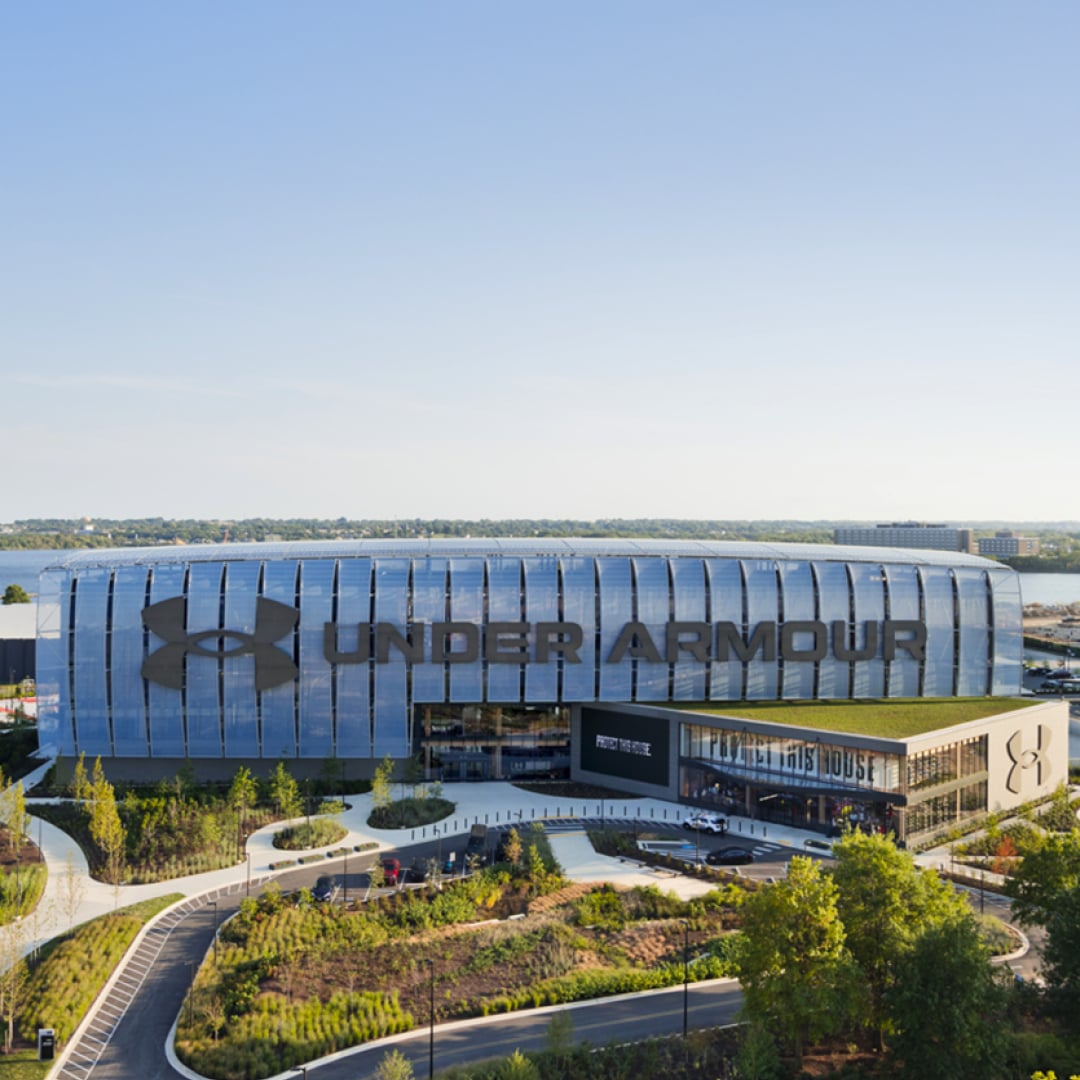
Yeah, so this is actually an ecosystem. It's not a campus. This is something that we created to not stand alone, but to stand together. And when you do that, you can bring forward all of the different organizations within Under Armour that we talked about just a few minutes ago, our commercial teams, our operations teams, our design teams, our innovative teams, et cetera, into a single space where each of the buildings starts to work differently for them. So we've created studio spaces that are intentional in bringing people together, bringing awareness to what we do, and aligning our teams and our guests on what it is that Under Armour does. What are we bringing forward, and then how do we present that to you? We also have what I refer to as design dens, where it's that unplugged space where you get to go and be creative and really test and challenge. What we think norms are, or where the trends need to take us, or what's the next big performance element that we want to apply, not to one product, but to a series of products that allows us to show up as a performance organization in this industry. And so making sure that you have those spaces set up, but that you also allow for those heads down moments where people just need to get away and just crank through some work. It's creating that ecosystem across multiple buildings here. That really makes this a powerhouse in how we perform. And I have one more piece of that, and that's the stadium out front. It's part of that ecosystem. That's where we engage with the community. We bring schools here. We have activations on the field with our emergency fire protection and police officers. We bring colleges and universities here. We have high school athletics here. But we also use that as a testing ground because the track has the plates in it that we can have folks run the laps in our shoes and we can create, or we can collect data that helps inform our Lighthouse on what do we need to break down further and faster and how do we improve what we just learned from that testing ground. And so it's really all of these spaces together throughout this campus that makes this building, or this headquarters,special.
Spencer Levy
There's a full football-lacrosse-athletic field with stands 50 feet from where we're sitting right now. And in addition to the high schools, you also have some lacrosse things going on now. What's going on right now?
Kathy Blessington
Yeah, so we have a lot of lacrosse activity right now. We have clinics. We have teams that come here to practice, and we actually host games on the weekends. And so we do that year round with all different sports, including football. We've had some soccer here. We have track clubs that come and work out with us. It's just a great part of who we are.
Spencer Levy
Moving headquarters. You just moved into this new building in December. That's about as complicated a move as you're gonna have. Can you tell us what were some of the greatest challenges and opportunities of moving buildings?
Kathy Blessington
So it was December a year ago. So about a year ago.
Spencer Levy
About a year ago.
Kathy Blessington
Yep. We were finishing construction and planning for the relocations. And we'd done a tremendous job of communicating and putting out change management practices for our teammates. And I'm going to be honest with you, the biggest challenge was kind of the shell game of who goes first. The building was permitted floor by floor so we could start moving them in as soon as a floor got a C of O. And so we went back to that as our primary schedule, but we had to take into consideration key elements, our go-to-market and our sell-ins, right? You can't interrupt that. They've got to stay at the old site until that work is done. And so then doing that shift and that shell game. But you know what? The Under Armour teams were excited about coming over here. They were excited about the new campus. You heard me talk about the vibe and the energy of our space. That was built intentionally through the environment but our teammates are what bring it to life. And so, yep, we pick people up, 1,200 of them, and we move them from our old campus to the new campus. We got them situated. We set them up with help for a week. For anything that they might have needed support on, we gave tours relentlessly. My team probably to this day is tired from them. Hundreds of tours to our teammates so that they understood not only that workplace, but all the different amenities, the studios, the design dens, the facts of the sustainability that would build energy and excitement around where we were going and why. And so that makes it a lot easier when everybody's excited about getting there.
Spencer Levy
Well, if I'm gonna put a nutshell around that, I call that change management done very well. And a lot of it is very, very heavy lifting because there's the fear factor. It's getting people excited. That's the magic. The magic isn't just, oh, okay, we're moving. It's, I am super psyched to move.
Kathy Blessington
That's correct. And, you know, teammate feedback is important, and so we proactively sought it through that change management process. Tell us what makes you uncomfortable. Help us understand why you might be reticent. And being able to address those before we ever picked up the first box was really an insightful approach that one of our team members brought forward.
Spencer Levy
Prior to this, you were at Coca-Cola. So you've been in consumer products for a very long time, and it comes down to innovating new products, getting them to the consumer, getting the consumer what they want faster. Is that a fair way to put it?
Kathy Blessington
That's 100%. It is about speed, scale, and efficiency all day long. And it doesn't matter what you're distributing. You want to get it out there and getting it to the market as quickly as possible.
Spencer Levy
And quickly is getting to be scary quickly. Yes. What does that mean to you?
Kathy Blessington
So Google Wing is what comes to mind as I think about that, this new automation where they can go to a warehouse, land in a designated area, pick up products and deliver it before you ever get home. And so we're not there yet, we're in that space, but it certainly is something that is at the forefront of I think every distribution team's mind of what is the next technology that's going to win for us as we look forward. Every technology doesn't fit every organization. So stepping through that and starting to understand what are the new elements that are coming forward that might work for us, and then how do we test and roll those out.
Spencer Levy
A.I. – and I joke sometimes I just learned how to spell A.I. but it seems to come up in every conversation today. How is A.I. impacting your work in real estate at Under Armour?
Kathy Blessington
So that's a great question. And I think that we don't really know the impacts of A.I. yet today. It is so new and how you apply it to what you're doing is something that we're investing in, but we haven't really figured out. So, don't know how A.I. will impact the talent or the people that we need to do the work, don't know it will impact our processes. But certainly our team is embracing it to better understand different categories or topics that maybe they don't have full knowledge on to give us the landscape of what we need to be thinking about. And so for us in real estate specifically, we're still doing it old school. We're not yet moving to the A.I. function, but we're playing with it to see what it means for us.
Spencer Levy
What do you look for in an optimal retail location? How do you find it? What are some of the things that make it attractive or maybe not?
Kathy Blessington
That's actually an evolving discussion because footfalls in our world have diminished. And so trying to find the perfect location has more to do with how that location shows up for you. And so we're looking for those spaces that are in environments that are more competitive, that have other stores in those spaces that are seen as successful. And so, we really want to focus not only on. What the rent is or what the zip code is, but what do we believe those conversion rates can be for the sales at those locations? And that's the million-dollar question, right? So we have an incredible retail team who has a deep, deep knowledge of the different markets throughout their geography and the world, but here in the United States specifically. And understanding that we are looking to elevate. Our brand into our brand houses, which are more exemplary to who we are and what we want to bring forward, all plays a part in how sites are selected throughout a space.
Spencer Levy
And so there's a term we've used. I didn't invent this term. I invented many a term that people have never picked up. But the term that people use a lot is “fidgetal” – or physical and digital. Do you think your store is there to sell the stuff there or just to highlight the brand and people buy it online?
Kathy Blessington
We are happy with both. We have a strong e-commerce team. But we are an in-person place. So touching, feeling, understanding the fabrics, being able to tell those stories, which educates our consumers on what they're capable of and what their strengths are, and why there are three different t-shirts instead of just one, and how you might use them is an important part of what we do. And so we do that through a lot of digital. Displays within our stores, interactive touch. We want you to come in and not just shop, we want you come in, and hesitate. Touch things, be interactive with a setup or an exhibit that we have. Get you understanding what products we have on display, why they're there, and why they are important to you, the consumer.
Spencer Levy
And I know some of this is not Under Armour, but a lot of the multifamily that's being built nearby, this neighborhood, when I moved to Baltimore, this neighborhood was warehouses. There was not much here. But now it looks like there could be thousands or soon to be thousands of housing units nearby, new retail. So you're making, this is the anchor of this community. It used to be called Port Covington. What was it called now?
Kathy Blessington
Baltimore Peninsula.
Spencer Levy
Baltimore Peninsula. When did that name change happen?
Kathy Blessington
That name change happened in the last three to four years, I don't know exactly, but this has been in the making for more than a decade. We came out here and we started buying pieces of property, more than 200 acres, over 37 different transactions to cobble together the space that we're sitting on today as this campus. But the vision was to revitalize and bring energy to this space in this of Baltimore that was literally abandoned it was–
Spencer Levy
There was nothing here. Having been here a little longer than you, Kathy, I can tell you there was nothing here.
Kathy Blessington
Right.
Spencer Levy
It was old warehouses, let's put it that way.
Kathy Blessington
And so, you know, we took the old Sam's Club and the Walmart location and we renovated them to use them as our first buildings. From there, we built the stadium. Then we built the headquarters building that creates the ecosystem that was important to us. But the rest of the peninsula has gone through some iterations as well. There's now restaurants here. We have the housing next door at Locke Landing. There's more development across the street that's in the works, and so the goal is to bring life back into this part of Baltimore and to create a destination.
Spencer Levy
Well, Kathy, if you won't mind me shifting for a second, I say this with pride that I've known you for a long time, but you're one of the senior-most female executives in the whole industry, and you have one of those great jobs here. How did you start your career, and how'd you get here? I know it's a long story, but the soundbite version of that very long story.
Kathy Blessington
Well, I started my career right here in Baltimore. I graduated from Towson State University at the time and went on to the University of Baltimore for some graduate work. So I got into real estate kind of by happenstance. I thought I wanted to do something with trading, and so I applied for a handful of positions at Alex Brown & Sons, which is now part of Deutsche Bank. I like to say I took the job that paid the highest, and that happened to be in real estate. And so I was very fortunate by taking that job. I thought I'd come in, do my six months, start transferring around to get to the different roles that I thought wanted to play. But I got bit by the real estate bug. And I was very fortunate because I had several very, very strong mentors. One who was a woman and two that were gentlemen. And they really helped mold who I became. They modeled leadership. They helped me understand what it meant to navigate corporate dynamics. They taught me this business. I started as a project manager and I knew nothing. I always sought out those challenging opportunities. I always delivered results because I knew that that was the making of people taking notice on what you're doing. And I worked to continuously broaden my experience because I knew that I didn't want to be a project manager forever. But I didn't know where it was gonna take me. And so that combination, along with resilience, really shaped how I think about corporate real estate today. And my journey wasn't that hard. It had some very distinct steps and some very distinctive pivotal moments. One was at Fidelity Investments, where I shifted from being a real estate provider to being a real estate strategist. They taught me to think about why what we do is important and how does that show up to the executive of that firm, right? Because they don't speak my language, and I didn't necessarily speak theirs, but I had to learn. And Coca-Cola taught me another. That was the first time I worked for a truly global company. And they taught me to take the complex and break it down, find a simple approach and turn everything back to them in layman's terms that align to the strategy of their business. What are they thinking about? What's important to them? They didn't care about all of the details of the deal. They cared about how does that show up for me? So what? So why is that important? And so here at Under Armour, I always like to say I work for one of the kindest companies there are. But here, we're doing a turnaround, right? So it takes grit, it takes humility, and it takes living in the gray. And those three lessons are the lessons that I would drive forward for others to think about as they go first. And a gentleman at Fidelity used to tell me that culture eats strategy for lunch. I would say that everything needs to start with culture because when you build the right culture, doing the right things, that's when we find success.
Spencer Levy
I was taking notes as you were saying, so I'm gonna repeat those three words if you don't mind me saying grit, humility, and living in the gray. Any case studies you wanna point to of specific successes? Or if you wanna go the other way, say, well, you know, we tried it and didn't work?
Kathy Blessington
When I think about my time here at Under Armour, this campus is what I would always bring forward. It serves as a model of how corporate real estate can evolve from a functional necessity to a strategic asset, which we've talked a little bit about. Rather than simply delivering office space, it was designed to integrate our ecosystem, bringing together our teammates, our athletes, the consumer, and the community all in one place. But I can't help but to bring back us to our leadership principles because a natural step for us was to consider the sustainable elements of who we are as a company, our products, and how do we manifest that into this campus location. And so this space was designed for LEED Platinum, WELL Platinum, net zero, carbon neutral. And we've achieved all that being one of the most sustainable facilities on the East Coast and all in a single building. So we have more than 4,000 solar panels.
Spencer Levy
I noticed in the parking lot, there's solar panels over the spots.
Kathy Blessington
And we have more than 300 geothermal wells buried 500 feet below the surface capturing rainwater which allows us to drive towards a net neutral or give back to the community on that grid and so as we think about who we are as a company and sustainability being top of mind we wanted to bring that forward in this facility. And so the integrated ecosystem is important here. We've talked a lot about that brand in its physical form and our storytelling is going to be something else that's really important to us here as we move through it. Flexibility and future readiness, I think this is something that's one of the hardest things to touch because we needed to make sure that this campus was designed to adapt to evolving work trends and being able to include different types of hybrid work as well as the different types of work that our teams needed to be here. And so, ensuring that we have capacity for the right number of years ahead, the ability to iterate on our hybrid approach to work. We can add capacity before we have to add additional footprint is a really important element here. And our goal was to get a 10-year view on it. And I would say we didn't quite get 10 years, but we're going to continue to iterate that as we look forward. And how we bring that forward to our teammates is all going to matter. And so for me, it's about all of those things, and then how do we best support that in this community? You know, doing tours every day, activating our spaces inside and out. And making the building work for the business, like it's a teammate.
Spencer Levy
The building is a teammate for the business, right? And again, going back to the original principles of intentionality, the original principles of productivity, the original principles that real estate is here, not to serve you, but actually make you better. We've talked about the big picture a lot, but I want to get down to the nitty gritty of a day in the life of Kathy, if that's okay. How do you ensure consistency of execution with your teams – doing it in a way that, not that they have to do it, but they want to do – how do they make them more productive?
Kathy Blessington
Yeah, that's a great question, and it's the evasive question, because a day in real estate is never the same. When I think about execution and how we drive things forward, first and foremost, I'll just say that I have an incredible team of leaders and teammates.
Spencer Levy
How big is your team, if you don't mind me asking, of real estate people?
Kathy Blessington
23 people and we focus on all of our work by discipline. In the last year, we have revamped our entire execution process mapping. And what does that look like? You heard me talk a little earlier about living in the gray. Living in the gray doesn't mean fear of missing out, everybody go to the meeting. It means that sometimes we have to ebb and flow in our lanes to make sure that all the information is captured and we bring the right people to the table. And so we have a new process map – getting really tactical – that shows everything we do from ask to operate. And it iterates through all the different disciplines. And at each of them, if a box is yellow, it means you're supposed to be someplace else doing this with somebody else in another discipline line. And so it really is driving forward that cross-functional team collaboration. It's driving forward accountability. In what each of us is responsible for doing and how it supports the rest of the team. When I got here, we had, like I said, a really capable team, they were running really hard, but they didn't all understand how it all fit together, the tie that comes through them. And so I applaud them because we unpacked that box and we put it all on the table and there were some tough conversations, but they were important. By and large, I am attributing the success that this team is seeing now to the dedication of each member of that team, to a process that's fully understood across all disciplines, and how that gets tied back into the business strategy, which we're very close to. We report up through the CFO, so financials are very important, but they're not the most important thing. And efficiency is very important to our supply chain teams, but it's not the only thing. And so really getting in there and understanding what is going to be important as we bring forward spaces that support those businesses and then how do we execute on that as seamlessly as possible.
Spencer Levy
We should cut and paste that into our processes, because that's the best description of process I've heard from an occupier, maybe ever, because it is literally. For people who think, oh yeah, well, we got 2,000 stores, or we've got 15,000 employees. It is process-driven. It is detailed. And I think Kathy just gave a great description of that. But let me ask you a very general question, right, so again, like a lot of things, there's a spectrum – a spectrum of productivity to efficiency. Meetings versus autonomy, right? I've seen a big change in my career in a number of conference calls, the number of meetings, and actually I'm seeing less and less of the conference calls. Less and less of the meetings. More of the this is the mission, let's fulfill the mission. Any point of view on that?
Kathy Blessington
Yeah, I think that we're moving further along in more personal interactions. Things that can be handled in an email should be, as opposed to scheduling a 30 minute meeting that you didn't really need more than five minutes of. So, you know, trying to find that efficiency and everybody doesn't have to be in a meeting, right? The right people need to be in a meeting and I challenge my team to think about that all the time. I ask a question, the same question a lot, why are you in that meeting? And it's not that I'm questioning them. It’s I want them to be able to explain it so it becomes clear not only to me but to them.
Spencer Levy
I'm gonna ask you a wrap-up question and where do you see Under Armour going in the next five to ten years?
Kathy Blessington
For us, it's the horizon, right? So we compete with some pretty big companies and they've been in business a really long time and we're the new kid. And so we're still stepping through that and figuring out how we're gonna show up every day. We know how we wanna show up, innovative, technology-driven, bringing great products to people around the world. We enable performance. Our job is to make athletes better. We want those little kids on the field who put on an Under Armour shirt to feel like they're invincible and that they've got the things that they need to go after whatever it is that they have dreams about. And so that is where we are in our journey and that is where our founder is taking us as an organization.
Spencer Levy
I have to say it: Will you protect this house?
Kathy Blessington
Yes, we will.
Spencer Levy
On behalf of The Weekly Take, what a pleasure to have my longtime friend and the Global Vice President of Real Estate, Kathy Blessington, here at Under Armour now for two years, back in Baltimore, my town. Thank you very much, Kathy, for having us. What a great conversation.
Kathy Blessington
Thank you so much for having me.
Spencer Levy
It's always a pleasure to hear from the occupier side of the business about the unique ways real estate factors into their thinking and operations. If you enjoy that too, you can look for many other brand stories we've done, including iconic names like Coca-Cola and Ford, and indeed many others from across the industry and commercial world. That's at CBRE.com/TheWeeklyTake or on your favorite podcast platform. As much as I enjoyed the commute for this conversation, we'll be back next week, covering the wider world of our industry. So stay tuned. Thanks for joining us. I'm Spencer Levy. Be smart. Be safe. Be well.

.jpg)