Download Transcript
Spencer Levy
If you're a NASCAR fan, or have driven down an American highway, or have been shopping for a sofa in one of the 27 U.S. States where they operate and counting, there’s a pretty good chance you've seen the cartoon figure on the logo and the name of this recognizable brand. On this episode, we learn about a value furniture store and the simple secrets behind an expansion plan that's made it one of biggest household names in its corner of American specialty retail.
Ryan Schaffer
When we're going into a new market or into an existing market, we're thinking about the endgame. What do we think this market can be, can mean for Bob's in the long term, from both a sales and a profitability perspective? The tactics that we use may change. The goals are always the same.
Spencer Levy
That's Ryan Schaffer, the Chief Legal and Development Officer of Bob's Discount Furniture, a leader working on the growth of a brand that's undergone rapid expansion in recent years with 2025 sales figures that top two and a half billion dollars.
Christopher Day
We are, as I like to say, getting taller and skinnier every year and more attractive to a lot of landlords. And we find ourselves having more opportunity.
Spencer Levy
And that's Christopher Day, the Senior Vice President of Real Estate at Bob's. He heads the team that's tasked with turning growth strategy into actual bricks and mortar. Coming up, stock cars and koi ponds, site selection and hiring strategies, lots of surprising secrets to the impressive growth of a recognizable retail brand. Bob's Discount Furniture, don't sleep on it. I'm Spencer Levy and that's right now on The Weekly Take.
Spencer Levy
Welcome to The Weekly Take and we are delighted to be here today in Manchester, Connecticut with our friends from Bob's Discount Furniture, starting with Ryan Schaffer. Ryan, thanks for coming out. Thanks for having us in.
Ryan Schaffer
Great to be with you, Spencer. Thanks.
Spencer Levy
It's great to be here. And I'm here with Christopher Day. Christopher, thanks for coming out.
Christopher Day
Thank you for having us.
Spencer Levy
Well, we're delighted to be here in such a cool place. And Ryan, Bob's recently went public, growing rapidly. Why don't you tell us, in your words, who is Bob's Discount Furniture?
Ryan Schaffer
Sure. Thanks. Yeah, in 1991 a guy named Bob Kaufman and his partners founded Bob's Discount Furniture. And they founded it on a really simple core belief. We believe that everyone deserves a home that they absolutely love. Bob and his partner saw the way that the furniture industry operated. There was a lot of phony sales, a lot a gimmicks, a lot of bring you in and upsell you. And they really thought there had to be a better way. They really believed in quality, style, value at everyday low prices. No haggling, no hassle, no fake sales. That was our first store in Newington, Connecticut in 1991. As you said, we're a publicly traded retailer, two and a half billion in sales, over 200 stores, 27 states. But that core belief hasn't changed. We believe everyone deserves a home that they love and that's what continues to drive the business.
Spencer Levy
And Chris, you helped lead the real estate effort here, and what would you like to add to that in terms of the growth of the business and where you're going?
Christopher Day
I mean, the growth of business has been vast. I've been at Bob’s for a while now, but our strategy has been disciplined, repeatable growth. The story that Ryan articulated is–it's about value. And we feel that we've got a great value offering to the customer at a price point that everyone should be proud of the home they live in. They should love their home and they shouldn't feel buyer's remorse when they walk out of the store.
Spencer Levy
This is a real estate show. So let's talk about the real estate. And you obviously have the 200 plus stores, but you have a broader profile than that, of distribution centers and others. Just give us the landscape of the real estate portfolio of Bob’s.
Christopher Day
Sure, well, you are sitting in the corporate headquarters here in Manchester, Connecticut, a building that we occupied, I believe, in 2017. And we have, as of today, over 200 open stores. We have six operating distribution centers. And that is the extent of our real estate portfolio.
Spencer Levy
How do you do that kind of growth and maintain quality and consistency?
Ryan Schaffer
I think the short answer is people. We are really thoughtful when we're entering a market. We think a lot about how do we make sure that the experience in the market where we haven't been really captures who we are and who we've always been. And one of the ways that we think about that is staffing. So we're really planful when going into a new market about bringing some Bob's veterans – store managers who maybe have been with us for quite a while in an existing region. And they'll move down. They'll relocate and help us open a new market like North Carolina, South Carolina. And we like to get a good mix because we certainly want to have people who are from the local market, so we have that knowledge. But we think those Bob's folks who come from other places, they're just so steeped in what our value proposition is – that quality, style, everyday low prices, and incredible shopping experience – that they can really be sort of the culture carriers, if you will, as we go to some of these new locations.
Spencer Levy
Let me ask a nuance to that question. On the office side, I always like to find analogies to different asset types. I often say, well, how much do you want the office here to look like the office in Tokyo or the office of California? Or the Bob's in Connecticut to look like the Bob’s in Carolina or the Bob’s in Texas? Are you trying to have identical stores or are you trying to mix with the local community?
Ryan Schaffer
It's both. We are looking to have some portion of our assortment that may work a little bit better in certain regions. It's the minority. The majority of our assortments will look the same in every Bob's Discount furniture that you walk in.
Spencer Levy
Chris, the same question to you from a more of a just a real estate perspective. How do you maintain that quality and consistency and maybe some of that local flavor as you're trying to expand quickly?
Christopher Day
Sure, well, we've got a wonderful team here at Bob's and we cross collaborate with the many departments that are here in Manchester in the home office. Part of what we do is we make a lot of field trips to the markets. It's not just the real estate team that goes. We go with the merchants and they drive the market with us. They're certainly looking at who's in the market and we're walking many different stores to get a flavor of what's going on in the marketplace. And we know what we bring to the table. Data is a major piece of the puzzle as you evaluate market growth, whether it's infill or new market entries, but having the discipline to put the people on the airplanes, get them into rental cars, drive the market, go back as many times as you need to, and get smart about what we're doing and where we're going.
Spencer Levy
And the distribution centers: I know you want to expand – straight out of your filings, by the way – to over 500 stores eventually. But expanding isn't just opening a store. You need to have a proximity to your distribution centers to your customers, that sort of thing. Tell us a little bit about that thinking.
Christopher Day
Well, the journey ends with the delivery of the furniture to the customer's home. And part of our premise for Bob's is that everyone gets their furniture at a fairly rapid pace, much quicker than many other furniture retailers. I think everyone at Bob's gets their furniture between two and, well, two days – one or two days when you buy it. And maybe everyone has their furniture by seven to 10 days. But we try to leverage our approach to the distribution centers because they're big buildings. And we try to service these stores from existing buildings when we're going into new territory so that we're leveraging that building as quickly as we can. There's expensive rent checks to cut every month for an 800,000 square foot distribution facility. So we've done our best and continue to open stores in front of a new building being built. So when the building opens, there is as many stores as we in. To fill out of that building ready to go the day that building is ready to take product.
Ryan Schaffer
As we think about our development plan, that store plan and that distribution plan have to go hand in hand. They have to live together because we need to understand not only where we're gonna grow from a store basis, but how we're going to fulfill that customer promise rapidly. We work very closely as we think about markets that we're to enter and direction that we are gonna take to make sure that we have a plan for the infrastructure to support it.
Spencer Levy
Just taking a look at where you are today, obviously you have a great strength here in the Northeast. You've got some stuff in California. You're beginning to branch out into the Southeast. Where do you see the distribution, or rather, the new stores going?
Ryan Schaffer
Well, we've been really pleased that we've been able to show through expansion into the Mid-Atlantic, the Midwest, the West Coast, and as you point out, most recently into the Southeast, to show what a portable brand this is. We've been able grow the brand, build brand awareness, and really see very strong results as we go into markets that maybe didn't know us as well before. We ventured into the South East starting last year, opening six stores in North Carolina. We've continued some growth in the southeast this year, including our first stores in Tennessee, which Chris and I will be attending the grand openings later this week. And we've been really pleased with the results. We've been pleased with reception we've seen as we've brought this brand to a new region.
Spencer Levy
Well, I was going to wait towards the end of the show to have some fun, but I'm going right to it with the Denny Hamlin, Bob's Discount Furniture car. What a brilliant combination of your business strategy and branding. NASCAR in the Southeast United States is about as big as there is, and you obviously have a terrific driver. You have a perfect team with Joe Gibbs. But tell us about that. How did that even come together? But it really fits your strategy.
Ryan Schaffer
Yeah, I mean, the NASCAR fan base is so engaged and so loyal. So as we thought about our entry, making that entry into the southeast, a lot of the things that we talk a lot about are building brand awareness. So how do we accelerate the building of brand awareness in a market where Bob's hasn't had brick and mortar stores before. So as were thinking about it, NASCAR seemed like a really excellent choice and we were able to partner with the number one driver and all of NASCAR by points, Denny Hamlin, and a phenomenal team in Joe Gibbs Racing to really bring that partnership to life. What's been interesting that we've found out, yes, there's strength in the southeast and it has no question helped us drive our brand awareness there. NASCAR is much more national than most people think, right? We've held events with Denny and with Joe Gibbs Racing and in Phoenix, in California. I was at an event a couple of weeks ago in Manchester, New Hampshire. We had hundreds of people lined up to get Denny's autograph. So we've been thrilled with the results that we've gotten from the partnership and looking forward to continuing with it.
Spencer Levy
Well, speaking of results, and Denny Hamlin has been a terrific driver for a long time, but this is the first year he might actually win it all. And I think it's the first that you've had a full partnership with Bob's. Coincidence? I think not.
Ryan Schaffer
Hey, I agree. We're gonna bring you to our negotiations for the next year.
Spencer Levy
There we go. I am totally in. So going back to stores, let's get a little nitty gritty here on the stores here. Tell me about what the typical size of store is, and then we can talk about what might be an optimal location.
Christopher Day
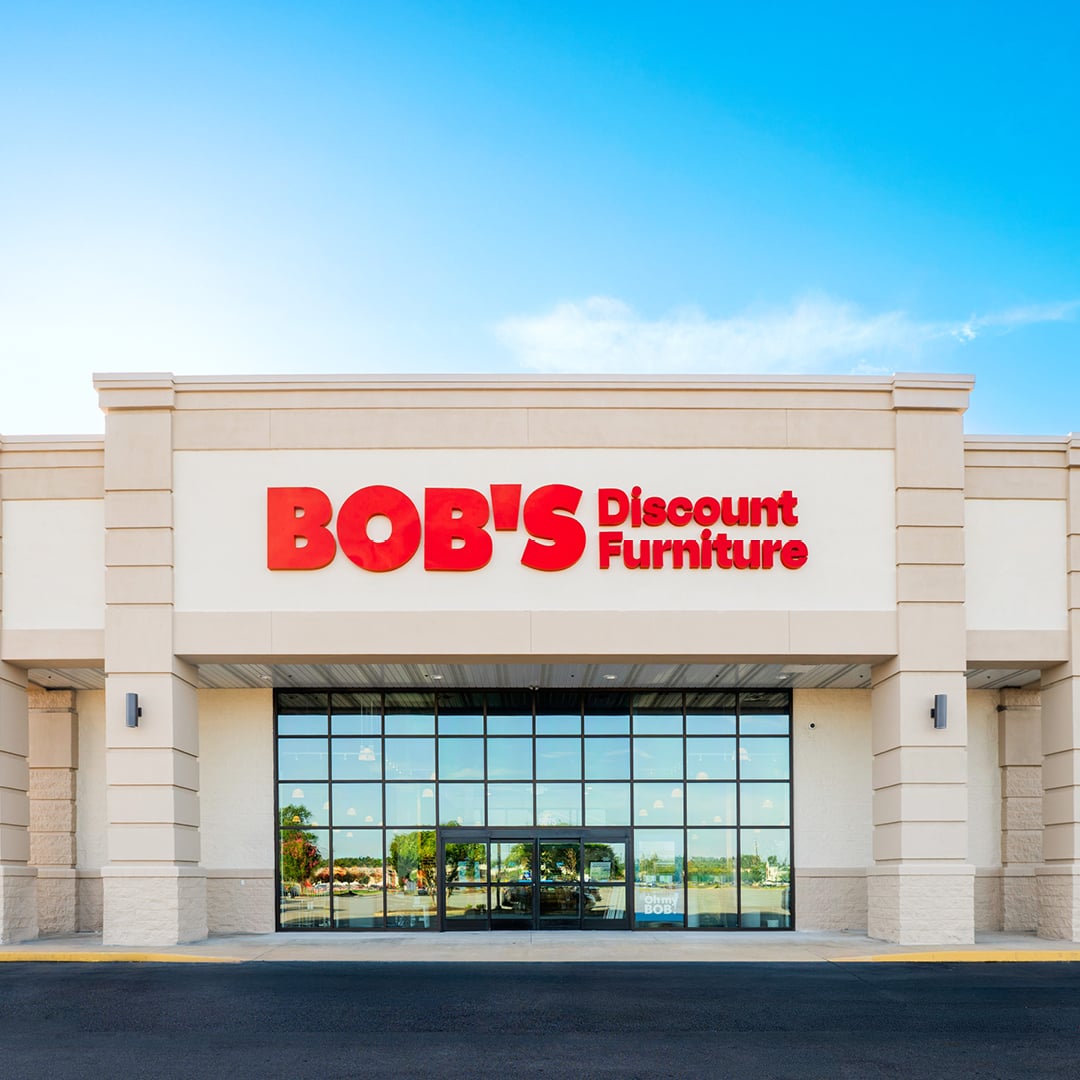
The store is typically 30 to 32,000 square feet. We've got stores that are bigger, stores that are smaller, but we're looking for the best real estate in town. And sometimes that's a larger box, sometimes it's a smaller box.
Spencer Levy
And when you say the best real estate in town, the best real estate is obviously locational. And let's talk about that first. And the location really has several attributes to it, not just the ease of the customer going there, but also has to do with the billboard value. The fact that people want to see, I drive down the road in New England. I can't see more, enough of the Bob's Discount Furniture trucks. They're everywhere. But isn't that a big part of picking a location?
Christopher Day
Visibility is one of the priority attributes that we look for in a store, easy access and egress for the customer. We like being proximate to other furniture retailers. We like to be in promotional shopping centers with national tenants and very strong local tenants as well. So we've taken a real estate approach to furniture that puts us in the promotional shopping centers where we are on Main and Main. And I like to say we like to be on Broadway as opposed to off Broadway.
Spencer Levy
And I think our listeners should really hear that point one more time that Chris just made. In many businesses in the retail trades, such as grocery, as an example, they don't want to be right next to the other grocery store. But you do want to be next to other furniture retailers. Why?
Christopher Day
Furniture is a large purchase for most households if not all households and it's likely that the customer is going to want to cross shop and we feel comfortable in that environment where we want the customer to see what we have to offer. We like to be in shopping centers and make it easy for them to do that. How often are people in a shopping in–not in a shopping center–but how often are in a furniture store? Certainly less frequently than you're in a grocery store. But if we're in the shopping center with the grocery store. certainly, and we have a wonderful cafe that we invite customers and our guests to come and relax, take some time. Buying furniture is not a quick event typically for people. And we feel that being proximate to the other furniture retailers in the market makes it easier for the customer to come in and we like the odds in the end they're going to buy from us.
Spencer Levy
One of the statistics I was reading from your filings was the percentage of your sales that come from online. And I was surprised at how low it was relative to other types of retailers. And the number I saw, and I might be slightly wrong, but it came out of the filings was about 15% of online shoppers versus in-store shoppers. But one of the things we've noticed from many retailers, they say, well, if we have a bricks and mortar presence, the online sales follow. They get higher as a result. Tell us about the online portion of your business and how it relates to bricks and mortar.
Ryan Schaffer
We really think that they work seamlessly together. We are a national omnichannel retailer. And we want to meet the customer wherever and however they want to shop. For most folks, it's not an either-or. It's an and. Many customers will perhaps start their journey online, browsing through a collection. But this is a sofa. This is a mattress. This is big ticket item, as Chris said. So they really then want to come into the store, Sit on the sofa, lie on the mattress. Then perhaps they need to go back and want to go back and talk to their spouse or partner before making that purchase. What we've done at Bob's is make that totally seamless. You can be in-store, work with one of our guest experience associates, and put items in what we call an omni-cart, and then that cart will travel with you. If you want to go home, talk to your spouse, measure in your room to make sure it will fit, you can then complete that purchase online without coming back to the store. If you want to come back to the store again, you can work with the guest experience associate that you worked with before and complete it in store. We're agnostic as to where the guest finishes the transaction. We really think of ourselves as omnichannel and the brick and mortar and the e-commerce working seamlessly together.
Spencer Levy
Now when your guest is in the store, you mentioned you have a cafe in your store, which, great. How did you come up with the cafe concept?
Ryan Schaffer
Well, I think it really all goes into the overall shopping experience. We really take a lot of pride in our guests having the best overall shopping experience. Part of that is no hassle. You don't have our guest experience associates hovering over you the entire time. They'll say, welcome to Bob's, would you like to look around? And they'll stay close enough that if you need an answer, they're right nearby, but it's low pressure. It's not high pressure sales tactics. Another part of that is the cafe. Really proud of the cafe. That's been a part of the Bob's concept for a long time. Maybe it is you're bringing your husband with you, maybe it is you're bring your kids with you. Or maybe you've just looked at a bunch of things and you just need a minute to sit down, have a cup of coffee, maybe some ice cream, and think about that before you make the purchase. So the cafe really is part of overall guest experience that we are really proud. The other nice thing about the cafe is we have a charitable component. We work with a different charitable organization, usually rotate quarterly, and we'll take donations in the cafe. We have a box for donations, which Bob's matches and provides. So charity serving our communities has always been a part of the Bob's brand, and it continues in the café.
Spencer Levy
And that's great. And I think it's great for a lot of reasons. And I think that being very bottom line about it, it increases the dwell time of somebody in the store, if they feel more comfortable. I can't tell you how many times I've gone to a store where I've got to sit in the shoe department, because that's the only seat in the place. But if you've got a place that's actually fun to hang out or relaxing to hangout, I'll hang out there all day.
Christopher Day
And the experience at Bob's has changed over time. We had fish ponds. There's a generation of people in Connecticut and New England area that are very familiar with the fish pond that Bob's had. We have some stores that have them. We've been sort of moving away from that.
Spencer Levy
Wait, wait, wait. Let's back up there. Fish ponds, like koi, that kind of thing?
Christopher Day
Yeah, exactly. And it creates a wonderful community environment. And kids love it. I have friends who's like, I take my kids to Brookfield because they've got the fish pond in the Brookfield, Connecticut store. But the whole premise was to create a fun environment. And one thing you'll notice in the Bob store is, the prices are everyday low pricing. But create an environment, just to echo what Ryan was saying, that is friendly, it's community, and it's quality.
Spencer Levy
But let's talk now about optimal real estate for a moment. And retail is very tight right now. It's very tight because we aren't building any more of it. And so given the size of your footprint, I would typically call Bob's a quote unquote power center user, meaning that you have a larger footprint. You might be near other large users, like a Ross Dress for Less, places that are larger users. There might even be a grocery store there. Tell us about what might be an optimal location for you.
Ryan Schaffer
Yeah, I think one thing I would say first is when we go into a market, we really think about it first from a total market perspective. We like to say around here, we don't open units we develop markets, right?
Spencer Levy
Say that again. We don't open units, we develop markets. Explain that a little bit more.
Ryan Schaffer
Yeah, again, when we're going into a new market or into an existing market, we're thinking about the end game. What do we think this market can be, can mean for Bob's in the long-term from both a sales and a profitability perspective? The tactics that we use may change. The goals are always the same – drive sales, take market share, leverage profitability – but the tactics may change depending on where we are in a market life cycle. I'll give you an example. We moved into North Carolina. We hadn't been in North Carolina before last year. As we entered that market, we went in with six stores. We thought about the market as a whole and really were focused on driving brand awareness. Who is Bob's? What makes us different? What's our value proposition? When you think about markets that we've been in for a much longer time, we're looking at strategic infills. Can we relocate from one side of the street to another because it's in a better center? Can we add? An infill location where based on our customer mapping and analytics, we can see that we're missing out on customers. So we really take that top down market approach. And then of course, at the box. There's all sorts of data analytics, site analytics that we look at to figure out what works.
Spencer Levy
A lot of people say, oh, we don't create demand, we take demand. You said that you're creating your own demand. And you're creating your own demands by the locations of your stores, by the mix of your stores, or by moving your stores. So if you are in a market, – we're here in Connecticut right now – how do you pick how far a store might be from another store before you start to cannibalize that other
Ryan Schaffer
Yeah. So that's something we think a lot about in existing markets. We use heavy data analytics, looking at all of our traffic and where it's coming from and all of sales. So as we consider an infill location, it's not just how's that store going to do on its own, but what's going to be the impact to the overall market. There could be cases where, yeah, we know it's going to take some sales from an existing store. But again, we believe that short term. We believe that adding density in a market can really drive that brand awareness, which we really see as key to driving market share and driving sales. So we're really thoughtful about adding in fill locations, but we believe that we have tremendous room to do that though, carefully.
Spencer Levy
So, Chris, the thing about the retail business as opposed to say the office business where it's not quite as easy is that there's quite a few landlords that own a disproportionate amount of the retail. So you can deal with the same landlord at five or six different centers. Are you able to engage in those conversations, bigger pictures, say, you know what, we need 10 of these. What do you say we talk about 10 instead of this one location?
Christopher Day
We haven't deployed that sort of strategy yet. I mean, it's our store count has grown steadily over the years and we're at 10% growth. We'll do 21 stores this year. So we have a broad base of landlords. I think the largest landlord in our portfolio has 16 or 17 stores and there's lots of landlords that have one or two. We look at landlords as long-term partners. And I think that the evolution of Bob's over time has demonstrated to landlords the quality of a retailer that we are, the value that we're bringing to their shopping centers. The furniture category is certainly different. Clothing and electronics and sporting goods draw off a pool of energy and promotion that come from being in the shopping center with other national brands in their particular category.
Ryan Schaffer
May be in the same center as them. I do think that our landlord relationships are frankly part of our secret sauce. Chris and the team have been in the industry a very long time and developed great relationships. And relationships not just because they think he's a nice guy, which he is, but relationships of honesty and integrity and if Chris tells you he's going to do something, he's gonna do it. And I think we've built that reputation which has allowed us to frankly punch above our weight and get to the front of the line on a number of deals.
Spencer Levy
And most of your centers, maybe all of your centers are located in what I might classify as a suburban location. Do you have any urban locations like literally in CBD type areas or have you considered that.
Christopher Day
We're in South Loop in Chicago, we're in the East River Plaza in Manhattan, so yes, we do have urban locations and the merchants, every store we have isn't just a planogram and all stores look the same. In an urban location you need smaller product because typically it's apartment living and you need small pieces of furniture to fit in apartments, get furniture up the stairs because sometimes furniture doesn't fit in an elevator. So yes, is the answer to your question. And as we evolve and we grow across the country, we go where we think the opportunity is. And if that's an urban setting, then we will go to the urban setting and we will develop a plan to be successful in that setting.
Ryan Schaffer
We can tailor from our assortment, especially if you have a smaller store or you're in an urban environment, you can have that small space living, we call it. Or as we think about– certain markets may tend to have more of a customer for outdoor furniture. So you may see that featured more heavily in some markets, but not necessarily in my hometown of Cleveland, Ohio where it snows quite a bit.
Spencer Levy
Value retail, that's the category that we've classified you as. Maybe I'm wrong. How do you see it?
Ryan Schaffer
Listen, we wear it as a badge of honor. We are a value retailer. And the good news for us is value is not a trend that just comes up during uncertain economic times. Our CEO has said and likes to say value is always in vogue. So we look at other great value retailers and we're thrilled to co-locate with them or be co-tenants with them. We feel really good about that. What's been interesting is we've seen over the last couple of years an increase in the percentage of our customers who are coming from higher income brackets. So again, that concept that everyone wants to make good decisions, right? Everyone wants to be smart and get value for whatever they buy. And that's true regardless of income bracket. So we wear our value retailer badge proudly, but we really have found that we've had quite a bit of appeal across income brackets
Spencer Levy
Let me just get a little bit personal here. I used to live in Riverdale in the Bronx, and the last remaining thing that I have from my apartment in Riverdale in the Bronx, is my sofa. I bought a good sofa, and I have it now 30 years later.
Ryan Schaffer
Wow.
Spencer Levy
Maybe that's too long for the furniture people, saying, oh no, you've got to get rid of them every five or ten years. It’s just a good sofa!
Ryan Schaffer
Yeah. Yeah, well, we know some people if you're looking for an upgrade
Spencer Levy
By the way, I will be calling you because my son just moved into a two-bedroom apartment in D.C., my other son's got another apartment, so we need some furniture.
Christopher Day
We got lots of stores in D.C.
Spencer Levy
All right. So let's now talk about the distribution for just a moment. Again, we're in retail. You get there. Two days is probably optimal. Maybe it's a little longer. Maybe it is a little bit less. But as you continue to build out and I believe you have, is it six distribution centers?
Ryan Schaffer
Six distribution centers and we've announced plans that we'll be opening a new one in Georgia in 2027.
Spencer Levy
But when you open that one in Georgia, that opens up a significant amount of the market. So do you have, like, a driving distance from that distribution center where you think it's optimal to have a store?
Ryan Schaffer
We do, but I think about it less in terms of a hard and static drive time. As Chris talked about before, what we really wanna do is can we fulfill that customer promise efficiently from that distribution center. A significant portion of our products are available to be delivered in three to seven days and from the backend, are we able to support that? We do think about stretching our existing DCs before we open a new DC. So there are stores today that are being supported out of an existing DC, which is in your backyard in Maryland. And when our Georgia DC opens, it will actually pick up distribution for those stores.
Spencer Levy
How much do you look at other asset types in terms of where you decide to locate?
Ryan Schaffer
I think it's all part of the equation. When we're going into a market, we're looking at all sorts of population and customer segmentation information. That includes things like housing starts, that includes things like population growth. One of the things that we've been really excited about as we looked at place like North Carolina, where we entered, it's not just population growth, we're seeing population growth from places like New York, like New England, where people know Bob's, they grew up with Bob's. So we're seeing the population there, it gives us a chance to really hit the ground running with higher brand awareness than we would have. But things like housing starts, multifamily, those are absolutely part of what we look at when we're looking at a market.
Christopher Day
We did a store in Assembly Square in Somerville mass in Boston, and that is a live, work and play environment. Federal Realty built the shopping center and that is exactly what you're talking about. So that is a large retail component. They've got office space. They've Got residential space. I've got a ton of restaurants and there they've created a live work and play environment so that was the right place for us to go and how we assess opportunities is. We look at the opportunities that are available, we figure out how to put the right store to square it up with the opportunity that's presented to us. And Assembly Square is an example of that. I'd say it's clearly the minority of our portfolio stores that are in that type of shopping center, but as part of Bob's evolution, we are, as I like to say, getting taller and skinnier every year and more attractive to a lot of landlords. And we find ourselves having more opportunity. And because we deliver on what we're talking about it’s a–landlords are long-term partners. We feel we're a long- term partner for a landlord as well. And understanding the dynamics of retail and the retail real estate marketplace, and there is not a lot of new growth out there. So second generation boxes is something that we've taken advantage of, as have many other retailers who are growing at a pretty good cliff as well
Ryan Schaffer
Yeah, I think having that flexibility, both in type of location, size of location in a really competitive real estate market serves us really well. If the best opportunity is only in a 12,000 square foot box, we can figure out how to make it work. If it's in a 50,000-square-foot box, we can make that work, too. If it’s in a, to your point, a power center, multi-family, the flexibility of our model really allows us to do well.
Spencer Levy
So the question that comes up in all these shows we have is your use of data. And you mentioned data in a lot of the very big picture ways, population growth, movement of people. How deep do you get into the data for opening a new store or figuring out maybe this store didn't work?
Ryan Schaffer
Very deeply is the short answer. When we are considering a market entry, particularly in a place we haven't been, we'll spend one to two years ahead of it really digging in deeply. And we start with the data. We start with demographic information, the psychographic information, the customer segmentation. Are there Bob's customers? How much is there for Bob's in this market. So we dive really deeply, but our development process is highly rigorous, highly analytical, but it's also highly cross-functional. So just as important as looking at that data is working with our pricing team and looking at the pricing environment in that market. It's working with our advertising and marketing team and looking the cost to advertise in a particular market. It's work with our merchants to see who is the competition and what are they selling. It's really, truly cross-functional. Data leads the way, it always will and it has to because the market has to support. The type of sales we're looking for. But there's so much more that goes into it from a cross-functional perspective before we would wade into a new market.
Spencer Levy
I have noticed more and more centers that are open air, even in colder environments, because I think people want to be outdoors.
Ryan Schaffer
Absolutely. It is destination. It is something to do. I know the death of retail is a story that's being told for years, right? And it's just not true. People not only want to see, touch, and feel considered purchase like furniture, but it's a day out. It's an event. It's going, being among people and doing that shopping that you just can't do online.
Spencer Levy
And going to marketing for just a moment – and we could stay on NASCAR the whole time because it's such a fun topic – but you have your trucks that go down the road that say Bob's Discount Furniture, and you've got the cartoon version of Bob. And I just want you to know I'm in the corporate offices, saw the photograph of Bob, and they do look alike. So this is not just made up Bob here, just so you know. But how do you try to marry that branding to your stores?
Ryan Schaffer
Yeah, I mean, when you walk into a Bob's Discount Furniture, we want you to know that you're in a Bob discount furniture through signage and branding. We wanna make it really clear and through elements of design that you'll find consistently throughout our stores. Chris mentioned our cafes. With all of our newer model stores, we have a welcome vignette right at the front door. We have sleep centers, which have blue headboards showcasing our mattress selection.
Spencer Levy
Does anybody ever fall asleep in your stores? I'm sure it happens all the time.
Ryan Schaffer
It does happen. It's frowned upon, but, you know, we–
Christopher Day
Very reasonable rates.
Ryan Schaffer
We do tend to wake them up with an ice cream though, so it's not all bad. It's not all bad. But no, I mean, what's really important is it's that brand awareness. We really believe that driving brand awareness in new markets and existing markets is so critical. And so whether it's our trucks in our supply chain, our stores, or whether it is on TV or online, we really strive to have a strong and consistent brand image.
Christopher Day
We make 30 to 35,000 deliveries a week. So there's a lot of opportunity to put trucks on the road. And for all of you out there in podcast land who have not been to a Bob store, I encourage you to go because it is a fun store. It's energetic, it's lively, it's bright. I don't know what images people might conjure up if they haven't been into a store, but I would put you to the test. Go see it and I like the odds you're gonna love it and I think you'll buy something.
Spencer Levy
Let's just talk about the future here. Let's start with you, Ryan. Tell me about how you see the next several years for Bob's Discount Furniture.
Ryan Schaffer
We're north of 200 stores today. And what we've said publicly is we think there's a clear path to 500 plus locations by 2035. How much plus that is, I can't tell you, but we are so excited about the fact that we have this really unique combination. We have this 35-year brand heritage where we've been delighting customers for a long time.
Spencer Levy
Delighting. That's a great word and that's a Danny Meyer word, right? Surprise and delight.
Ryan Schaffer
Absolutely. We want you to have a delightful experience, but we have this brand heritage and this brand capital build up, and yet we have so much white space in front of us. We think we can very clearly get to 500 plus stores by 2035. We're excited about what we've seen, as I've said, as we've taken the brand to regions where we haven't been before. And we think the future is bright.
Spencer Levy
Chris, same question for you. What do you see as the next couple of years for Bob's Discount Furniture?
Christopher Day
I think the story is what we opened up the show with. It's disciplined, repeatable growth. We've proven that we have a model that has worked in Connecticut. It's worked throughout New England. We've taken it on the road from Connecticut to all sorts of corners of this country and there's more ground to cover. As Ryan said, there's a lot of white space out there and we're going to keep on trucking, doing what we do and doing what we do best.
Spencer Levy
All right, well, what a terrific conversation today at Bob's Discount Furniture with Ryan Schaffer, Chief Legal and Development Officer for Bob's. Ryan, great job.
Ryan Schaffer
Spencer, it's great to have you. Thanks so much for having us on.
Spencer Levy
And Chris Day, Senior Vice President of Real Estate, Bob's discount furniture. Chris, great.
Christopher Day [00:35:09] Pleasure. Thank you for having us.
Spencer Levy
Well, for the record, as we put this episode to bed, Denny Hamlin remained a contender in the chase for his – and of course Bob's – first ever NASCAR season title. Let's all keep an eye on the Bob's Discount Furniture Number 11 car as the NASCAR Championship draws near. And as we look ahead to the end of our season, we hope you'll stay on top of The Weekly Take by visiting our website, CBRE.com/TheWeeklyTake, or by subscribing on your favorite podcast platform. We're also starting to look ahead to a new season in 2027, so don't touch that dial. For now, thanks for joining us. I'm Spencer Levy. Be smart. Be safe. Be well.

.jpg)