Adaptive Spaces
2026 Americas Office Occupier Sentiment Survey
From Retreat to Rebalance
July 30, 2026 15 Minute Read

Executive Summary
CBRE’s 2026 Americas Office Occupier Sentiment Survey reflects a market that has found its footing.
Occupiers are making deliberate choices about the quantity, quality and location of their space. The gap between aspiration and action is narrowing, and the survey findings show where it’s closing the fastest—and where it’s not.
Key Takeaways
-
Three Days Is the New Standard
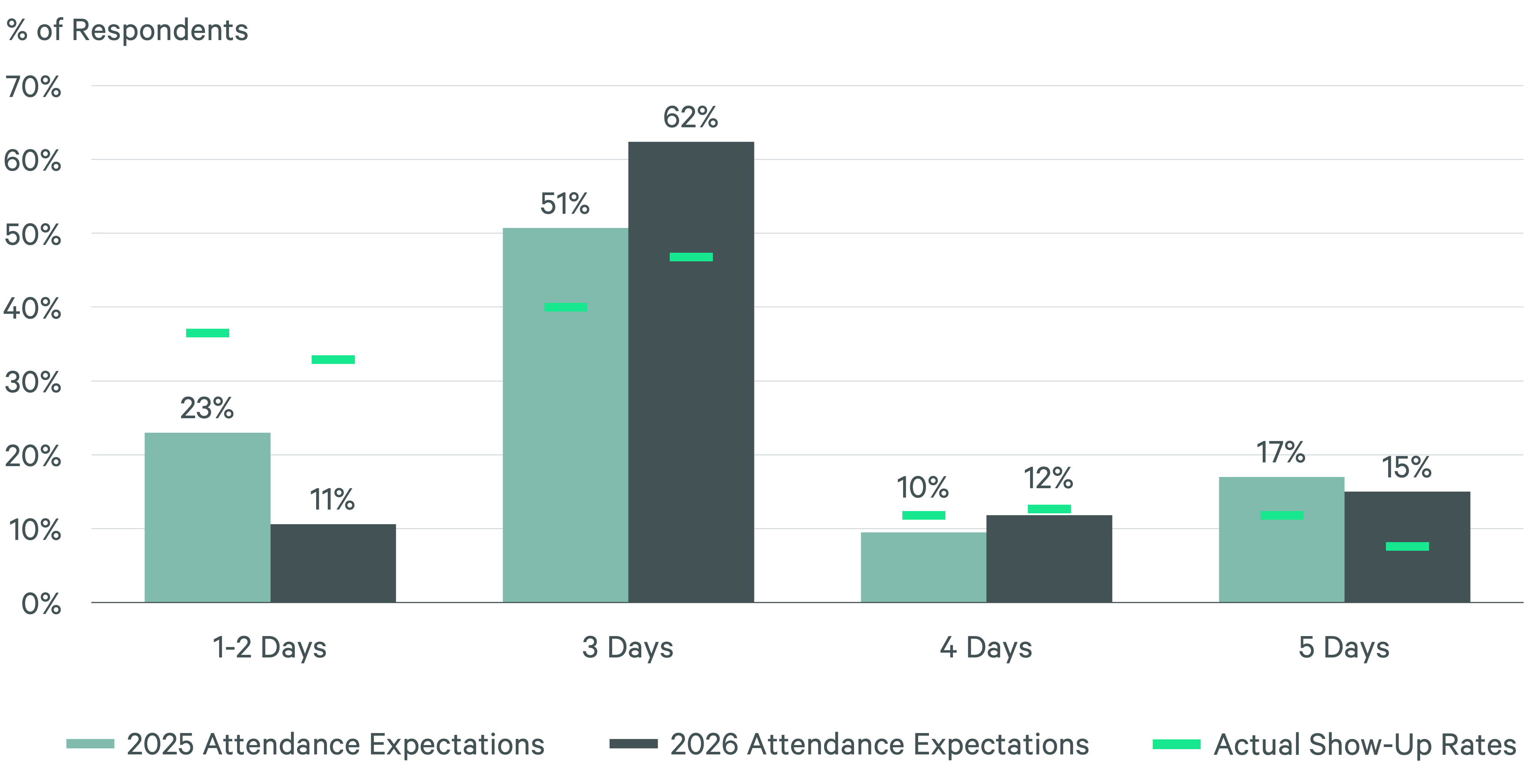
Eighty-nine percent of employers now require at least three days of office attendance per week, up from 78% in 2025. Employers expecting just 1 to 2 days of office attendance dropped sharply to 11% from 23% in 2025. Yet the gap between expectation and reality persists, as average office attendance (2.9 days) continues to lag employer targets (3.2 days). For the fourth consecutive year, nearly a third of organizations expect attendance to increase. -
Connection Draws People to the Office
Colleague engagement (77%) is driving office attendance. When peers are present, the office's core value proposition proves out. The top factors limiting attendance are an inconvenient location (62%) and a lack of amenities (53%). Easing physical and logistical friction can help occupiers close the gap. -
Most Offices Lack Transformative Investment
Nearly half of organizations (47%) rate their current workplace experience as insufficient, a sentiment being driven by a lack of transformative investment in the office. Fifty-four percent of organizations are making incremental improvements, while only 14% are pursuing meaningful reinvention. As a result, many companies are occupying offices that do not meet business needs. -
AI Is Already Influencing Space Planning
Twenty-three percent of organizations report that artificial intelligence (AI) is already influencing space planning decisions. Another 30% expect it will have a meaningful impact in the next two years. Financial services firms and large companies are already feeling the effects. But it’s not a simple story of contraction. Most expect a shift toward more flexible, multipurpose space. -
Portfolio Sentiment Has Stabilized
For the third consecutive survey, two-thirds of organizations (66%) plan to maintain or expand their space over the next three years, a sign that occupier sentiment has stabilized. The technology sector stands out, with 64% of organizations planning to expand, up from 41% in 2025. Large organizations remain the most likely to contract but at a notably lower rate (46% vs. 60% in 2025).
A Decade of Evolving Office Priorities
What matters most to occupiers has evolved since CBRE launched its first Office Occupier Sentiment Survey a decade ago. This animation tracks 10 years of shifting priorities—from talent attraction to employee experience, from efficiency to effectiveness, and from flexibility to a true hybrid operating model.
The New Normal Is Set, but There’s Still a Gap to Close
CBRE’s historical trend data makes it clear that the structural shift in how and when people use the office is now permanent.
Hybrid work, while still evolving, is here to stay. The office is as important as ever. Both statements can be true, and portfolio strategies need to align with this new normal.
The growing alignment on office attendance expectations underscores this finding. Eighty-nine percent of employers now require at least three days of office attendance in 2026, up from 78% in 2025. Over the same period, the share expecting 1 to 2 days dropped sharply to 11% from 23%, signaling consistent movement toward higher in-office requirements.
However, the gap between expectation and reality persists. While 89% of employers expect at least three days of attendance, fewer report that as the reality. Conversely, although only 11% of employers expect 1 to 2 days, three times that share say it reflects actual attendance patterns. The average days in office edged up to 2.9 from 2.8 in 2025. This is real movement, but not enough to fully meet average employer expectations (3.2 days).
For the fourth consecutive year, nearly a third of organizations expect usage to increase over time, raising the question: Will this gap ever be closed?
Figure 1: Employer Attendance Expectations vs. Actual Show-up Rates
Hybrid work, while still evolving, is here to stay. The office is as important as ever. Both statements can be true, and portfolio strategies need to align with this new normal.
Closing the Gap Between Expectation and Reality
Understanding the attendance gap requires looking at both the companies’ and employees’ perspectives. This year's survey asked respondents to identify what draws employees into the office and what drives them away.
People and place draw employees to the office. When colleagues are present, the office delivers on its ability to foster collaboration, connection and a strong sense of community.
Beyond that, employees need to feel they can do their jobs well. Functional technology, available meeting space and adequate focus rooms are prerequisites, not perks. Attendance expectations and visible leadership reinforce the message that showing up matters.
By contrast, location is the biggest barrier to office attendance. No amount of workplace investment will offset a long or difficult commute. Moreover, if employees can't grab lunch, run an errand or find a quiet outdoor space, the office asks for more of them than it gives back. Lastly, a dated or uninviting space signals that the employee experience isn't a priority, and employees respond accordingly. The bottom line: Employees don’t come to the office if it doesn’t have the basics that make the trip feel worth it.
Figure 2: What Drives Employees to Come In or Stay Home?
Are occupiers investing enough in the office?
The Gap Between Intent and Impact
The debate about whether the office matters is over. The question now is whether organizations are willing to invest as if it does. The data suggests that most are not.
Real estate spend per employee has declined in real terms since the pandemic, even as employee wages and company revenues have grown. Not surprisingly, nearly half of organizations (47%) rate their workplace experience as average or below average relative to peers. For many companies, the office is not a differentiator when it comes to attracting and retaining talent.
Figure 3: Real Estate Spend vs. Wage and Revenue Growth
Note: S&P 500 sales index reflects a one-time methodology refinement effective 2006. Year-over-year comparisons spanning 2005–2006 are not directly comparable; growth resumes on a consistent basis from 2007 onward.
For many companies, the office is not a differentiator when it comes to attracting and retaining talent.
At best, organizations are making incremental progress. At headquarters (HQ) locations, 65% of respondents report maintaining or refining their current design, while only 23% are undertaking genuine transformation or repositioning. In non-HQ locations, 56% are holding steady or making modest updates, while 20% are pursuing meaningful design change.
The more telling figure is the 25% of non-HQ locations that are being vacated rather than reimagined because they no longer fit the portfolio. Overall, office investment remains modest compared with the gap it needs to close.
Figure 4: Appetite for Office CapEx Over the Next Three Years
Overall, office investment remains modest compared with the gap it needs to close.
Opposing Goals, No Easy Resolution
The two opposing objectives dominating the workplace agenda—optimizing space utilization and efficiency (74%) and enhancing the employee experience (62%)—explain why organizations aren’t making transformative office investments. The former prioritizes doing more with less, while the latter demands real investment. Most organizations land in the middle, making incremental investments that don’t fully satisfy either goal.
Additionally, corporate real estate teams are increasingly competing with higher-priority business initiatives, such as AI adoption, digital transformation and broader reinvention. This makes it even harder to gain approval for substantial workplace investment, even when the need is clear.
If organizations don't appropriately balance optimizing space utilization and efficiency with enhancing the employee experience, the risk is significant. The office will remain expensive but not differentiated, mandatory but not magnetic and occupied but not effective. This position is increasingly unsustainable as AI sets a higher standard for workplace productivity.
Figure 5: Top Workplace Strategy Objectives
If organizations don't appropriately balance optimizing space utilization and efficiency with enhancing the employee experience, the risk is significant.
The next identity crisis for office? AI.
AI and the Workplace: Signal Without Certainty
AI is quickly moving through the economy but its influence on real estate decisions is just beginning to emerge.
A minority of organizations (23%) say AI is already influencing their space planning decisions. Another 30% expect meaningful impact within the next two years. However, nearly half of organizations don't expect AI to affect their space planning anytime soon.
Financial services firms are already feeling the impact, driven by the sector's substantial investment in AI-powered workflows and historically high office density. Marginal shifts in headcount or work patterns quickly affect these firms’ real estate decisions.
For large companies with over 10,000 employees, AI transformation has become a strategic business priority. Sixty-eight percent of S&P 500 earnings calls cited AI in Q4 2025, according to FactSet. This reflects the urgency that large companies are placing on AI deployment. As a result, these organizations are more likely to make space planning decisions before smaller firms where AI adoption is slower.
Figure 6: Timeline of AI Impact on Office Space Planning
For large companies with over 10,000 employees, AI transformation has become a strategic business priority.
AI's Impact on Space Is More Complex Than Simple Contraction
AI's influence on office space is not a straightforward story of shrinking footprints. The reality is more nuanced.
Most organizations (50%) expect AI adoption to spur a shift toward more multipurpose, reconfigurable space. Additionally, nearly one-third (30%) anticipate it will increase demand for specialized AI-focused environments, such as labs, innovation studios and training rooms. Collectively, these expectations suggest stable to improving office demand.
Thirty-seven percent of organizations expect that AI will lead to reduced headcounts and less total space, reflecting genuine concern about workforce automation. However, headcount anxiety often outpaces reality in periods of rapid technological change. History suggests that near-term contraction expectations moderate as organizations find new ways to deploy and redeploy talent.
More than one-third of organizations (36%) expect that AI will drive them to incorporate higher-quality amenities and experiences in their offices to attract top talent. This will likely result in heightened demand for premium space rather than less space.
The effects of AI on real estate will vary significantly by organization, with financial services firms and large organizations leading the way. Some will shrink. Some will reconfigure. Some will expand into new uses. Ultimately, humans will remain responsible for creativity, judgment and decision-making. First-class spaces that not only enable but maximize these activities are vital in an increasingly AI-driven world.
Organizations that are already using data and technology to optimize their hybrid environments will be well-equipped to make the right decisions when the time comes.
Figure 7: Expected AI Impacts on Workplace Needs
Ultimately, humans will remain responsible for creativity, judgment and decision-making. First-class spaces that not only enable but maximize these activities are vital in an increasingly AI-driven world.
What are occupiers signaling about the market?
The office market has moved from retreat to rebalance. For the third consecutive survey, two-thirds of organizations plan to maintain or expand their portfolios.
A growing share (28%) anticipate a static portfolio in 2026, up from 24% last year. And 38% expect their portfolio to grow over the next three years, citing headcount growth driven by the business cycle. Meanwhile, a slightly smaller share (34%) expect to contract due to hybrid-work rightsizing and pre-pandemic portfolio inefficiencies.
Figure 8: Portfolio Expectations Over the Next Three Years—Overall, Large and Tech Companies
Significantly smaller — Contracting by more than 30%
Moderately smaller — Contracting by 10-30%
Minimally smaller — Contracting by less than 10%
Minimally larger — Expanding by less than 10%
Moderately larger — Expanding by 10-30%
Significantly larger — Expanding by more than 30%
Downsizing Slows Among Large Companies
Large organizations are still shrinking their footprints, though less aggressively than in prior years. Among companies with 10,000 employees or more, 46% plan to reduce space, down from 60% in 2025. Leasing data tells a similar story. Big-block leases (100,000 sq. ft. or more) remain below pre-pandemic levels but have recovered from their 2023 lows, suggesting large occupiers are beginning to stabilize.
The reasons for contracting have also shifted. Pre-pandemic inefficiencies remain the primary driver, as large organizations are still rightsizing space that was underused before the prevalence of hybrid work. Meanwhile, fewer large organizations cite hybrid work as a reason for contracting, dropping to 47% from 67% in 2025. This suggests that most large companies have already made the necessary adjustments.
AI is emerging as a new rationale. Nearly a quarter of large organizations now cite AI-driven headcount reduction as a reason for contracting, compared with 8% of smaller organizations. It's an early signal, but one worth watching as AI adoption accelerates.
Tech Occupiers Lean into Expansion
The technology sector is poised to lead workplace expansion, with 64% of companies planning to grow their footprint this year, up sharply from 41% in 2025. Leasing data supports this view. Tech companies accounted for 21% of all office leases signed in H1 2026, marking the sector’s highest share since 2019. Leasing activity is especially concentrated in top gateway markets, where expansion sentiment is driving strong demand from tech tenants and resulting in signed deals.
Portfolio Sentiment Moves from Retreat to Rebalance
Contraction sentiment dominated in 2021. Nearly half of all occupiers and more than 80% of large occupiers planned to reduce space. Today, overall expansion and contraction sentiment each hover around 35%, while contraction sentiment among large occupiers has fallen below 50%. Meanwhile, expansion sentiment among large occupiers has more than doubled.
Clarity is driving stabilization, as most organizations have settled into hybrid work and have a clearer view of how their space is used. This understanding has given leaders the confidence to make definitive space decisions and recognize that fewer days in the office doesn't mean less space.
Figure 9: Historical Occupier Expansion/Contraction Sentiment
Figure 10: Occupier Relocation Strategy & Essential Amenities for Building Value
Occupier Portfolios Must Be Flexible
Flexibility has become a defining priority for occupiers navigating economic uncertainty, shifting utilization patterns and the unknown impacts of AI. Most organizations’ portfolios are still built around conventional office leases. However, they are increasingly adding flexibility when they have the negotiating power to do so, usually through expansion and contraction rights and lease-break clauses. While some desire shorter lease terms, this trend is not showing up in the data.
Flex space has also become a mainstream portfolio strategy. Most organizations prefer to incorporate flex space to manage uncertain demand, enter new markets and preserve capital. Only 16% say they don’t have a flex strategy, down from 24% in 2025.
To align with the new normal, occupiers should treat flexibility as a portfolio strategy that includes a mix of long and short-term commitments, the buildings and flex offerings chosen, and the terms negotiated before signing.
Conclusions
Conclusions for Investors
- Flight-to-quality is structural. Nearly half of occupiers surveyed are actively pursuing relocation—a trend confirmed by the growing share of new leases every quarter. Buildings that can't compete on tenant experience, location and flexible lease terms will continue to lose tenants to those that can.
- Amenity preference vs. prerequisite. Commuting and convenience considerations are site-selection prerequisites. Sustainable building operations and building amenity space are table stakes, resulting in rent discounts when absent. Fitness facilities and outdoor amenities command the strongest premium over market rates.
- The CBD advantage must be earned. The majority of relocating occupiers prefer a CBD location with walkable amenities, transit access and proximity to talent. For investors, submarket selection matters more today because some CBD submarkets meet occupiers’ needs better than others.
- Lease flexibility as a retention tool. The flexibility mechanisms occupiers want—expansion and contraction rights, break clauses and shorter terms—are largely embedded in traditional leases. Coworking supports increased tenant flexibility rather than serving as a core portfolio strategy for most occupiers. Landlords who build flexibility into their standard offering are more likely to retain tenants and attract new ones.
- AI is a tailwind. More than half of occupiers say AI will impact their space planning within two years, accelerating demand for modern, adaptable environments. Occupiers and landlords must remain flexible on lease terms, space configurations and the evolving needs of a tech-first workforce.
Conclusions for Occupiers
- People and place close the attendance gap. Colleague presence and a functional workplace make the trip to the office worth it. A difficult commute or a lackluster environment signals that experience is not a priority and keeps employees away. Attendance isn't won by adding more; it's lost by missing the basics.
- Invest in a functional and purposeful office. Nearly half of organizations rate their workplace experience as average or below average relative to peers, yet only a minority are pursuing meaningful reinvention. Investing in a functional workplace that reflects employee value is a strategic priority that supports business outcomes.
- Flexibility is strategy, not a lease clause. Organizations that are building flexibility into every layer of their real estate decision-making are well-positioned for the road ahead. This includes a mix of long and short-term space, the shared and flex space available in the buildings they choose and the terms they negotiate before signing.
- A building can be upgraded—a location can't. Location wins over building quality every time. Relocating organizations are prioritizing walkable amenities and transit access when evaluating CBD locations. If portfolio consolidation is on the agenda, the bias should be toward locations that work for employees.
- The impact of AI is nuanced. AI is not a simple contraction story. The most anticipated impacts are a shift toward reconfigurable space and toward new specialized environments. Organizations should modernize their workplace in tandem with the AI workforce transformation that is already underway.
Related Insights
-

CBRE’s 2026 Asia Pacific Office Occupier Survey finds that half the respondents expect their office space to expand over the next three years.
-

Demand is rising. Supply is tightening. AI and net zero are compressing timelines. CBRE's European Office Occupier Sentiment Survey 2026 – read the findings.
-
Article | Evolving Workforces
Business Insights | Closing the Relationship Gap in Workplace Strategy
June 23, 2026

Most workplace strategies track attendance and utilization, but miss the relationships that drive performance.
-

AI growth is accelerating tech office leasing and reshaping demand across global gateway markets.
-

$3.7 trillion of AI investment could reshape the economy. Here’s what that means for jobs and commercial real estate.
-
Article | Adaptive Spaces
Beyond the Desk: How to Design Offices That Draw Employees In
February 18, 2026
Discover how collaboration, amenities and activity-based design are redefining the office as a place employees choose to be.

Office Services for Occupiers
Unlock value by improving productivity and optimizing office locations, portfolios, and capital structures with our holistic solutions for workplace performance, talent attraction and retention, and cost reduction.


