Report | Intelligent Investment
Japan Market Outlook 2026
December 16, 2025 10 Minute Read

Looking for a PDF of this content?
01 Macro Environment
The Japanese economy is expected to see moderate growth through 2026. Private consumption should remain firm given government measures to address economic and inflationary issues, while continued accommodative lending conditions are anticipated to lead to an expansion of corporate capital investment. Interest rates are expected to continue to trend gradually upward.
02 Investment
Full-year investment volume for 2025 is set to top JPY 6 trillion, establishing a new single-year record high. Activity should remain robust in 2026, with CBRE projecting investment volumes to reach a level not far from 2025’s figure. While interest rate increases have accelerated somewhat, the accommodative stance maintained by financial institutions and steadily rising rents should support investors’ appetite for real estate investments.
03 Office
Office rents rose across all cities in 2025 on the back of robust leasing activity from tenants whose strong corporate performance encouraged them to improve office environments or expand floor space. Structural labor deficiencies should ensure that demand remains solid into 2026 and beyond. Vacancy rates continue to hover at extremely low levels in most cities, with any loosening of the supply-demand balance resulting from localized supply expected to be limited. Rents are projected to increase in all cities.
04 Logistics
The vacancy rate in Greater Tokyo has already begun to fall from its peak in Q1 2025, and is projected to drop to the 7% range with the sharp decline in new supply in 2027. Greater Osaka is expected to maintain a robust supply-demand balance even after seeing record-breaking new supply. On the back of efforts to achieve logistics efficiency, tenant demand is spreading from Greater Tokyo to other regions across the country.
05 Retail
In Q3 2025, the supply-demand balance in Japan’s retail market remained extremely tight nationwide, with four of the nine surveyed high street areas recording vacancy rates of 0.0% and two areas below 1.0%. Rents are projected to continue rising nationwide on the back of robust retailer demand for storefront space.
Macro Environment
Gradual economic growth set to continue
Japan recorded positive real GDP growth for five consecutive quarters from Q2 2024 to Q2 2025. While real GDP dropped by 1.8% q-o-q in Q3 2025 (first preliminary estimate), private consumption and corporate capital investment continued to make positive contributions, suggesting that the economy is continuing to recover gradually. On April 2, 2025, the Trump administration announced the implementation of reciprocal tariffs on the U.S.’s trading partners, creating concerns of economic stagnation in both the U.S. and elsewhere. However, progress in trade negotiations and the removal of some of these tariffs ensured that the U.S. economy remains resilient. In Japan, while increasing tariff costs have exerted downward pressure on earnings for some manufacturing companies, corporate performance has been generally strong. This has been due primarily to the avoidance of price hikes in order to mitigate the effects of tariffs, as well as robust performance by AI-related sectors and growth in non-manufacturing industries. The large corporate business conditions diffusion index in both the manufacturing and non-manufacturing sectors has remained stable and in positive territory (Figure 1-1) .

Japan’s GDP growth is projected to remain moderate through 2026 (Figure 1-2). While private consumption is somewhat underwhelming as a result of increasing prices, expectations are high that government measures to address economic and inflationary issues, including support for pay rises for small-to-mid-sized companies, tax reductions, and the provision of stimulus payments, should help support consumption. Continued accommodative lending conditions should lead to an expansion of corporate capital investment, particularly in the areas of labor reduction, AI and digitization, and supply chain reinforcement. However, should companies see their profits depressed by being forced to continue absorbing additional tariff costs, or should uncertainty around economic or foreign demand increase further, capital investment may decline. Other headwinds include the possibility of a continuation of the current tensions between Japan and China, which could lead to a drop in inbound demand and a stagnation of exports from Japan to China.

Moderate rate hike seen as most likely scenario
Several unforeseen events over the course of 2025 generated unease with regard to Japan’s economic outlook, leading to increased volatility in the financial markets. The Trump administration’s announcement of reciprocal tariffs in April 2025 triggered fears of adverse effects on Japanese companies and the economy as a whole, leading to the purchasing of bonds and the benchmark 10-year government bond yield (long-term interest rates) falling from above 1.5% at the end of March to just over 1.1% on April 7. However, the subsequent easing of U.S.-China trade tensions and the successful conclusion of trade negotiations between Japan and the U.S. have alleviated much of this uncertainty, pushing long-term interest rates back up to their original levels. In October 2025, Sanae Takaichi won a surprising victory in the Liberal Democratic Party leadership elections, with the Komeito subsequently withdrawing from the ruling coalition. While concerns regarding political instability eased following the establishment of a new ruling coalition with the Japan Innovation Party, new PM Takaichi’s plans to pursue a policy of aggressive fiscal spending have once again raised concerns, leading to a further rise in long-term interest rates (Figure 1-3).
At its January 2025 monetary policy meeting, the Bank of Japan (BoJ) lifted its policy rate by 25bps, to 0.5%. While further rate increases later in the year were anticipated at the time, the impact of U.S. tariff policy and changes in the domestic political scene have pushed these back. During a press conference following the BoJ’s latest monetary policy meeting in October 2025, BoJ governor Ueda stated that downside risks to the U.S. economic outlook have receded, and that he would be closely monitoring movements leading up to the “shunto” spring wage negotiations in early 2026.
The consumer price index (the core index, excluding fresh foodstuffs) has now maintained the BoJ’s target level of above 2% for three and a half years (Figure 1-4). The BoJ anticipated in its latest outlook report that the rate would come down to +1.8% in FY 2026 but rise again to +2.0% in FY 2027. While the Takaichi administration is said to be maintaining a cautious stance toward rate hikes, it should be keen to avoid a drastic weakening of the yen that could drive up inflation. The market is therefore expecting two or three further policy rate hikes between December 2025 and the end of 2026. The most likely scenario for long-term interest rates is also a gradual increase. However, the pace of increase has accelerated more recently due to the possibility of further policy rate hikes, as well as the rise in concerns regarding Japan’s fiscal condition and the loosening supply-demand balance in the bond market under the Takaichi-led government’s “responsible and proactive fiscal policy”.

Continue

Investment
Investment set to remain robust in 2026 following record-breaking 2025
Full-year investment volume for 2025 (transactions of JPY 1 billion or more) is set to comfortably outstrip 2024’s figure of JPY 4.97 trillion and is projected to exceed JPY 6 trillion. This would surpass 2007’s JPY 5.4 trillion and establish a new single-year record high (Figure 2-1).
Market activity should continue to be robust in 2026, with CBRE projecting transaction volume to reach levels close to those of 2025 (Figure 2-2).

Continue

Office
Solid demand should ensure rents continue to increase in all cities
Strong corporate performance and positive economic conditions underpinned robust demand for office space throughout 2025. Relocations for the purposes of upgrading, expansion, or moving to superior locations were common, along with some new office openings and on-premise expansions. This drove down vacancy rates in most cities. Looking ahead, corporate appetite for improving office environments and expanding floor space is expected to remain strong. According to the results of CBRE’s latest office tenant survey, the most-selected reasons for office recalibrations were given as “improvement and enhancement of working environment” and “staff increase due to business expansion” (Figure 3-1). When asked about their plans for future office floor space, the percentage of companies indicating they planned to expand floor space significantly outnumbered those planning to reduce it, across all current office size brackets (Figure 3-2).


New supply across all grades for the Tokyo office market for the three years between 2026 and 2028 is slated to reach an annual average of 153,000 tsubo, below past average levels. With pre-leasing proceeding well, particularly in larger buildings, the vacancy rate is expected to continue to hover at just above the 1% mark. While a record amount of new supply came on stream in Osaka in 2024, vacancies continue to be steadily filled. With new supply for 2026 and beyond extremely scant, the vacancy rate is projected to fall below the 2% threshold. While several new large office buildings are due for completion in Nagoya in 2026, they are expected to enter operation with high occupancy rates, limiting the likelihood that the supply-demand balance will loosen significantly. Sapporo, Yokohama, Hiroshima, and Fukuoka are projected to receive a higher amount of new supply as a proportion of existing stock compared to other cities, but robust demand should ensure any loosening of the market is minimal. Vacancy rates should generally keep falling in all other cities.
Assumed achievable All-Grade office rents as of Q3 2025 registered y-o-y increases in all cities. Tokyo had the highest rate of increase, while average rents set new record highs in both Osaka and Nagoya. Sapporo, Saitama, and Hiroshima continued to report record high rents. As structural labor deficiencies are likely to ensure that demand for office space remains robust, rents should continue to rise across the nation.
Continue

Logistics
Rents to rise in all four major metropolitan areas; demand to expand nationwide
Effective rents for Large Multi-Tenant (LMT) logistics facilities in Q4 2027 are projected to have risen from their Q4 2025 levels for all four major metropolitan areas.
In Greater Tokyo, the vacancy rate should remain elevated at 10% in Q4 2025. However, rising construction costs mean that new supply is projected to slip significantly from the 467,000 tsubo to be recorded for the full year of 2025, to an estimated 157,000 tsubo in 2027. Tenant demand is likely to remain robust, driven by the desire for locational improvements and supply chain enhancements. This combination of factors leads CBRE to project the vacancy rate to fall below 8% by Q4 2027.
In Greater Osaka, both new supply (401,000 tsubo) and net absorption (369,000 tsubo) are projected to set new all-time annual records by the end of 2025. While logistics development is likely to spread to new areas in the suburbs, strong demand should ensure that the vacancy rate remains steady in the range of 4 to 5% through Q4 2027.
Vacancy rates are projected to rise in Greater Nagoya and Greater Fukuoka, on the back of significant new supply in 2025 and 2027 in the former area, and 2026 and 2027 in the latter. However, stored stock types are expanding from electronic and machinery products, to encompass foodstuffs and daily necessities amid a diversification of tenant demand.
Tenant demand is growing and gradually spreading across the country. Partly because new supply outside of Greater Tokyo is driving demand in those areas, the geographical concentration of demand for LMT logistics facilities is currently in flux. After accounting for 76% of total demand in 2016, Greater Tokyo is projected to comprise just 46% of total demand in 2027, with the other three major metropolitan areas increasing their share to 54%. This is the result of the logistics industry’s efforts to recalibrate the nationwide distribution of logistics bases to improve efficiency. Starting in April 2026, companies handling a certain amount of freight will be required to appoint a chief logistics officer, as part of further pushes by the government to improve logistics efficiency. This is also likely to make tenants even more selective about location and specifications when choosing new logistics bases.


Continue

Retail
Rents continue to rise in tight markets nationwide
The supply-demand balance in Japan’s retail market is extremely tight nationwide, with four of the nine surveyed high street areas (Ginza, Shibuya, Shinsaibashi, and Sakae) recording vacancy rates of 0% in Q3 2025. Average rents now exceed the pre-pandemic peak in seven of the nine areas surveyed. These rent increases are due to a burgeoning appetite for storefront space, driven by strong sales figures across a diverse range of retail sectors, as well as fierce competition between retailers for limited available units (Figure 5-1).
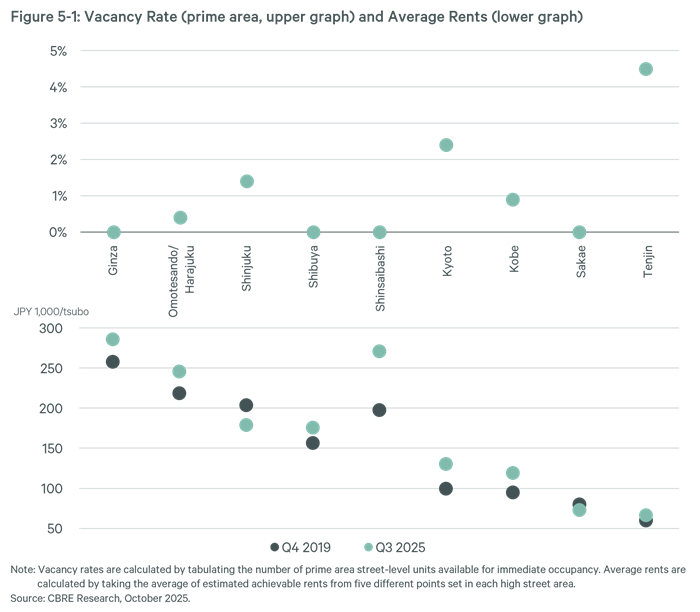
With retailer demand projected to remain strong in 2026 and available units limited, rent levels should continue to rise nationwide. CBRE projects Ginza high street rents to reach JPY 299,500 by the end of 2027, up 4.7% from Q3 2025 levels. In Shinjuku, increased retailer interest in available units is likely to intensify competition and push up average rents. In Kobe, should inbound consumption levels continue to rise due the introduction of international charter flights, retailers may be able to afford to pay higher rents.
Continue

Research Contacts





Contact Us
Please contact us below for inquiries related to our services, media, research reports, and recruitment.