Report | Future Cities
The Next Chapter: Retail and Logistics in Europe’s e-commerce future
May 1, 2026 10 Minute Read
Looking for a PDF of this content?
European e‑commerce has entered a new phase. Online sales volumes across the region are growing, though growth in the share of e-commerce over total retail sales in major markets is seeing more moderate growth as the market matures.
As a result, the emphasis is shifting from rapid expansion to optimisation. Retailers are reassessing how physical space is used, while supply chains and logistics networks are adapting to support more efficient and resilient fulfilment models.
CBRE’s latest report examines how these changes are reshaping both retail and logistics real estate across Europe, highlighting key market differences, category‑level trends and implications for occupiers and investors.
Analysis Profile
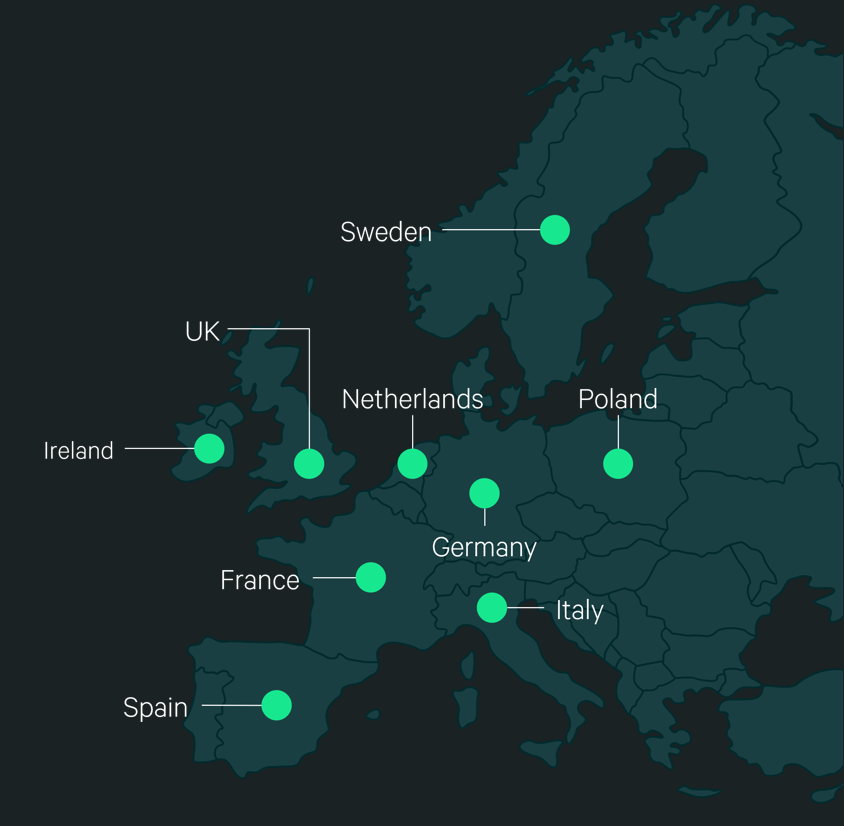
9 Markets
5 Goods Categories

Appliances & Electronics

Clothing & Footwear

Grocery

Health & Beauty

Home & Garden
Key findings
· European e‑commerce sales volumes continue to rise, but in most major markets the share of e‑commerce within total retail sales has converged towards the pre-pandemic growth trend.
· Retail stores are playing an increasingly important role in fulfilment, with some larger retailers dedicating a greater proportion of store space to stockrooms as brands integrate online and in‑store operations.
· E‑commerce penetration growth varies significantly by market, with most major markets seeing more moderate growth. Spain, Poland and Ireland stand out for sustained above‑trend growth, driven by unique local factors.
· Grocery and Health & Beauty are the fastest‑growing e‑commerce categories, while Appliances & Electronics and Clothing & Footwear have reached relatively high penetration levels.
· E‑commerce continues to support demand for logistics real estate, though at more sustainable levels, with increasing reliance on third‑party logistics (3PL) providers and more standardised warehouse requirements.
European e‑commerce: growth, maturity and market differences
European e‑commerce spending continues to grow in constant price terms and remains dominated by a small number of large markets. The UK, Germany, and France together account for more than half of total online sales, with Italy, Spain, the Netherlands, and Poland also representing significant volumes.
Over time, subtle shifts have emerged across the region. More mature markets such as the UK and Germany have seen a modest decline in their share of European e‑commerce spending, while less mature markets have increased their contribution as adoption deepens.
While further growth in e‑commerce penetration is expected across all markets, the pace and profile of growth are increasingly shaped by country‑specific factors, reflecting different stages of market maturity.
Market maturity varies widely across Europe, reinforcing the importance of localised retail and logistics strategies.
E‑commerce and logistics demand across Europe
E‑commerce continues to support demand for logistics real estate across Europe, reflecting the more space‑intensive nature of online fulfilment compared with traditional retail channels. Facilities supporting single‑item picking, higher inventory turnover, and last‑mile distribution remain essential.
While the surge in e‑commerce‑driven take‑up seen in earlier years has eased, demand has become more structurally embedded. Activity is now distributed across 3PLs, omnichannel retailers, and pureplay operators, rather than concentrated among online retailers alone.
As the sector matures, occupiers are placing greater emphasis on operational efficiency, location quality, and flexibility, supporting increased demand for automation‑ready facilities and more standardised warehouse specifications.
E‑commerce‑driven logistics demand is shifting from rapid expansion to long‑term optimisation.
E‑commerce performance by goods category
E‑commerce penetration and growth vary materially by goods category.
Appliances & Electronics has reached high penetration levels, supported by product standardisation, price transparency, and the strength of online marketplaces. Clothing & Footwear has also achieved significant penetration, although high return rates continue to present operational challenges to retailers.
Grocery and Health & Beauty have delivered the strongest growth relative to earlier baselines. While Grocery e‑commerce penetration remains low relative to other goods categories, growth in this category has an outsized impact on sales volumes, owing to the large (c. 40%) share of grocery sales as a proportion of total retail.
Despite low current penetration, grocery’s scale makes it a critical driver of future e commerce value growth.
Implications for retail real estate
Retailers are increasingly rationalising store portfolios in secondary locations to focus on prime locations and flagship formats. Larger stores with high‑quality fit‑outs are being used to reinforce brand presence and support omnichannel strategies.
Charging for online returns is becoming more widespread, particularly in Clothing & Footwear, as retailers seek to manage reverse‑logistics costs and encourage in‑store visits.
At the same time, stores are increasingly being used as fulfilment hubs, with a growing proportion of space allocated to stockrooms to support this omnichannel shift.
Implications for industrial & logistics real estate
E‑commerce remains a driver of logistics demand, even as growth has become more measured. The outsourcing of distribution to 3PLs continues, supporting more diversified and resilient demand across the sector.
Warehouse specifications are becoming less bespoke as operators seek greater flexibility. This benefits both occupiers and landlords, reducing single‑tenant dependency and supporting liquidity over the longer term.
Automation and efficiency are increasingly central to logistics strategies, with occupiers prioritising modern facilities capable of supporting robotics, streamlined flows, and lower environmental impact.
For detailed market analysis, data and country‑level insights, download the full report.