Adaptive Spaces
Business Insights | Top 10 Technologies Needed for an Engaging Workplace Experience
December 17, 2025 7 Minute Read

Executive Summary
With the digital work experience becoming as important as the physical experience, organizations that invest in technology consistently and holistically can strongly influence employee engagement. Consequently, 70% of corporate real estate leaders are using their technology strategy to optimize their real estate portfolios and workplace experience.
CBRE has partnered with Technology Architecture Design (TAD), a leader in innovative technology experience strategy, to identify the top 10 workplace technology trends. Each trend includes actionable steps to implement the approach both as a fundamental baseline for today’s business operations, as well as leading the future of work.
Figure 1: Tech Trends Ratings

01. Brand as Digital Experience
- High
- Medium
- Low
- High
- Medium
- Low
- Up
- Established
- Down
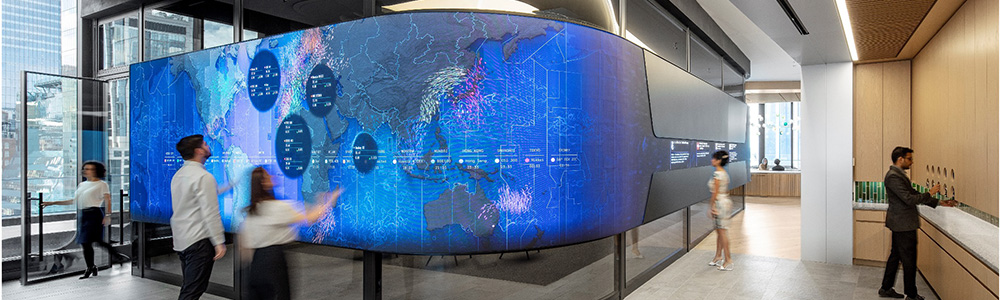
Technology has become a canvas for brand expression with high-impact displays, interactive installations and immersive environments now serving as stages for culture and innovation. These visible investments communicate identity and values to both talent and clients. As organizations refine their approach, the challenge is balancing bold brand statements with consistency across locations and the ability to evolve over time.
How to Implement:
Consider an immersive arrival experience featuring an interactive digital wall that shares your company’s vision, recent press releases and on-site events for the week, immediately informing visitors of your culture and providing wayfinding guidance.
02. Agile and Strategic Executive Spaces
- High
- Medium
- Low
- High
- Medium
- Low
- Up
- Established
- Down
Executive offices are evolving beyond the traditional boardroom. Approximately 30% of Fortune 500 firms took some major action regarding their physical HQ space over the past 5 years. Executive boardrooms and the comprehensive journey to the boardroom need to be efficient and intuitive, while advancing decision-making. Circular and multi-orientation layouts, studio-ready environments and adaptive furnishings create more flexible command centers for organizations. Paired with intelligent technologies, these spaces enable high-impact meetings with fewer staff and greater strategic value.
How to Implement:
Adopt automatic facial tracking or multiple cameras in executive meeting rooms with intelligent sound-masking to improve hybrid meetings for all participants. Innovators are rethinking meeting room design, introducing square layouts with circular or trapezoidal tables and in-the-round displays that foster natural eye contact between in-person and remote participants. In reception areas for executive meeting rooms, digitally immersive, intimate spaces set a calm tone for visitors before entering the formal meeting room.
03. High-Resolution Displays for Collaboration
- High
- Medium
- Low
- High
- Medium
- Low
- Up
- Established
- Down
Clarity drives connection. As hybrid and remote work increase, organizations need displays that deliver both detail and scale. Ultra-wide and high-resolution 8K Micro-LED walls allow teams to view participants and content side by side. More pixels mean more context, enabling seamless collaboration, sharper data visualization and moments that impress.
How to Implement:
Enhance hybrid meetings by adding more displays for dual-screen setups or moving to a 21:9 ultrawide format. The most advanced teams are creating seamless canvases, wrapping the room in a high-quality, immersive experience layered with intelligent screens that enable flexible, dynamic layouts.

04. Workplace as a Curated Experience
- High
- Medium
- Low
- High
- Medium
- Low
- Up
- Established
- Down
Offices no longer consist of rows of desks within four walls. They are evolving into destinations designed with hospitality at their core. Concierge apps, in-house catering and clubhouse-style lounges make the workplace feel more like a curated experience than an obligation. Over the past four years this shift has become critical: 65% of survey respondents prioritize improving the workplace experience as a key goal in their CRE tech strategy. Hospitality and holistic user experience have become the magnets that attract employees to work in-person.
How to Implement:
Design intentional spaces, from zones that prioritize digital and analog interaction to immersive entry areas that inspire and connect. Leading organizations go further by integrating visitor-management systems for seamless arrivals, wellness-focused amenities that support work-life balance and mobile applications that help employees navigate and orchestrate their day.
05. Turning Data into Intelligence
- High
- Medium
- Low
- High
- Medium
- Low
- Up
- Established
- Down
Workplaces are no longer designed and managed using assumptions. We are entering an era of ubiquitous available data providing insights to define user experience, organizational impact, and real estate performance. Approximately 97% of survey respondents’ Computer-Aided Facility Management (CAFM) or Integrated Workplace Management System (IWMS) system have automated data feeds to receive data from upstream systems. From digital twins to Internet of Things (IoT) driving machine-learning models predicting future occupancy, data is becoming the engine behind smarter, more agile and more responsive environments. The shift is clear: Workplaces that harness intelligence are better equipped to align space, performance and business goals.
How to Implement:
Track occupancy and space utilization to inform operational decisions. Leading organizations are unifying these data streams through smart building platforms and building robust network architectures. These can leverage digital twins to model and simulate scenarios, linking insights to business outcomes for more strategic decision-making.
06. AI as Infrastructure
- High
- Medium
- Low
- High
- Medium
- Low
- Up
- Established
- Down
AI is shifting from experiment to infrastructure. No longer treated as a novelty, it is becoming a core layer of workplace intelligence. From automation and translation to recognition and analytics, AI is streamlining workflows, surfacing insights and enabling more responsive environments. The emphasis is moving away from hype toward practical, scalable applications that reshape how organizations operate day to day. Approximately 36% of companies use AI in their daily workplace occupancy management.
How to Implement:
Many organizations lack a strategic approach to AI and instead deploy tools that are bundled with existing software without a cohesive plan. While 77% of organizations cite some level of technology maturity, none have achieved the highest level (Level 5), indicating significant growth potential. Leading organizations take a more deliberate approach by engaging the right stakeholders across HR, Real Estate and Technology, starting with a clearly defined challenge and mapping the AI workflow to ensure a structured process that aligns all parties.

07. Consumer Simplicity at Work
- High
- Medium
- Low
- High
- Medium
- Low
- Up
- Established
- Down
The technology people use every day sets their expectations at work. Smartphones, apps and smart devices are intuitive, seamless and fast; employees expect the same from enterprise systems. Audiovisual (AV) platforms are responding with simplified interfaces, wireless casting, device compatibility and automation. While software solutions are providing location awareness technology that facilitates greater in-person interaction and nudges behaviors for spontaneous collaboration. The result is a workplace experience that feels familiar, reduces friction and keeps users engaged without bypassing security or policy.
How to Implement:
Simplify the user experience by standardizing technology kits and creating consistent interfaces. Leading companies go further by evaluating the employee technology journey and adapting to evolving expectations shaped by consumer tech trends, ensuring investments align with these norms. They also plan for ongoing technology refreshes, allowing meaningful improvements to the user experience without requiring major upgrades or capital expenditures.
08. Designing Meetings for True Equity
- High
- Medium
- Low
- High
- Medium
- Low
- Up
- Established
- Down
Hybrid work exposed an inequity, since not everyone in a meeting has the same presence or voice. True equity means every participant—remote or in-room—can see, hear and contribute on equal terms. Organizations are responding with hybrid-ready furniture, camera-aware layouts and acoustic tuning. The goal is simple but powerful: Design meetings where no one feels like a second-class participant.
How to Implement:
Provide automatic camera tracking to follow speakers during meetings. Leading organizations are taking this further by integrating AI-powered features: participant identification, real-time guidance and embedded feedback or training tools that detect unusual behavior or anticipate delays. These systems can also collect post-meeting feedback to continuously improve the user experience and resolve issues proactively.
09. Flexible Spaces, Adaptive Infrastructure
- High
- Medium
- Low
- High
- Medium
- Low
- Up
- Established
- Down
Workplaces are demanding more from every square foot. Multipurpose rooms with reconfigurable layouts and orientations allow a single space to shift between lounge, presentation and conference modes with minimal friction. This pushes audiovisual systems and infrastructure to adapt in real time, delivering seamless transitions and consistent user experiences across constantly changing setups.
How to Implement:
Coordinate AV, furniture design and IT systems, selecting a ceiling or floor “technical surface” to house power, data and AV connections, which frees walls and furniture for mobile, reconfigurable equipment. At the forefront, innovators are applying behavioral AI analysis to model how employees are likely to use the space, optimizing configurations and equipment while reducing the need for complex room divisions, lowering both cost and operational friction.

10. Sustainability Becomes Standard
- High
- Medium
- Low
- High
- Medium
- Low
- Up
- Established
- Down
Sustainability is moving from aspiration to expectation in audiovisual design: 44% of CBRE survey respondents see sustainability goals as part of their tech strategy. Energy efficiency, lifecycle responsibility and carbon transparency are becoming core factors in technology decisions. With new global regulations and rising awareness, organizations are being asked to account for AV’s impact while still delivering high-performance systems. The focus is shifting toward solutions that balance environmental responsibility with innovation.
How to Implement:
While most companies have set sustainability targets for real estate and engineering systems, they often leave AV out due to limited sustainable options. Forward-thinking organizations, however, design with long-term value in mind, incorporating lifecycle management and equipment reuse to create future-proof AV systems that align with broader sustainability goals and reduce carbon output throughout procurement.
Conclusion
Companies vary in their maturity of workplace technology; much of this differs by industry, organizational size, culture and values.
What is essential is understanding where you lie on the technology-maturity scale, defining your goals and comprehending the actionable steps it takes to achieve them.
Workplaces that thrive enable flexibility, recognizing that technology evolves far faster than the built environment. Most organizations view their workplace as the physical embodiment of their culture and a tool for employee engagement, defining how technology is going to integrate and reflect those priorities in the workplace will have organizations seeing the greatest return on their investments.
Related Insights
-
Article | Creating Resilience
Business Insights | How Property Management is Building Resilience to Climate Risk
October 14, 2025

With the built environment estimated to account for up to 40% of all greenhouse gas emissions globally, the corporate real estate industry is well positioned to play a lead role in combating climate change.
-

Higher interest rates weigh on transactions; rental momentum continues
Related Services
- Plan, Lease & Occupy
Workplace Strategy
Build resilience, attract and retain talent, and foster connection and collaboration in your workplace.
- Transform Business Outcomes
Consulting
Gain comprehensive guidance on insightful, executable real estate strategies for both investors and occupiers.
Contacts
Sarena Ehrlich
Managing Director, Americas Consulting
.png)