Pittsburgh, PA
CBRE Analysis: Pittsburgh Emerges as a Prime Location for Life Sciences Research Talent
Pittsburgh ranks among top 25 U.S. life sciences labor markets
June 12, 2023

Media Contact
Comms Manager

A new analysis conducted by CBRE identifying the 25 top U.S. life sciences labor markets ranks Pittsburgh 23rd for life sciences research talent due to its density of researchers, graduates in life science-related disciplines and low cost of living.
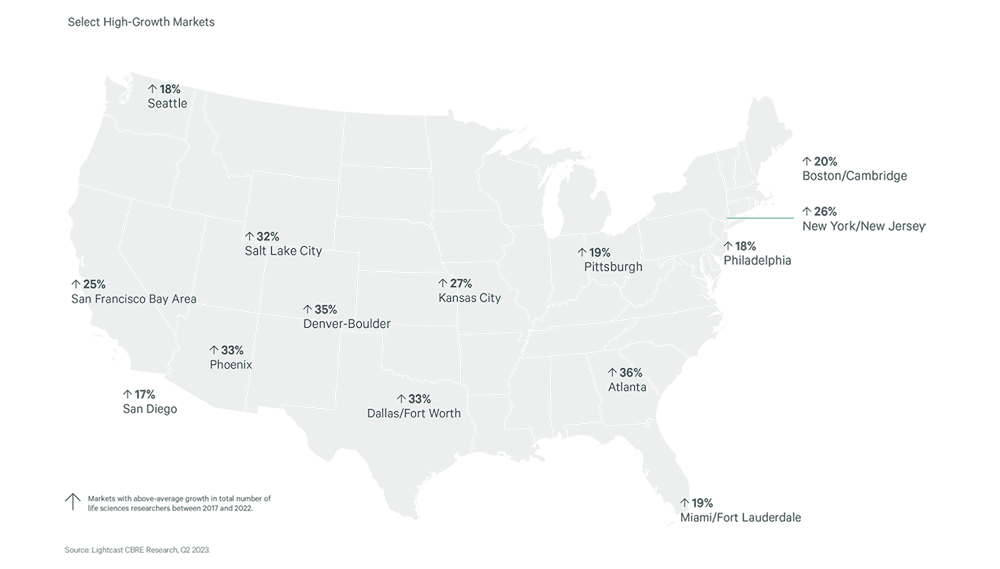
Between 2017 and 2022, Pittsburgh’s pool of life sciences researchers increased 19%, adding 422 positions for a total of 4,680. The metro’s growth in talent brings its share of life science researchers as a percentage of its total labor force to 0.4%, among the highest in the nation.
Pittsburgh also produced the ninth fastest growth rate of new life sciences graduates (1,771 graduates in 2021: 22% growth from 2016-2021) and has the 23rd lowest cost of living among all ranked markets ($49,275).
“Pittsburgh’s laboratory science community continues to expand on an annual basis,” said CBRE’s Andrew Miller, senior vice president in Pittsburgh. “Both local and national investors are exhibiting a strong interest in owning life science real estate here and are increasingly acquiring and expanding the younger companies that use our lab space. The region’s talent pool, which includes a high amount of life science graduates, and the low cost of living with comparable salaries to larger markets, has a lot to do with both of those trends. In the coming years, the growing interest of investors, companies and employees in Pittsburgh is anticipated to fuel our rise as a burgeoning life sciences hub.”
Nationally, the growth of U.S. life sciences researchers remains resilient in the face of economic concerns. The number of life sciences researchers in the U.S. increased by 87% over the past 20 years, compared with 14% for all U.S. occupations. Research jobs have not fallen across those 20 years, through three recessions and amid a tight labor market of recent years.
Life sciences research professions – from biochemists to epidemiologists and data scientists – increased in headcount by 3.1% in 2022 to a record 545,000 specialists. In comparison, the overall U.S. job growth rate last year was 2.2%. The continued growth in life sciences research jobs is driven by established markets such as Boston/Cambridge and the San Francisco Bay Area and emerging hubs, including Atlanta, Dallas/Fort Worth and Miami/Fort Lauderdale.
CBRE evaluated each of the largest 74 U.S. life sciences labor markets against multiple criteria, including the number and concentration of life sciences researchers, number of new graduates with life sciences degrees and specifically with doctorate degrees in life sciences, concentration of all doctorate degree holders, and concentration of jobs in the broader professional, scientific, and technical services professions. The analysis produced CBRE’s second annual ranking of the leading markets for U.S. life sciences talent.
| Rank | Market | Score | Rank | Market | Score |
| 1 | Boston/Cambridge | 139.6 | 13 | Houston | 103.5 |
| 2 | San Francisco Bay Area | 132.1 | 14 | Atlanta | 103.3 |
| 3 | Washington, D.C./Baltimore | 129.0 | 15 | Sacramento | 102.3 |
| 4 | New York/New Jersey | 126.8 | 16 | Austin | 101.8 |
| 5 | San Diego | 118.8 | 17 | Worcester | 101.7 |
| 6 | Philadelphia | 114.5 | 18 | Salt Lake City | 101.7 |
| 7 | Raleigh/Durham | 114.1 | 19 | Dallas/Fort Worth | 101.0 |
| 8 | Los Angeles/Orange County | 112.3 | 20 | Miami/Fort Lauderdale | 100.6 |
| 9 | Seattle | 109.8 | 21 | Albany | 100.3 |
| 10 | Denver/Boulder | 108.9 | 22 | Portland | 100.2 |
| 11 | Minneapolis/St. Paul | 106.7 | 23 | Pittsburgh | 100.1 |
| 12 | Chicago | 106.4 | 24 | New Haven | 99.6 |
| 25 | Nashville | 98.5 |
“Demand for life sciences research workers is above pre-pandemic levels,” said Matt Gardner, CBRE Advisory Services Life Sciences Leader. “We’re also seeing a closely balanced ratio of hiring to job cuts in the biopharma industry compared with the technology sector and the broader economy, which positions the life sciences to remain stable despite an economic downturn.”
“It’s worth mentioning that large lab markets, such as Boston and the San Francisco Bay Area remain stable,” he said. “But in the second year of our analysis, we’re seeing cities like Atlanta, Philadelphia and Denver/Boulder gain ground as hubs for life science research talent.”
CBRE’s analysis allows for examination of the industry from various angles, including shifts in the type of life science research occupations. For example, the number of digital and analytics roles has increased by 101% in the last five years due to innovation in artificial intelligence and machine learning. The industry is also experiencing a shift from chemistry to biology, resulting in a 1.2% decrease in the number of chemists over the past five years.
Phoenix produced the fastest growth rate of new life sciences graduates (2,000 graduates in 2021: 91% growth from 2016-2021). Additionally, markets that produced the highest number of graduates in specialized fields include Washington D.C./Baltimore (582 biotechnology graduates in 2021) and the San Francisco Bay Area (877 cell/cellular biology and anatomical sciences graduates in 2021).
Another interesting finding: Several markets saw above-average growth in the total number of life sciences researchers between 2017 and 2022. These include Atlanta (36%), Denver/Boulder (35%), Dallas/Fort Worth (33%) and Phoenix (33%). The national average in that span was 16%. It’s important to note that each market is also home to leading research and higher education institutions.
To read the full report, click here.