Evolving Workforces
Business Insights | How Automation Helps Manufacturers Scale Without Adding Headcount
Automation & the Manufacturing Workforce, Part 1 of 3
October 15, 2026 4 Minute Read

Contact Us To Get Started
This is the first in a three-part series on automation and the manufacturing workforce. This article examines how automation allows manufacturers to increase output without proportionally increasing headcount, and how that shift is changing capacity planning, labor costs and workforce requirements.
For most of manufacturing’s history, growth meant hiring people. If a company wanted to meet rising demand, the standard strategy was to add a shift or expand the workforce. The relationship between production volume and people defined how manufacturers thought about capacity, risk and expansion.
Automation has weakened that link. Manufacturers can now increase output without hiring at the same scale and respond to fluctuating demand without hiring delays or employing underutilized workers. As a result, manufacturers have changed how they plan for, invest in and size their real estate footprints.
The Limits of a Traditional Manufacturing Scaling Model
Before automation became a genuine operational option, manufacturers scaled through people and space.
But when demand spikes, manufacturers that depend on headcount can’t respond fast enough. Recruiting, screening, onboarding and training a skilled production worker takes weeks, if not months.
Manufacturers that staff their workforce for peak cycles carry expensive, excess labor throughout the rest of the year. Those who staff for average demand create fulfillment risk during peak demand, losing orders to competitors that can deliver products faster. Both strategies are inefficient and erode margins.
Labor volatility exacerbates this problem. Employee turnover in repetitive manufacturing roles has historically run high. And high rates of absenteeism create daily uncertainty about production capacity, particularly when workers are required to perform physically demanding tasks. Despite sophisticated production planning systems, attendance is impossible to predict.
To promote attendance and sustain productivity, some manufacturers offer production and attendance-based bonus programs to their employees. While these incentives can improve workforce reliability, they also create an additional labor-related expense.
How Automated Scaling Works
A facility with substantial automation runs a different model. Capacity is a function of equipment, not headcount.
To scale up, a manufacturer reconfigures lines, adds shifts to operate automated equipment at a minimal labor cost or brings additional robotic cells online. Employees primarily fill technical, oversight and quality control roles, leaving headcount relatively stable as production needs fluctuate.
To scale down, manufacturers run fewer shifts. That's the decoupling automation enables: output can grow substantially without proportional growth in headcount, and a drop in demand no longer forces immediate layoffs since production workers represent a smaller share of total variable cost.
The economics are easiest to see on a single production line.
Example Scenario: High-Volume Production Operation
Before Automation
- Headcount: The high-volume operation runs one production line with 23 people:
- Twenty workers performing repetitive physical labor at $18 an hour
- Two supervisors
- One maintenance technician
- Total labor cost: $451 per hour or $938,000 per year
- Units produced: 500 units per hour
- Labor cost per thousand units shipped: $902
After Automation
- Headcount: The same line runs with nine people, a 61% reduction in headcount:
- Four machine operators monitoring and adjusting equipment
- Three maintenance technicians with electrical and mechanical credentials
- One automation engineer managing programming and continuous improvement
- One supervisor with increasingly complex responsibilities
- Total labor cost: $316 per hour or $658,000 per year
- Units produced: 1,200 units per hour
- Labor cost per thousand units shipped: $263
On the automated production line, wages are higher across the board, with technicians at $42 per hour and the engineer at $65. Even so, a reduced headcount drives down labor costs, resulting in savings of approximately $280,000 per year. With an initial capital investment of $900,000 for the automated line, the manufacturer will recoup its investment in just over three years. Moreover, the automated line produces more than double the output, and per-unit labor cost declines by about 70%.
The Labor Paradox
Modern manufacturing presents operators with a key challenge: The same technologies that reduce dependence on large labor pools increase dependence on highly skilled talent that is in short supply.
In an automated manufacturing facility, workers with advanced skills are essential. Equipment operation, mechanical and electrical knowledge, data literacy and programmable logic controller programming are highly sought after. Meanwhile, physical strength, basic dexterity and stamina—the once-dominant requirements of manufacturing—matter less.
While automation increases labor costs per person, workforces are smaller, more specialized and far more productive per dollar spent. However, most workers displaced by automation can’t be easily retrained. As a result, manufacturers typically upskill the few employees with adjacent skills, hire externally for high-skill positions and manage attrition or severance for the rest.
Manufacturers have largely solved how to automate their plants. The next transformation is happening in the workforce itself.
Figure 1: Annual Labor Impact of an Automated Production Line
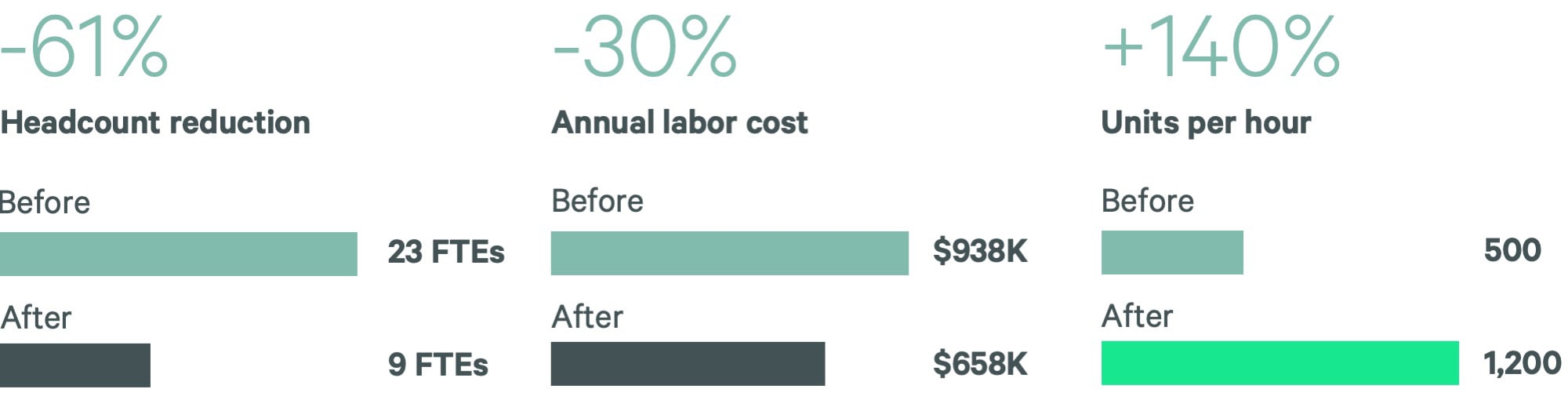
Source: CBRE Labor Analytics, 2026.
The next article in this series explores the impact of automation on specific roles, which manufacturing positions are growing in demand and the impact of automation on worker compensation.
Read The Next Article In The Series
-
Article | Evolving Workforces
Business Insights | Manufacturing Jobs Growing in the Age of Automation
October 15, 2026

Automation is restructuring manufacturing jobs. Learn which roles are declining and which are growing.
-
Article | Evolving Workforces
Business Insights | Closing Manufacturing's Skills Gap
October 15, 2026
Learn why manufacturing's technical skills gap is slowing automation and how employers can close it.
Related Services
- Property Type
Industrial & Logistics
We represent the largest industrial real estate platform in the world, offering an integrated suite of services for occupiers and investors.
- Consulting
Labor Analytics
Make better location decisions with a holistic approach that weighs factors like labor costs and availability, supply chain logistics, and incentives.
Contact
Valentin Hernandez
Senior Director of Client Strategy