Evolving Workforces
Business Insights | Manufacturing Jobs Growing in the Age of Automation
Automation & the Manufacturing Workforce, Part 2 of 3
October 15, 2026 4 Minute Read
Contact Us To Get Started
This is the second in a three-part series on automation and the manufacturing workforce. This article examines which manufacturing jobs are most vulnerable to automation, which roles are growing and how the transition toward a more technical workforce is changing wages and labor costs.
Read Part 1 of the series here: How Automation Helps Manufacturers Scale Without Adding Headcount
For decades, manufacturing jobs primarily centered on operating a machine or working a line. The work was physical, the training was short and the wages were reliable. Millions of Americans built comfortable, middle-class lives in this sector. The worry now is that automation is taking those jobs away.
The reality is more nuanced and demanding. Automation isn’t eliminating manufacturing jobs. It’s restructuring them, replacing many manual roles with fewer, more technical roles. However, the work is changing faster than the workforce being trained for it, presenting a considerable challenge for manufacturers and the communities that depend on them.
What Jobs Does Manufacturing Automation Displace?
The jobs most vulnerable to automation are repetitive, predictable, rule-based and physically demanding. Robots now outperform people on speed, precision and cost per unit in a wide range of manufacturing roles, including pick-and-place assembly, spot welding, basic quality inspection and materials handling between workstations.
As a result, employment for routine cognitive and manual occupations has stagnated or declined, while employment has risen for occupations requiring analytical, technical, problem-solving and interpersonal skills. Economists call this shift job polarization: automation absorbs repetitive, rule-based tasks and raises the value of judgment, adaptability and complex decision-making.
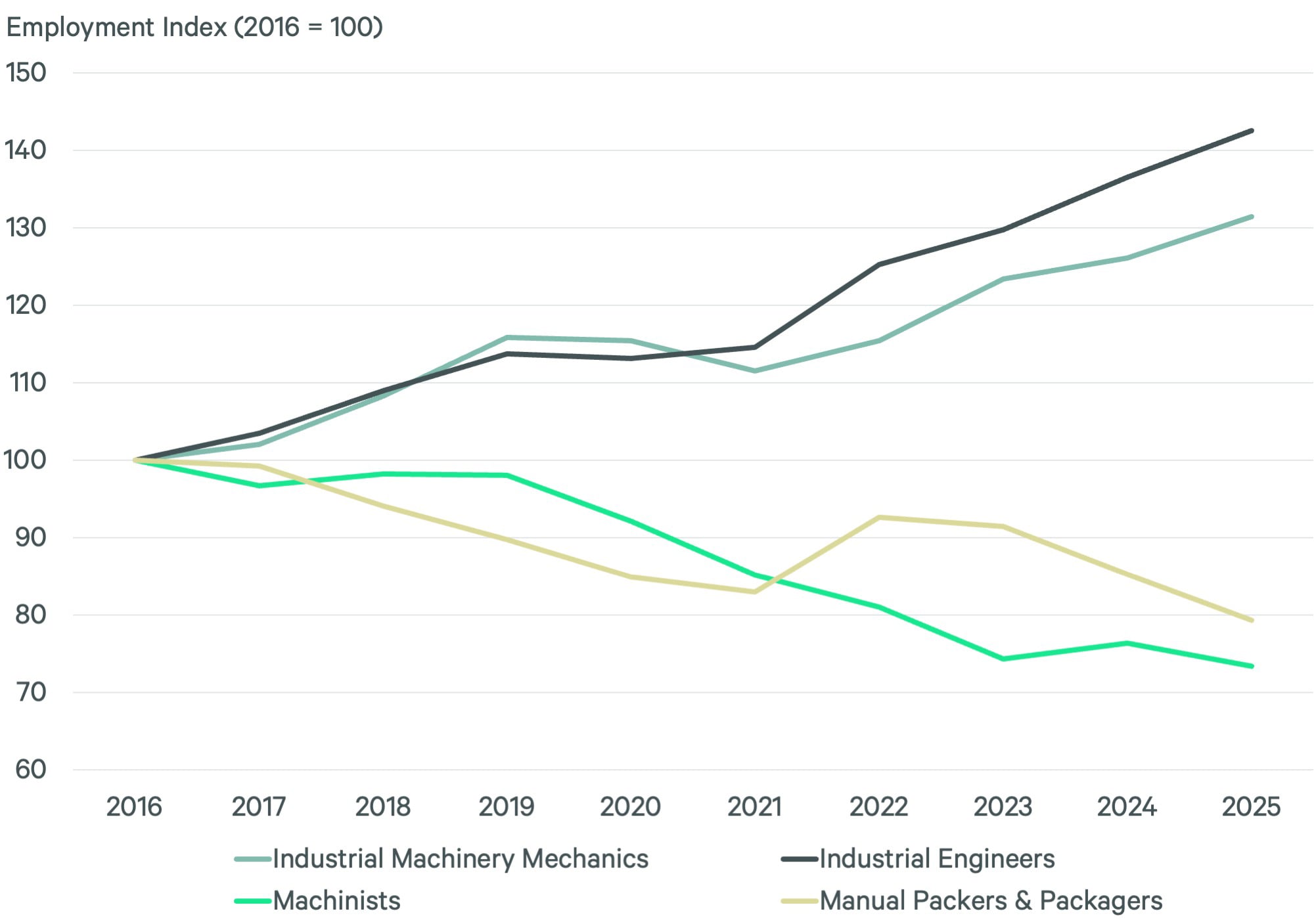
For select manufacturing positions, employment for hand packers & packagers and machinists declined the most from 2016 to 2025, with machinists down by more than 25%, according to Bureau of Labor Statistics (BLS) Occupational Employment and Wage Statistics (OEWS) data. Meanwhile, employment for industrial engineers, computer numerical control tool operators and industrial machinery mechanics had the strongest growth.
Figure 1: Employment Trends for Select Manufacturing Occupations
This dynamic is impacting workforce planning. Many employees in the roles being eliminated can’t perform the highly skilled tasks that are in demand. For example, an assembly line worker who spent 20 years doing repetitive fastening can’t easily step directly into a robotics technician role. The skills, training pathways and cognitive demands differ.
As demand for skilled labor continues to outpace supply, manufacturers, educators, and economic development stakeholders are under increasing pressure to create scalable, cost-effective talent development pathways that align with evolving workforce needs.
The New Manufacturing Workforce Profile
The manufacturing facilities being built and upgraded today need a different workforce than the ones they’re replacing. Three categories of roles are growing faster than the sector overall:
Automation technicians and robotics maintenance specialists keep increasingly automated factories running. When a collaborative robot fails, a robot cell stops or a conveyor system malfunctions, they diagnose the issue, make the repair and return production to service. These roles require mechanical aptitude, electrical knowledge and expertise in programmable logic controllers and robotic systems. Despite the technical skills involved, they rarely require engineering degrees and pay well above traditional production occupations.
From 2016 to 2025, employment for industrial machinery mechanics rose by 31%, while employment for electro-mechanical and mechatronics technologists and technicians increased by 13%, according to BLS OEWS. Moreover, median annual wages for both occupations rose by 29% and 32%, respectively, during the same period.
Process engineers and automation systems integrators design and optimize production workflows that blend human and robotic work. As manufacturers adopt AI, these roles now include machine vision, predictive maintenance, digital twins and AI-enabled process optimization. The convergence of engineering, automation and data science has created demand for skilled workers who can connect physical production systems to advanced analytics. These positions require a bachelor’s degree, at minimum, and specialization in controls, robotics or industrial engineering.
Employment for industrial engineers rose by nearly 43% from 2016 to 2025, according to BLS OEWS. Even then, supply is not keeping pace with demand in most major manufacturing markets.
Data analysts and technology specialists are a new manufacturing occupation category. These individuals analyze the enormous volume of data generated by automated facilities—including equipment uptime and defect rates, throughput variability, and energy consumption—to improve operations. The analytical capability required to perform these responsibilities was never part of traditional manufacturing skill sets. As a result, manufacturers are recruiting data and technology professionals from other industries.
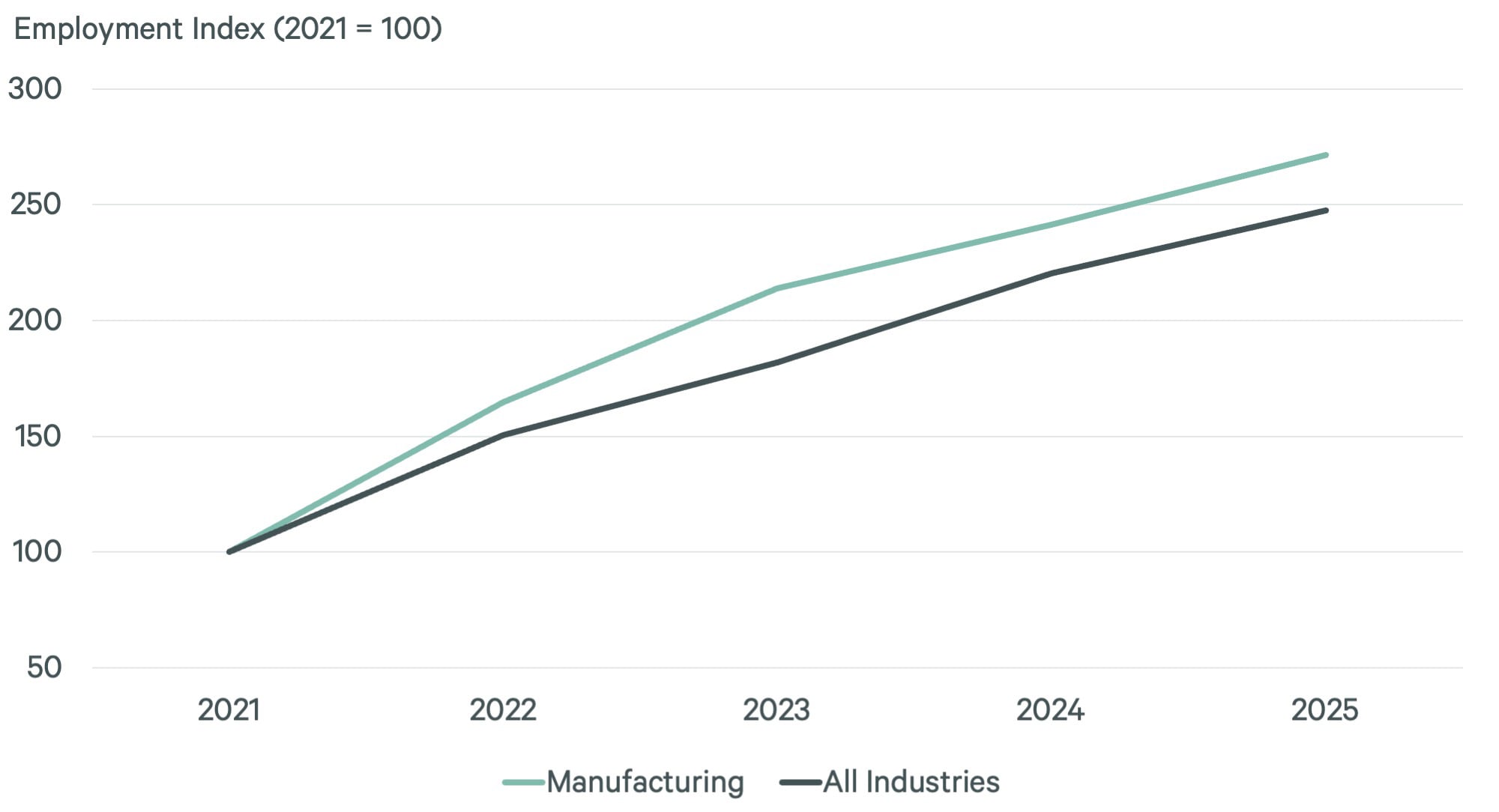
Employment for data science and computer occupations within manufacturing rose by 171% and 72%, respectively, from 2021 to 2025, according to BLS OEWS. Data science roles in manufacturing outpaced the occupation’s 147% growth across all industries during that same period.
Figure 2: Data Scientist Employment Trends by Industry
Automation’s Impact on Manufacturing Wages
Automated manufacturing is primarily affecting pay levels, not wage growth.
The technical positions that design, program and maintain automated lines command much higher compensation than production work. In 2025, industrial engineers and data scientists earned median annual compensation of $102,000 and $120,000, respectively—nearly double the $45,000 to $55,000 of machinists, welders, assemblers and machine operators. This premium illustrates how automation changes a manufacturer’s labor economics.
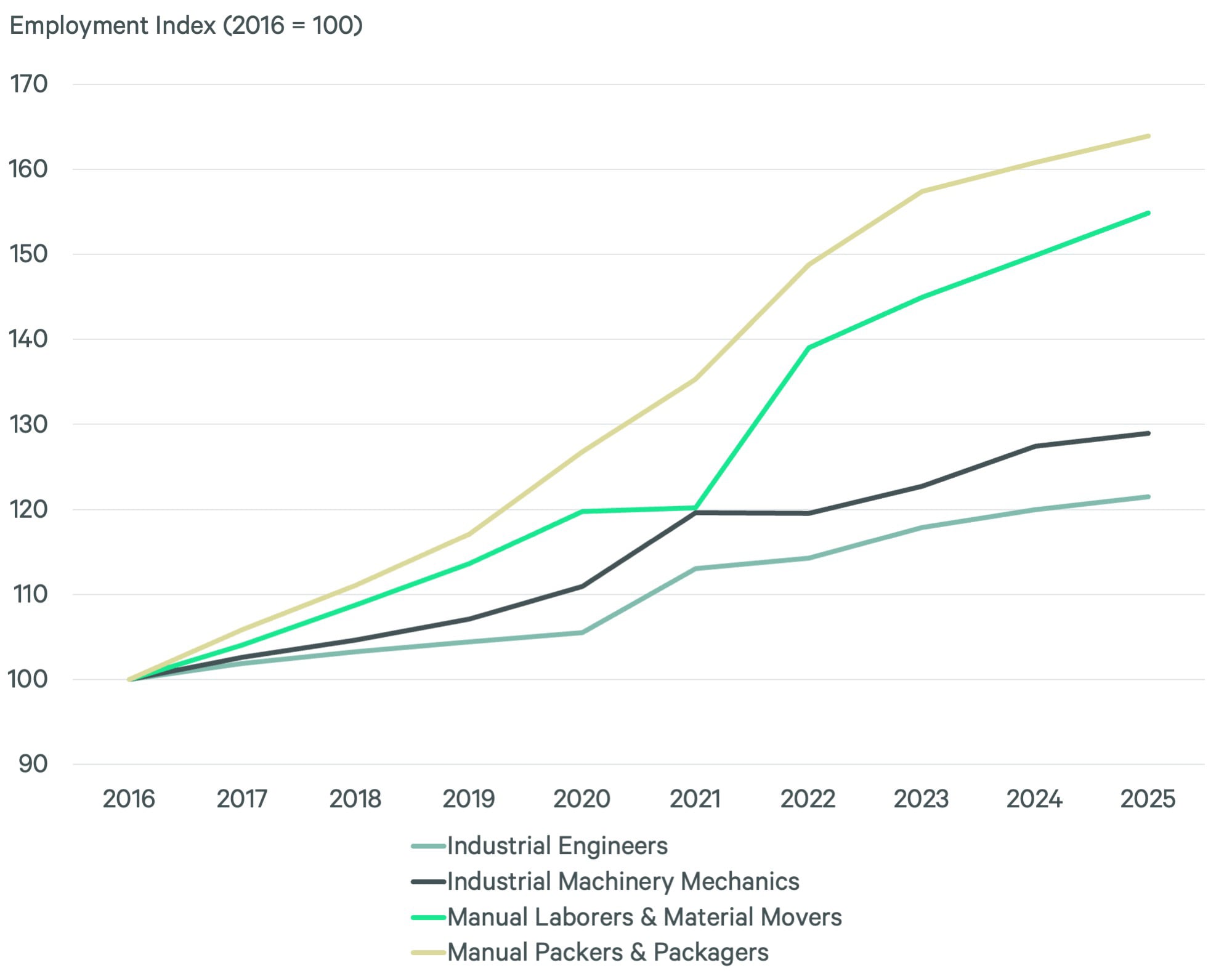
Recent wage growth has run the other way. A dwindling supply of traditional production workers has increased wages for those roles. From 2016 to 2025, median pay for nearly every production role increased, with the largest percentage gains concentrated in manual roles, according BLS data. Wage growth for hand packers and laborers rose by 64% and 55%, respectively, lifted by a tight labor market and rising wage floors. Meanwhile, wages for technical roles grew at a slower pace during that same period, but inflation absorbed much of the increase, limiting gains in real income.
Figure 3: Median Annual Wage Trends of Manufacturing Occupations
Automation has the greatest impact on workforce composition. As technical manufacturing headcounts rise to meet demand, a larger share of payroll shifts to those more highly compensated roles. Recruiting and retaining that talent is costly and time intensive, particularly in regions with large manufacturing bases. The net effect: total labor cost per unit falls as automation lifts output and the average cost of each remaining highly skilled worker rises.
Keeping Pace with Manufacturing’s Evolving Workforce
Workforce transformation will define the next era of manufacturing competitiveness. Demand will shift toward workers who can maintain automated systems, optimize complex processes and convert operational data into decisions. As a result, manufacturing workforces will have less routine, manual roles and more high-skill, high-value positions.
Manufacturers that attract, develop and retain technical talent across automation, engineering and analytics will be best positioned to capture the productivity gains the technology offers.
The next article in this series explores the skills gap between traditional and technical manufacturing workers and what employers, educators and policymakers are doing to close it.
Read The Next Article In The Series
-
Article | Evolving Workforces
Business Insights | How Automation Helps Manufacturers Scale Without Adding Headcount
October 15, 2026

Learn how automation lets manufacturers increase output and cut labor costs without adding headcount.
-
Article | Evolving Workforces
Business Insights | Closing Manufacturing's Skills Gap
October 15, 2026

Learn why manufacturing's technical skills gap is slowing automation and how employers can close it.
Related Services
- Property Type
Industrial & Logistics
We represent the largest industrial real estate platform in the world, offering an integrated suite of services for occupiers and investors.
- Consulting
Labor Analytics
Make better location decisions with a holistic approach that weighs factors like labor costs and availability, supply chain logistics, and incentives.
Contact
Valentin Hernandez
Senior Director of Client Strategy