Future Cities
2023 North America Industrial Big Box Review & Outlook: Central Florida
April 4, 2023 5 Minute Read

The Central Florida market continues seeing significant demand from industrial warehouse and logistics occupiers seeking to utilize the region’s central geography for statewide distribution. Improved road linkages throughout Central Florida, including a widening of I-4 and the completion of Orlando’s Western Beltway (SR 429), are driving new development opportunities.
Demographics
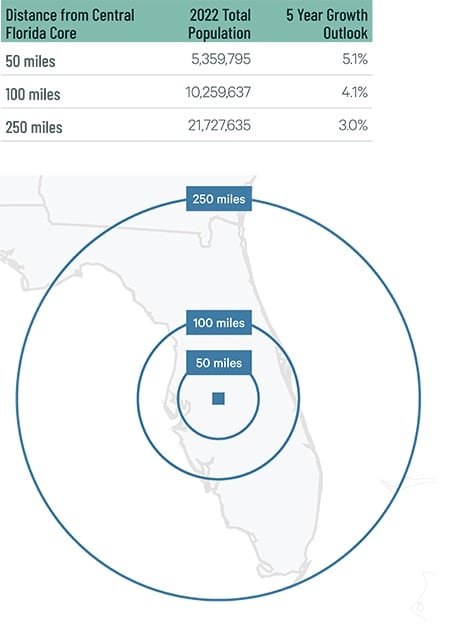
Over 5 million people live within 50 miles of the region’s core, with a 5.1% expected five-year growth rate—the second-highest of any region in the Southeast. Within 250 miles, occupiers can reach 22 million people or 8.6 million households.
Figure 1: Central Florida Population Analysis
Source: CBRE Location Intelligence, Q4 2022.
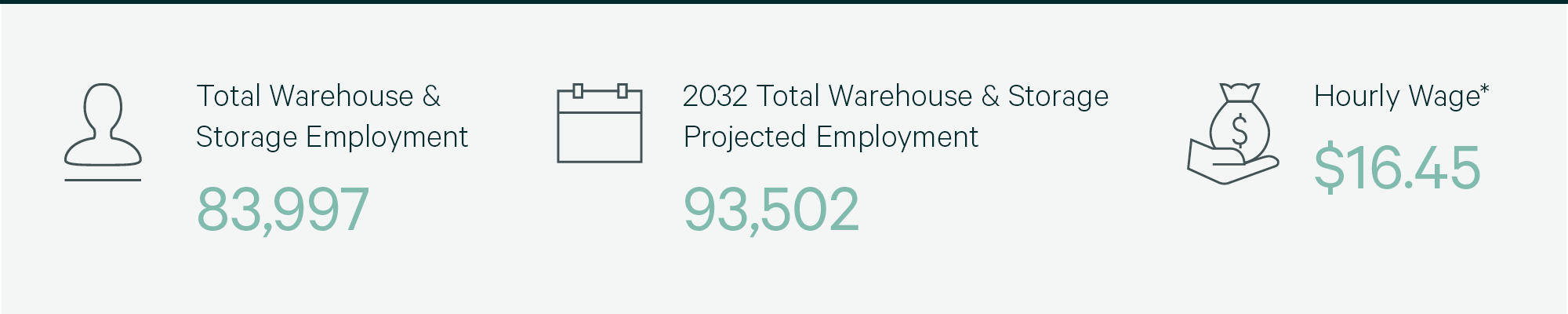
The local warehouse labor force of 83,997 is expected to grow by 11.3% by 2032, according to CBRE Labor Analytics. The average wage for a non-supervisory employee in Central Florida is $16.45 per hour, 2.7% lower than the U.S. average and the lowest for any U.S. market in this report.
Figure 2: Central Florida Warehouse & Storage Labor Fundamentals
Source: CBRE Labor Analytics, Q4 2022.
*Median wage (1 year experience); non-supervisory warehouse material handlers.
Location Incentives
Over the past five years, there have been 173 publicly known economic incentives deals totaling over $126 million for an average of $4,693 per new job in metro Tampa and Orlando combined, according to Wavteq.
CBRE’s Location Incentives Group reports that top incentive programs offered in metro Tampa and Orlando is the Quick Response Training grant, offering funding for new full-time employee training. This grant typically goes to businesses in high-skill industries, produce exportable goods and services and have wages 125% above the state or local average.
Florida also offers the Capital Investment Tax Credit (CITC) and High Impact Performance Incentive (HIPI). CITC is a corporate income tax credit for businesses that make a minimum investment of $25 million and create at least 100 new high-paying jobs. HIPI is a cash grant for businesses that make a minimum investment of $50 million and create at least 50 new high-paying jobs.
Figure 3: Central Florida Top Incentive Programs
Source: CBRE Location Incentives Group, Q4 2022.
Note: The extent, if any, of state and local incentive offerings depends on location and scope of the operation.
Logistics Driver
Central Florida provides many logistics advantages to reach the entire state of Florida and beyond. The region hosts two international airports (Tampa and Orlando) with growing air cargo capabilities. Work is underway on the I-4 Ultimate Project, which will improve truck flow throughout the region. The region’s biggest logistics advantage is its rail capabilities. CSX Central Florida ILC is an innovative facility that can process 300,000 containers annually and can increase capacity.
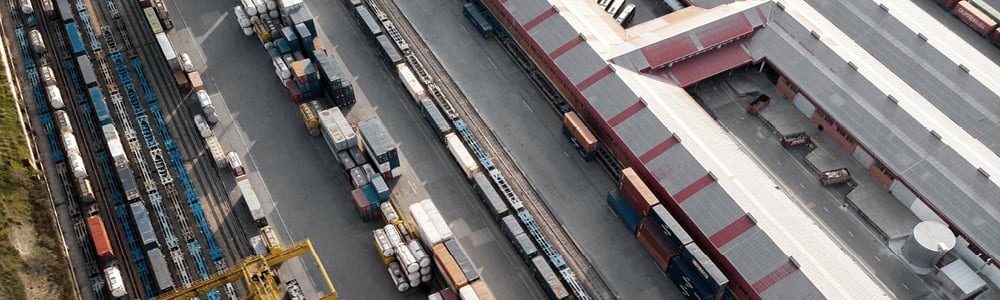
Central Florida's biggest logistics advantage is its rail capabilities.
Capital Markets
Historically, Florida has been a distribution hub to other bulk markets in the Southeast region. But the flow of goods is now moving into Florida due to its nation-leading population growth. Larger big-box facilities have performed well. Key sites are scarcer now because of competition from residential developers over strategic access to major interchanges. Investor interest in ground-up development, vacant shells and stabilized product has significantly increased in Florida.
Supply & Demand
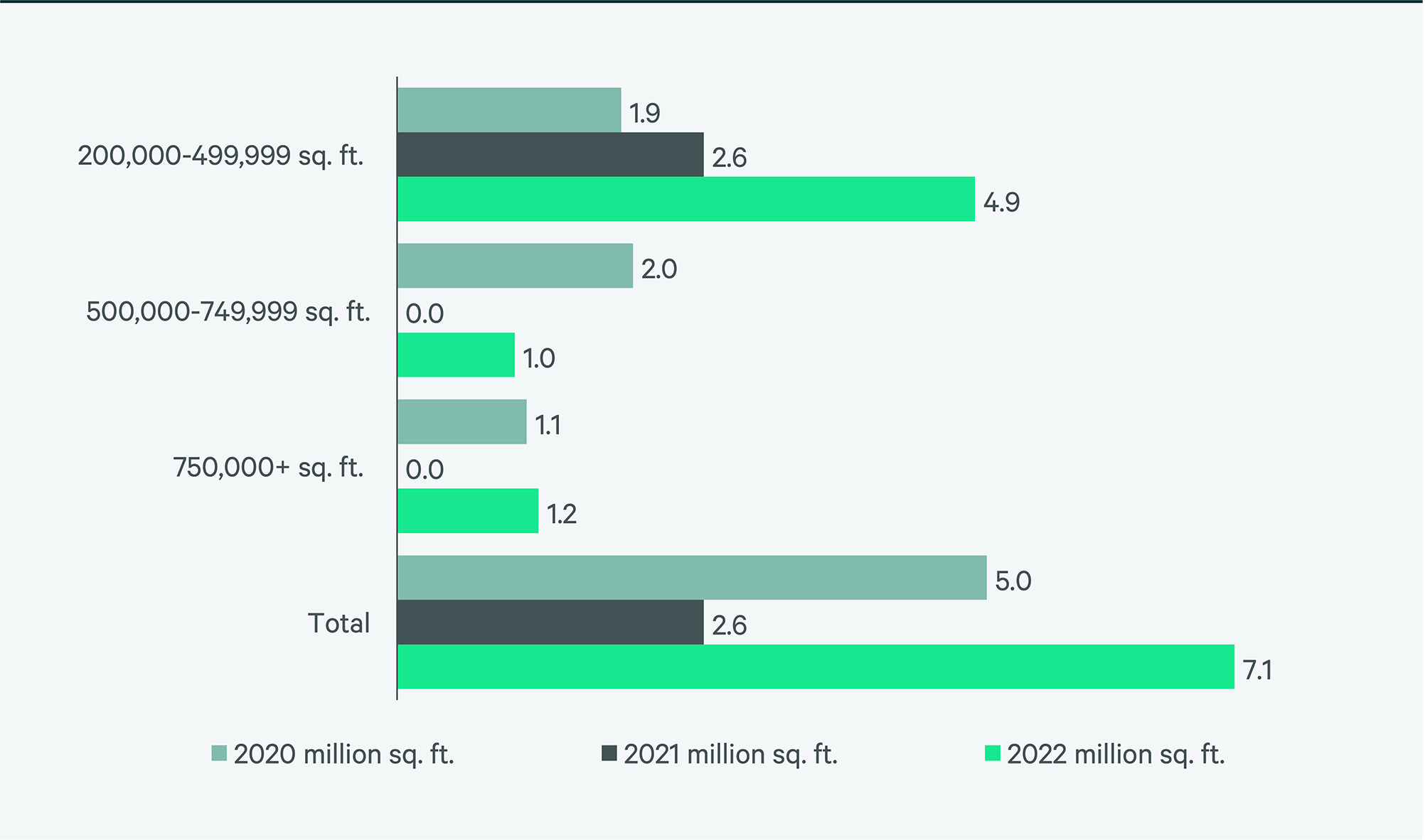
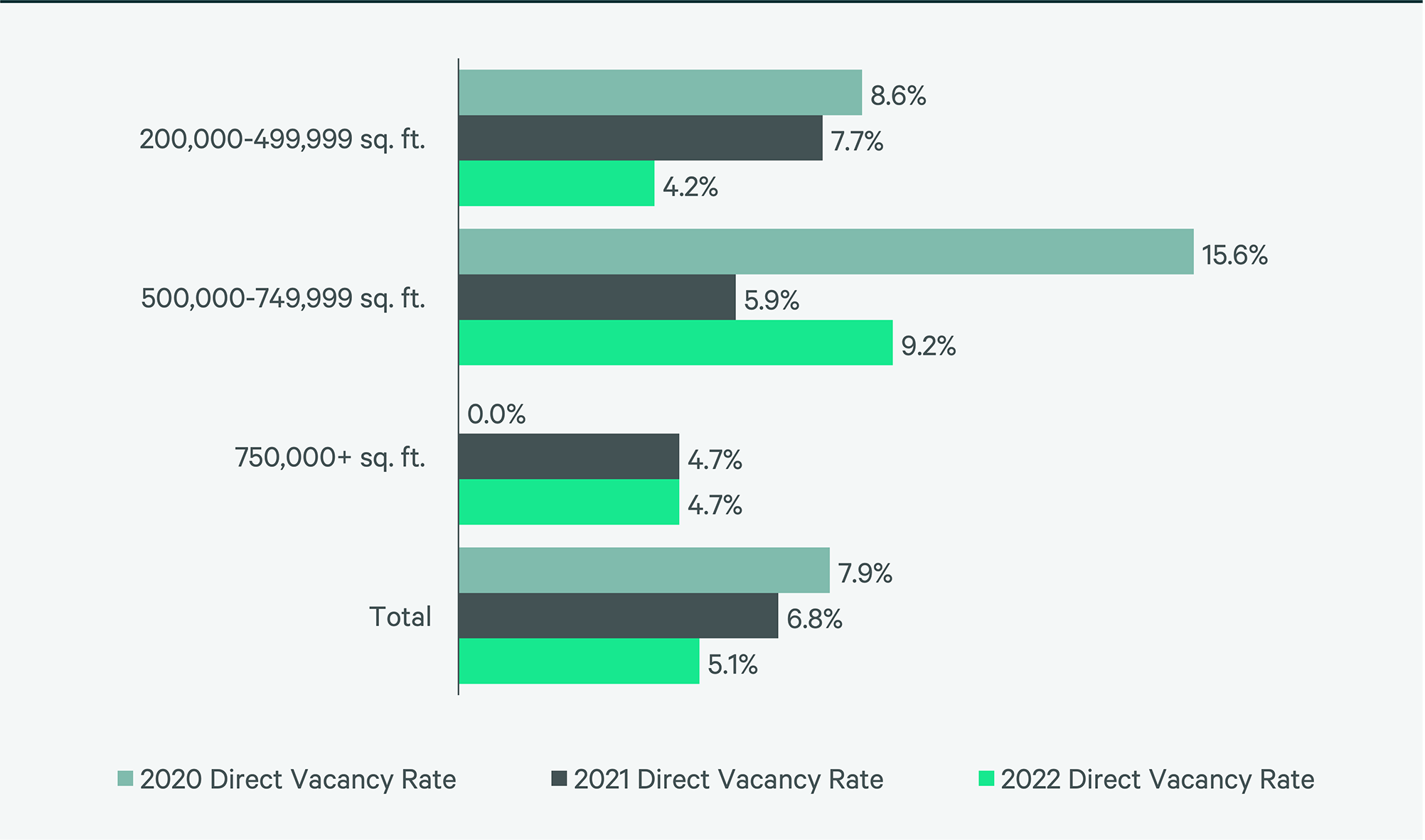
Most of Central Florida’s 100 million sq. ft. of inventory is made up of facilities under 500,000 sq. ft. Transaction volume was robust in this size range, driving overall big-box leasing to 7.1 million sq. ft., triple 2021’s rate of leasing and nearly double 2020’s. Robust transaction volume drove up net absorption, lowering the direct vacancy rate to 5.1%. General retailers & wholesalers (33%) and automobiles, tires, & parts (20.8%) drove demand in the market in 2022.
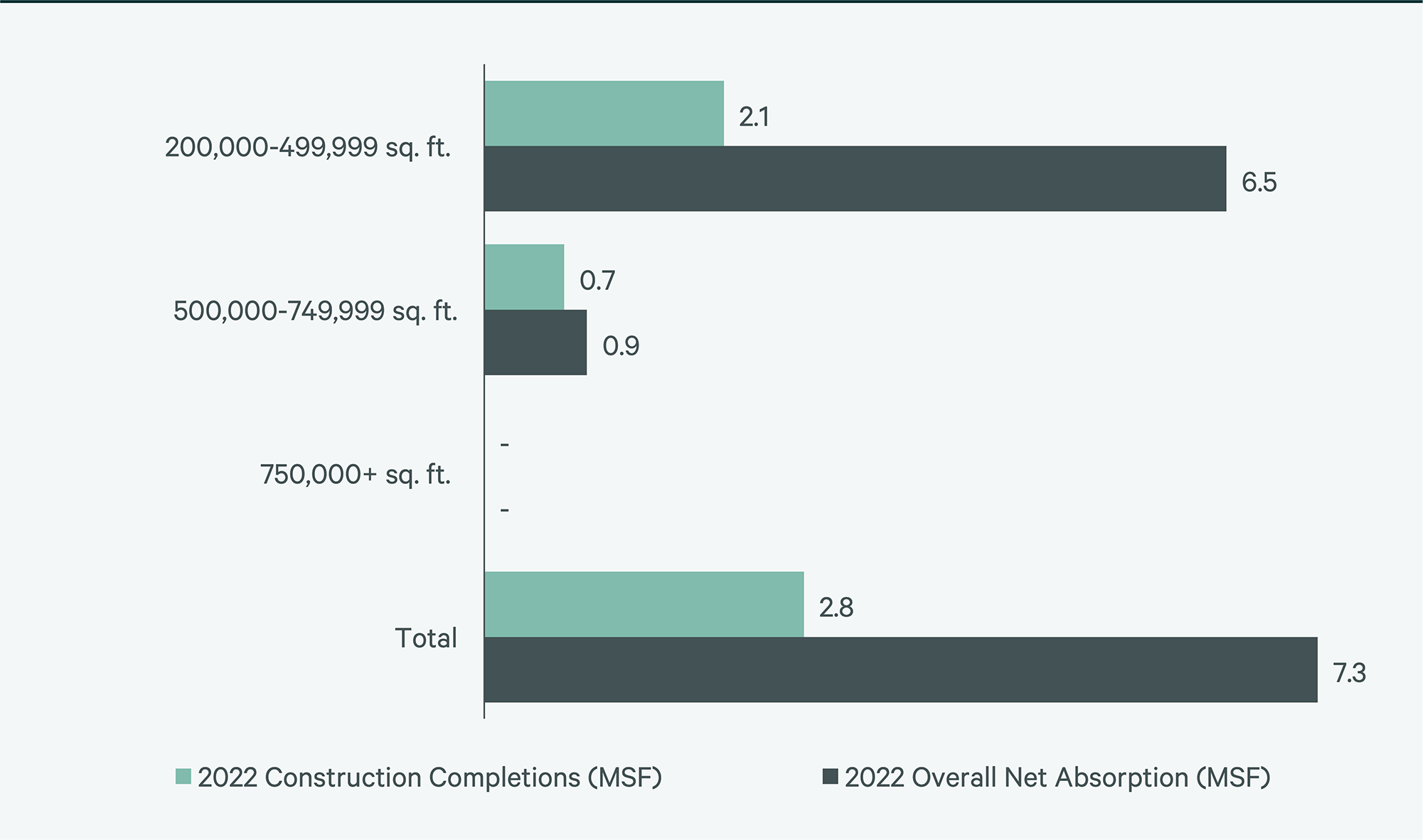
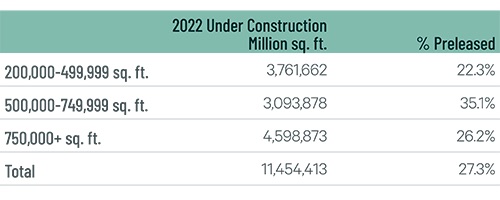
Construction completions totaled only 2.8 million sq. ft. in 2022. But a record-breaking 11.5 million sq. ft. is under construction in 2023, including 4.6 million sq. ft. of product over 750,000 sq. ft. The available space under construction is 51% larger than existing vacant space. This product will test a market that has been yearning for large facilities in a time of economic slowdown. Florida’s strong economy and population growth could keep demand strong, protecting the market from vacancy increases.
Figure 4: Share of 2022 Leasing by Occupier Type
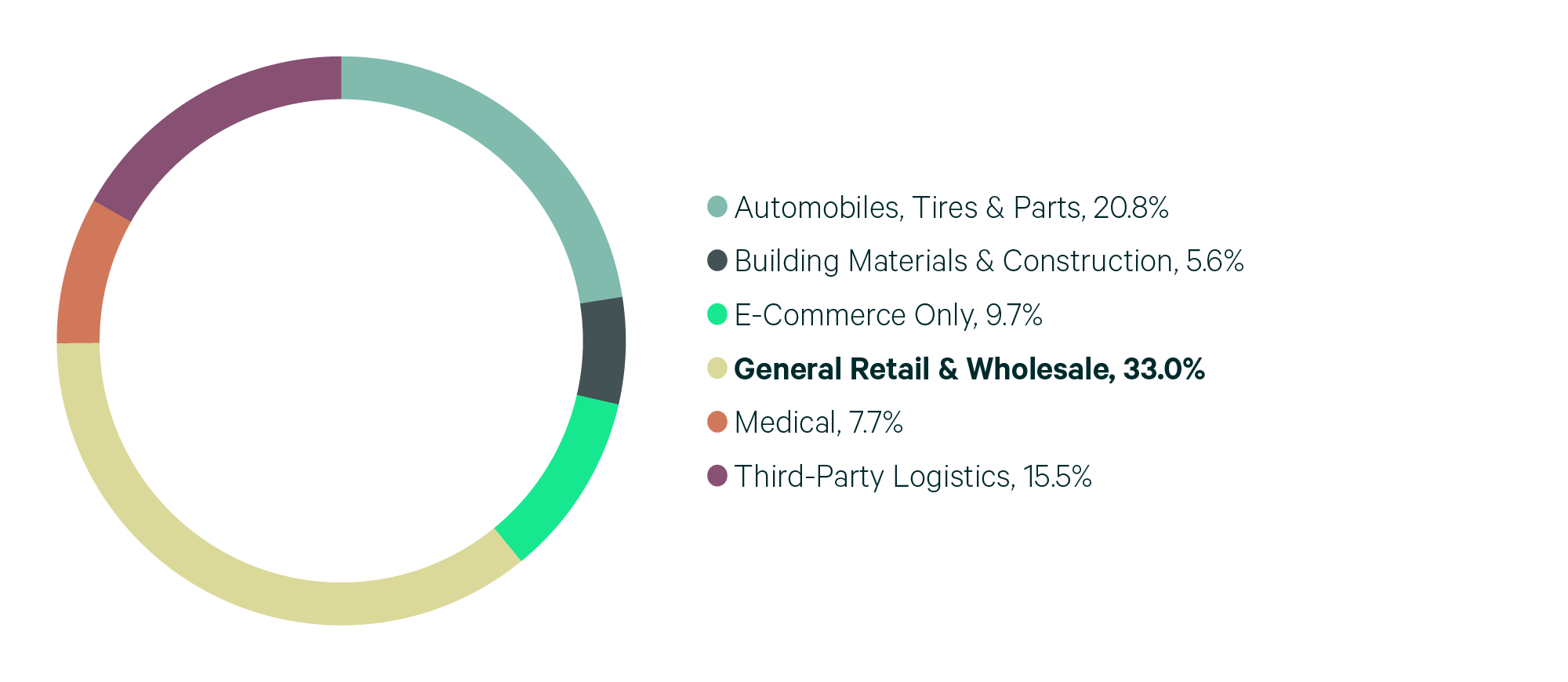
Note: Includes new leases and renewals 200,000 sq. ft. and above.
Source: CBRE Research, 2022.
Figure 5: Lease Transaction Volume by Size Range
Note: Includes new leases and renewals 200,000 sq. ft. and above.
Source: CBRE Research, 2022.
Figure 6: 2022 Construction Completions vs. Overall Net Absorption by Size Range
Source: CBRE Research, 2022.
Figure 7: Direct Vacancy Rate by Size Range
Source: CBRE Research, 2022.
Figure 8: Under Construction & Percentage Preleased
Source: CBRE Research, 2022.
Figure 9: First Year Taking Rents (psf/yr)
Note: Includes first year taking rents for leases 200,000 sq. ft. and above.
Source: CBRE Research, 2022.
Explore Big Box Insights by Market

Atlanta is the major population center of the Southeast and one of the country’s fastest-growing metropolitan statistical areas (MSAs).

More than 7 million people live within 50 miles of the market core, with five-year growth of 5.1% expected, second to only DFW.

Memphis has over 1.4 million people within 50 miles of its core, and 23.4% are aged 18-34.
Contacts
John Morris
Group President, Advisory Leasing