Future Cities
2023 North America Industrial Big Box Review & Outlook: Kansas City
April 4, 2023 5 Minute Read

Kansas City has continued strengthening as a key logistics hub for automotive supplies, distributors and 3PLs due to strong infrastructure of four major interstates bisecting the city, strong labor pool and multiple intermodal facilities. In the past three years, the city has delivered record big-box space while seeing absorption exceed space delivered, decreasing available inventory.
Demographics
Kansas City’s biggest draw is its easy reach to a large portion of the country. More than 2.4 million people live within 50 miles of the market core. Close to 15 million people or 6 million households are within 250 miles.
Figure 1: Kansas City Population Analysis

Source: CBRE Location Intelligence, Q4 2022.
The local warehouse labor force of just over 35,000 is expected to grow by 9.7% by 2032, according to CBRE Labor Analytics. The average wage for a non-supervisory warehouse employee is $17.31 per hour, 2.4% above the national average.
Figure 2: Kansas City Warehouse & Storage Labor Fundamentals

Source: CBRE Labor Analytics, Q4 2022.
*Median wage (1 year experience); non-supervisory warehouse material handlers.
Location Incentives
Over the past five years, there have been 219 publicly known economic incentives deals totaling over $445 million for an average of $16,016 per new job in metro Kansas City, according to Wavteq.
CBRE’s Location Incentives Group reports that top incentive programs in Kansas include the High Performance Incentive Program (HPIP), offering a 10% tax credit for capital investment totaling over $1 million. To qualify, for-profit manufacturing companies must pay above-average wages and significantly invest in employee training.
Among the top incentive programs in Missouri is the Missouri Works Program, offering payroll rebates and discretionary income tax credits for new jobs. To qualify, at least two full-time jobs must be created with wages exceeding 80% of the average county wage.
Figure 3: Kansas City Top Incentive Programs
Source: CBRE Location Incentives Group, Q4 2022.
Note: The extent, if any, of state and local incentive offerings depends on location and scope of the operation.
Logistics Driver
Kansas City’s central location gives it access to 85% of the U.S. population in two days. Numerous ground, air, water, and rail transportation options make it one of North America’s most logistics-friendly industrial markets. Kansas City has five Class I rail lines intersecting the region (Kansas City Southern, Burlington Northern Santa Fe, Canadian Pacific, Norfolk Southern and Union Pacific), four of which have intermodal facilities.
Four major U.S. interstate highways (I-35, I-70, I-29 and I-49) intersect the region, which has 30% more interstate miles per capita than any other U.S. city. Kansas City also has low traffic congestion.
Kansas City International Airport is one of the U.S.’s best locations for air cargo and distribution development. It moves more air cargo than any other airport in the six-state region and will add a new terminal in 2023.
Kansas City is on the Missouri River, the largest navigable inland waterway in the U.S. Port KC has over 900 feet of shoreline, which includes three load cells and docking structures for 14 barges. The port terminal has an annual capacity of 800,000 tons and provide rail and truck transfer, covered storage and product distribution.

Kansas City's central location gives it access to 85% of the U.S. population in two days.
Capital Markets
Kansas City sale activity decreased in H2 2022. Rapidly rising interest rates have led to approximately 100 bps increase in core cap rates from the mid-4% range to the mid-5% range. Kansas City offers investors an opportunity to acquire assets at an attractive basis below replacement cost, and a going-in yield that offers positive leverage during year one.
Supply & Demand
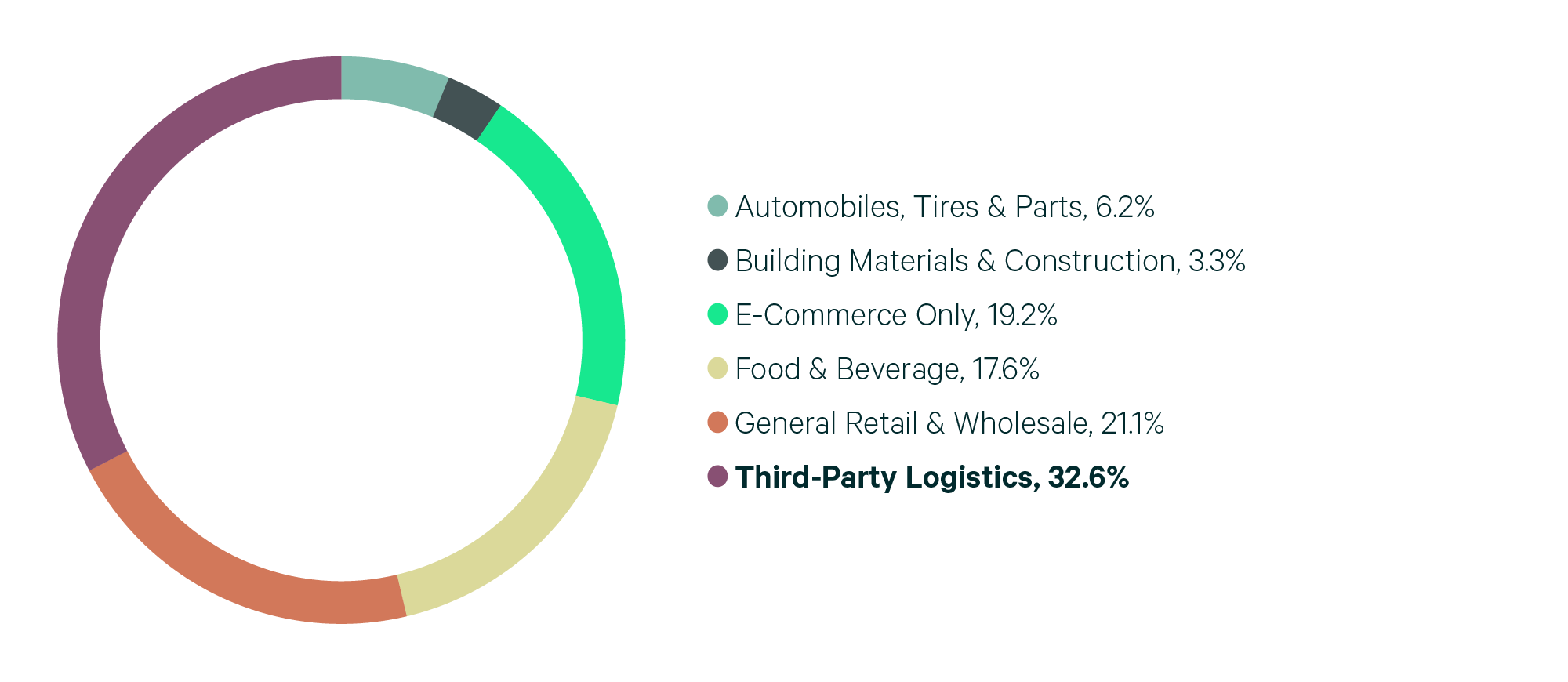
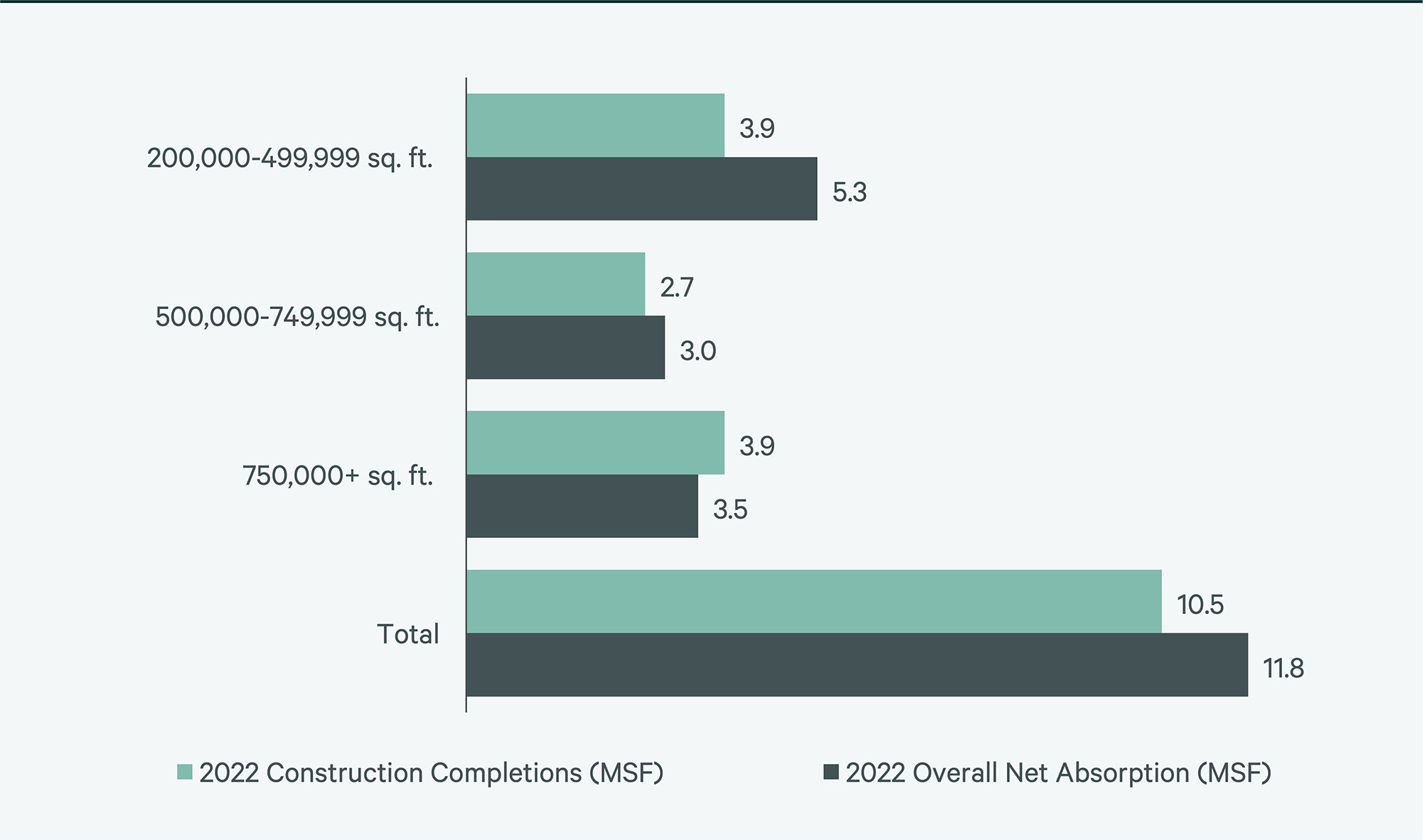
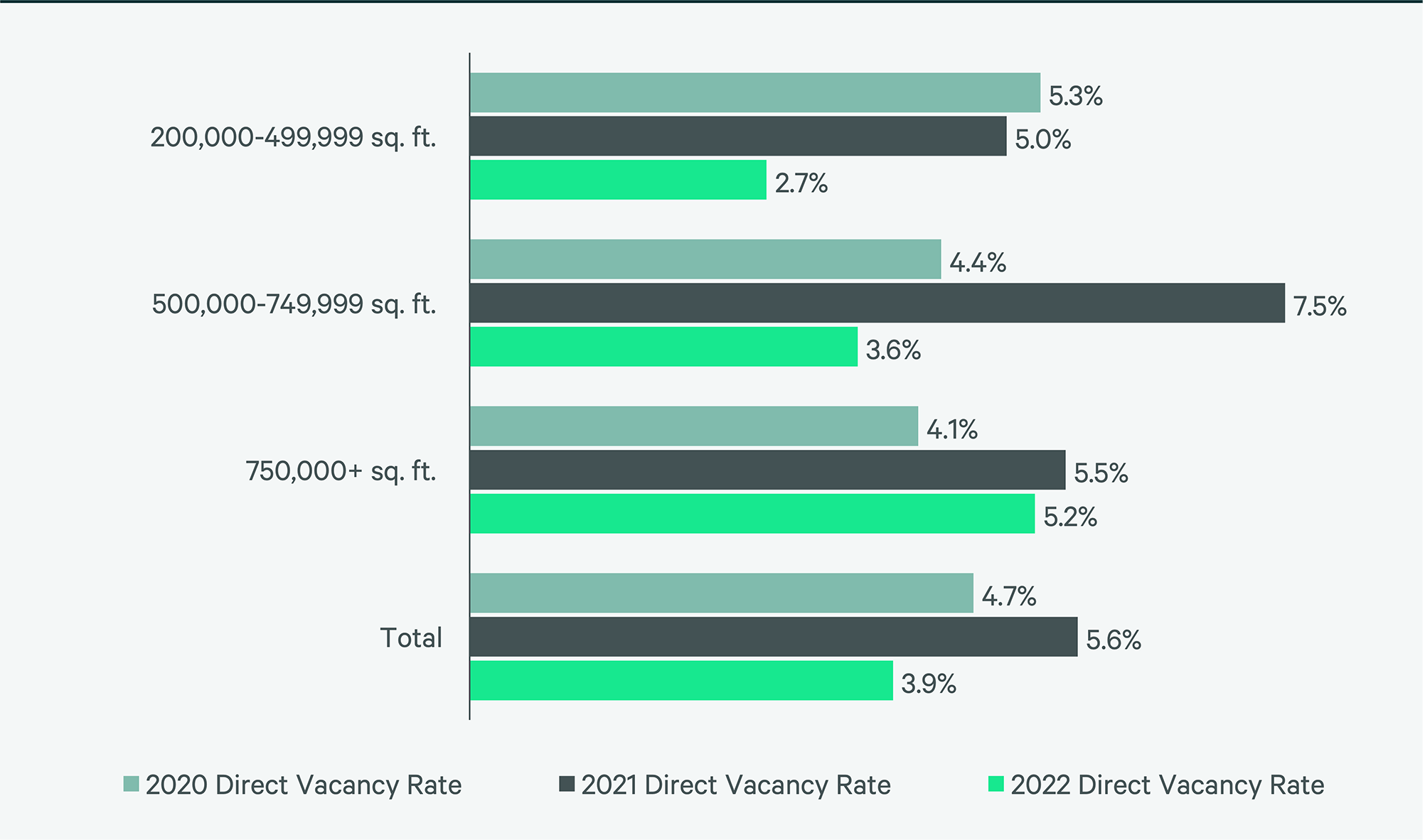
Robust demand for space improved all fundamentals in 2022. Transaction volume equaled 2021’s record pace, leading to a 44% increase in net absorption to 11.8 million sq. ft. This made Kansas City the sixth-highest growth market (net absorption/existing inventory) in North America. The direct vacancy rate decreased 170 bps to 3.9% despite 10.5 million sq. ft. of construction completions. 7.0 million sq. ft. is currently under construction, with 17% pre-leased. A diverse tenant mix expanded activity in Kansas City. Four separate occupier types had over 10% market share, led by 3PL providers at 33%.
The market is well-positioned against an occupier slowdown in 2023. 10.5 million sq. ft. is under construction, with 22% pre-leased. The region’s central location and economic rental rates will incentivize further 3PL expansion into the market, leading to increased taking rents.
Figure 4: Share of 2022 Leasing by Occupier Type
Note: Includes new leases and renewals 200,000 sq. ft. and above.
Source: CBRE Research, 2022.
Figure 5: Lease Transaction Volume by Size Range

Note: Includes new leases and renewals 200,000 sq. ft. and above.
Source: CBRE Research, 2022.
Figure 6: 2022 Construction Completions vs. Overall Net Absorption by Size Range
Source: CBRE Research, 2022.
Figure 7: Direct Vacancy Rate by Size Range
Source: CBRE Research, 2022.
Figure 8: Under Construction & Percentage Preleased

Source: CBRE Research, 2022.
Figure 9: First Year Taking Rents (psf/yr)
Note: Includes first year taking rents for leases 200,000 sq. ft. and above.
Source: CBRE Research, 2022.
Explore Big Box Insights by Market

Over 9 million people live within 50 miles of downtown Chicago, with a robust warehouse labor force of over 230,000 workers.

Memphis has over 1.4 million people within 50 miles of its core, and 23.4% are aged 18-34.

Nearly 3 million people live within 50 miles of St. Louis but, like many Midwest markets, this is expected to decline by 0.4% over five years.