Report
The Resilience of Dutch Prime Shopping Streets
How the 25 most expensive retail streets adapt to shifting consumer behavior and economic pressures
December 11, 2025

Dutch prime shopping streets show resilience. Current vacancy levels are at 4.3%, a rate considered healthy, and rental prices are also stabilizing after years of downward correction. This confirms the strong position of these top retail streets within the broader retail landscape and creates potential for rental growth in certain locations. Retailers are regaining confidence as well: key money[1] has returned due to scarcity and sustained demand, with some parties even offering amounts above the asking price.
This recovery did not happen overnight. Over the past two decades, the market faced prolonged challenges. Where fashion once dominated the streetscape, the rapid rise of e-commerce triggered a major shift. Secondary streets emptied, stores found new purposes, and rents declined. This restructuring made city centers more compact and attractive for new concepts, creating a new balance. Today, shopping streets are more accessible for retailers and more surprising for consumers.
Just as this recovery began to take shape, new shocks followed: lockdowns, temporary revenue drops, and an inflation wave that drove up costs. Yet, the prime streets proved resilient throughout this turbulent period.
Room for Rental Growth
In the 25 most important shopping streets, vacancy has increased by 1 percentage point since 2019, reaching 4.3%. At the same time, footfall remains on average 8% lower than before the pandemic. However, many streets are showing signs of recovery. Well-known brands such as MyJewellery, Rituals, Miniso, New Balance, Normal, and Decathlon are expanding their presence, while new concepts like Oysho and UNIQLO are enhancing the appeal of Dutch prime retail streets.
Prime rents[2] have undergone a clear correction in recent years, averaging a 9% decline since 2019.Declines of 20–35% occurred in the main high-street retail corridors of the four largest cities: Kalverstraat in Amsterdam, Lijnbaan in Rotterdam, Grote Marktstraat in The Hague, and Oudegracht in Utrecht.
Mid-sized cities, including Breda, Tilburg, Arnhem, and Zwolle, also saw significant drops of 20–30%. The market is now entering a stabilization phase, with some locations even experiencing modest rental growth.
Prime Rents in Amsterdam’s Premium Streets on the Rise
Not all locations experienced rental corrections. Amsterdam’s premium streets show the opposite trend, driven by strong commercial dynamics. PC Hooftstraat remains the most expensive retail street in the Netherlands, with a prime rent of €3,500 per m² per year. A 23% increase since 2019.
Van Baerlestraat is also benefiting. Running perpendicular to PC Hooftstraat, it attracts high-end retailers unable to secure space on the main luxury strip. Prime rent here rose by 11% to €1,350 per m². Additionally, mixed retail areas with boutique stores, such as Utrechtsestraat and the Negen Straatjes, are gaining popularity. This demonstrates that diversity and experience have become new engines of growth. The figures below show Zone A[3] prime rents:
Figure 1: Prime Rent Development in Top Retail Streets (2019–2025)
|
Street |
Prime Rent per m² per year in 2025 |
Street |
Prime Rent Growth since 2019 |
|
PC Hoofdstraat A'dam |
€ 3.500 | PC Hooftstraat A'dam | 23% |
|
Kalverstraat A'dam |
€ 2.500 | Negen Straatjes A'dam | 16% |
|
Leidschestraat A'dam |
€ 2.500 | Van Baerlestraat A'dam | 11% |
|
Negen Straatjes A'dam |
€ 1.550 | Utrechtsestraat A'dam | 5% |
|
Lijnbaan R'dam |
€ 1.400 |
Rechtestraat Eindhoven | 4% |
Diversity as a Strength
Dutch consumers are increasingly spending on food, drinks, and experiences. As a result, retail areas have evolved from traditional streets dominated by fashion and luxury into vibrant, mixed-use destinations featuring F&B, leisure, and convenience. While prime retail streets remain the core for major fashion and luxury brands, this trend is also visible there.
The share of fashion and luxury declined from 68% to 61% between 2019 and 2025. During the same period, F&B grew from 7% to 9%, and leisure from 10% to 13%. This shift makes shopping streets more attractive and less dependent on a single visitor motive. The result is a dynamic mix that caters to multiple needs, creating a more stable foundation for consumer interest and turnover.
Commercial Strength and Resilience at a Glance
The stabilization of rental prices, growing diversity, and healthy vacancy levels form the basis for a broader analysis: how vital and resilient are Dutch prime shopping streets in 2025?
CBRE has developed a model that maps the commercial strength and resilience of 25 prime streets across the 15 most important Dutch city centers. The model combines multiple dimensions, including footfall, vacancy rates, prime rent trends, diversity and tenant mix, turnover rate, and consumer potential. The latter is based on population growth within the catchment area. The model also measures actual visitation, using anonymized location data to track visits from different lifestyle segments to retail streets.
Bringing these factors together provides a clear picture, showing which streets currently hold the greatest commercial strength and which have proven most resilient since 2019. The model provides retailers and investors with valuable insights into streets offering the highest opportunities and lowest risks.
Figure 2: Commercial Strength and Resilience of 25 Dutch Prime Retail Streets
Amsterdam’s Premium Streets Remain Market Leaders
The analysis paints a clear picture: Amsterdam continues to dominate in terms of commercial strength. Luxury streets PC Hooftstraat and Van Baerlestraat top the ranking, followed by Kalverstraat. Characterful boutique areas such as Utrechtsestraat and the Negen Straatjes also demonstrate strong commercial performance. Amsterdam’s retail streets score highly on prime rents, footfall, maintain low vacancy rates, and attract affluent consumer segments.
Outside Amsterdam, Demer in Eindhoven stands out as the strongest street, followed by Spuistraat in The Hague. Grote Staat in Maastricht and Hoogstraat in Rotterdam also rank among the leaders. At the bottom of the top 25 are streets in mid-sized cities such as Kalanderstraat (Enschede), Diezerstraat (Zwolle), Grote Houtstraat (Haarlem), Ketelstraat (Arnhem), and Heuvelstraat (Tilburg). Many of these streets have lower footfall, higher vacancy, and attract less affluent visitors.
Figure 3: Top Ten Streets by Commercial Strength in 2025
|
Street |
Current strength |
|
PC Hoofdstraat A'dam |
9,3 |
|
Van Baerlestraat A'dam |
9,1 |
|
Kalverstraat A'dam |
8,6 |
|
Utrechtsestraat A'dam |
8,3 |
|
Negen Straatjes A'dam |
8,2 |
|
Leidsestraat A'dam |
8,2 |
|
Demer Eindhoven |
7,2 |
|
Spuistraat Den Haag |
7,1 |
|
Grote Straat Maastricht |
6,6 |
|
Hoogstraat R'dam |
6,5 |
Resilience Since 2019: Luxury Streets Show Positive Momentum
PC Hooftstraat in Amsterdam shows the strongest development. Rising prime rents, higher footfall, lower vacancy, and a turnover rate below 7% make it the most dynamic street in the top 25. PC Hooftstraat clearly benefits from its popularity among international retailers, tourists, and the luxury boom visible in the post-Covid era.
Van Baerlestraat follows closely, developing as a natural spillover area for high-end brands and affluent consumers. This has led to a strong increase in prime rents. Utrechtsestraat, a third Amsterdam street, also shows significant progress and ranks fourth. This progress is driven by further reductions in its already low vacancy, a strong tenant mix, and its ability to attract affluent consumer segments. The street combines authenticity with high-quality concepts and a diverse mix, strengthening its position and appealing to consumers with multiple shopping motives.
Regional Prime Streets Show a Mixed Picture
Several regional prime streets show positive momentum. Herestraat (Groningen), Kalanderstraat (Enschede), Broerstraat (Nijmegen), Diezerstraat (Zwolle), and Hinthamerstraat (Den Bosch) benefit from lower vacancy, a more diverse tenant mix, and rising footfall.
At the same time, some regional prime streets face pressure. In Ketelstraat (Arnhem), Heuvelstraat (Tilburg), Grote Houtstraat (Haarlem), and Ginnekenstraat (Breda), the combination of falling visitor numbers, rising vacancy, and high turnover rates creates a challenging situation. Property owners are working with local businesses and municipalities to find solutions. These include creating a broader mix of uses with more culture, F&B, and leisure, introducing distinctive retail concepts, converting retail space into residential units, and greening and enhancing the street’s appeal.
Figure 4: Top Ten Streets with the Most Positive Commercial Development (2019–2025)
|
Street |
Development 2019-2025 |
|
PC Hoofdstraat A'dam |
8,6 |
|
Van Baerlestraat A'dam |
8,6 |
|
Demer Eindhoven |
8,4 |
|
Utrechtsestraat A'dam |
8,4 |
|
Herestraat Groningen |
7,6 |
|
Rechtestraat Eindhoven |
7,5 |
|
Kalverstraat A'dam |
7,5 |
|
Negen Straatjes A'dam |
7,2 |
|
Leidsestraat A'dam |
7,1 |
|
Kalanderstraat Enschede |
6,9 |
Eindhoven on the Rise
Demer in Eindhoven ranks third, showing that prime streets outside the capital are also thriving. Footfall is rising sharply, vacancy is almost absent, and the tenant mix is becoming more diverse. The turnover rate remains very low (around 5%). Eindhoven benefits from strong population growth and rising incomes. Rechtestraat in Eindhoven also shows strong momentum, with rising footfall and limited vacancy.
Stable Development in Rotterdam’s Prime Streets
The contrast between Lijnbaan, Hoogstraat, and Coolsingel is limited. Lijnbaan has shown the strongest development since 2019, while Hoogstraat maintains its role as the main crowd-puller. Coolsingel is developing steadily and adds to this dynamic.
Although the Koopgoot as a planned shopping center was not included in this study, it remains a crucial anchor location in the heart of Rotterdam. With strong retailers and a steady flow of visitors, it reinforces the overall appeal of the entire shopping area.
Prime Streets in Utrecht Remain Resilient Despite Shifting Focus
Oudegracht remains strong and shows resilience with positive development and the arrival of new anchors such as UNIQLO. This occurs despite the major renovation of Hoog Catharijne, which shifted the center of gravity in the shopping district. Steenweg, on the other hand, is developing less favorably and appears to suffer from this shift.
Competition from Mall of the Netherlands Puts Pressure on The Hague’s Prime Streets
Spuistraat is slightly better positioned than Grote Marktstraat, but both streets show limited development. Notably, prime rents in Spuistraat are rising slightly, creating a mixed picture for the city center. A key factor is competition from Mall of the Netherlands, a shopping center with a strong focus on fashion and luxury that attracts consumers from The Hague and surrounding municipalities, making it a direct competitor to the inner city.
Figure 5: Commercial Strength and Resilience of Prime Retail Streets in Other Major Cities

From Price to Potential: Strategic Choices in Prime Retail Streets
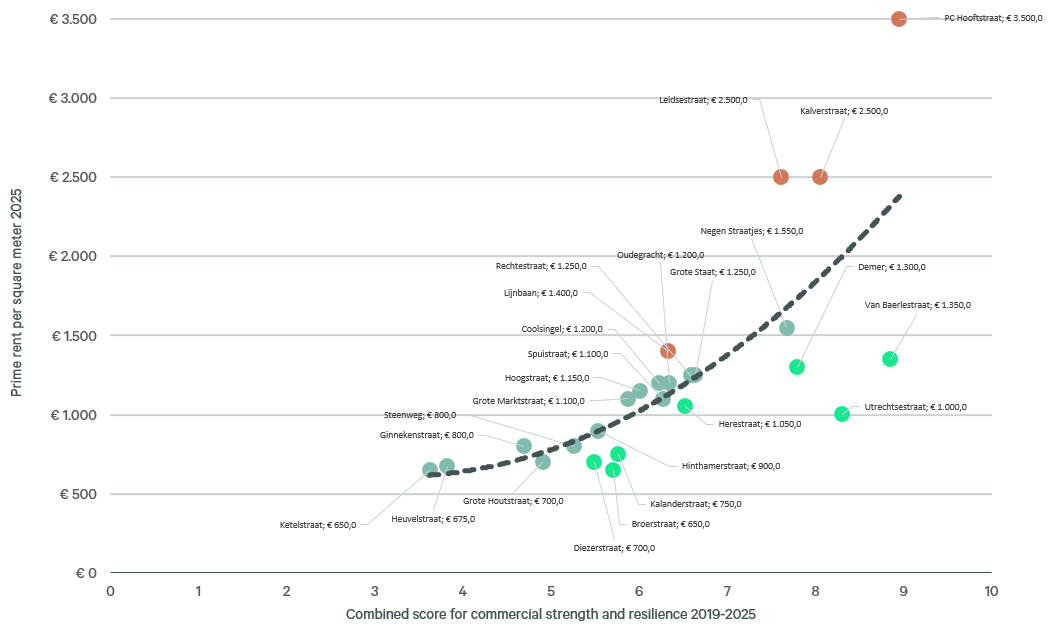
In recent years, Dutch shopping streets have undergone a profound transformation. Analyzing prime rents alongside the combined score of current commercial strength and development since 2019 shows that commercial strength and prime rent levels do not always move in sync. This reveals where prime rents are disproportionate to commercial strength—and where the greatest opportunities for value creation lie.
The black trend line in the chart illustrates the expected correlation: the stronger a street, the higher the prime rent. Streets that deviate significantly from this trend line are notable for various reasons.
Figure 6: Distinction Between Commercial Strength, Resilience, and Prime Rent Levels
Amsterdam’s Unique Dynamics
PC Hooftstraat is the leading luxury retail street in the Netherlands. At the same time, Van Baerlestraat is developing as a hub for high-end brands, while Kalverstraat, extending into Leidsestraat, remains the country’s most renowned shopping street. As the tourist heart of Amsterdam, these streets attract international retailers who primarily focus on the capital. The result: prime rents here are significantly higher than in other streets within the top 25.
A store in these locations is not just a point of sale; it is an investment in brand strategy. For investors, this means value growth in this segment is driven mainly by scarcity and international demand, rather than local dynamics.
Meanwhile, Van Baerlestraat and Utrechtsestraat are gaining momentum. Van Baerlestraat benefits from interest by international luxury brands, while Utrechtsestraat stands out with a distinctive tenant mix. Both streets show rising prime rents, and this trend is likely to continue.
Commercial Strength at Relatively Low Prime Rent Levels
On the other end of the spectrum are streets that represent strong commercial value relative to their current prime rent. These retail streets combine commercial strength and resilience with rent levels that do not yet fully reflect their potential.
Demer stands out with strong development and clear opportunities for retailers and investors. There is visible room for prime rent growth, while the redevelopment of the Heuvel area further strengthens the core shopping district.
Other streets such as Broerstraat (Nijmegen), Kalanderstraat (Enschede), and Diezerstraat (Zwolle) show resilience through lower vacancy and stabilizing prime rents.. These streets offer entry opportunities for investors and retailers thanks to lower vacancy and rent stabilization.
Ultimately, two factors remain decisive: the situation and positioning of the individual property. Elements such as marketability, frontage width, footfall, facade quality, and zoning determine potential, turnover, and return. The model helps narrow down the search area, but the final decision requires a detailed asset-level assessment.
Retail insights
-
Report | Intelligent Investment
Netherlands Real Estate Market Outlook Midyear Review 2026
September 1, 2026

In this repory, we set out our expectations regarding the key developments in the property investment market for the remainder of 2026.
-
Book | Intelligent Investment
European Real Estate Market Outlook Midyear Review 2026
August 6, 2026

How is European real estate performing at midyear 2026? CBRE's review updates forecasts across the economy, capital markets, living, logistics, and offices.
-
Dutch retail parks are showing resilience: stable rental income, low vacancy rates, and attractive returns for investors.
-

In this publication, we share our expectations for the most important developments in the real estate investment market in 2026.
-

Discover the evolving real estate market cycle for the year. Learn why elevated interest rates, income-driven returns, and proactive asset management are key. Explore growth in the living sector and data centers amidst improving financing conditions.
-
How the 25 most expensive retail streets adapt to shifting consumer behavior and economic pressures.
-
Viewpoint | Intelligent Investment
Larger shopping centres are regaining investor interest
August 21, 2025

Dutch retail is regaining its footing after a decade of transformation. Larger shopping centres are attracting renewed investor interest, fueled by attractive yields and repositioning potential.
-
Book | Intelligent Investment
European Real Estate Market Outlook Mid-Year Review 2025
August 7, 2025

Welcome to CBRE’s 2025 European Mid-Year Market Outlook. In this report, we revisit the predictions we made at the beginning of the year, assess their accuracy, and share our perspective for the months ahead.