Chapter 3
Market Forecasts
CBRE New Zealand Real Estate Market Outlook 2026
10 Minute Read
10 Minute Read
Looking for a PDF of this content?
After limited rental growth in 2024, yield movements are set to lift investment returns in 2025. By 2026, both rents and yields contribute positively to capital returns, with total returns forecast to reach double‑digit levels as the recovery cycle strengthens.

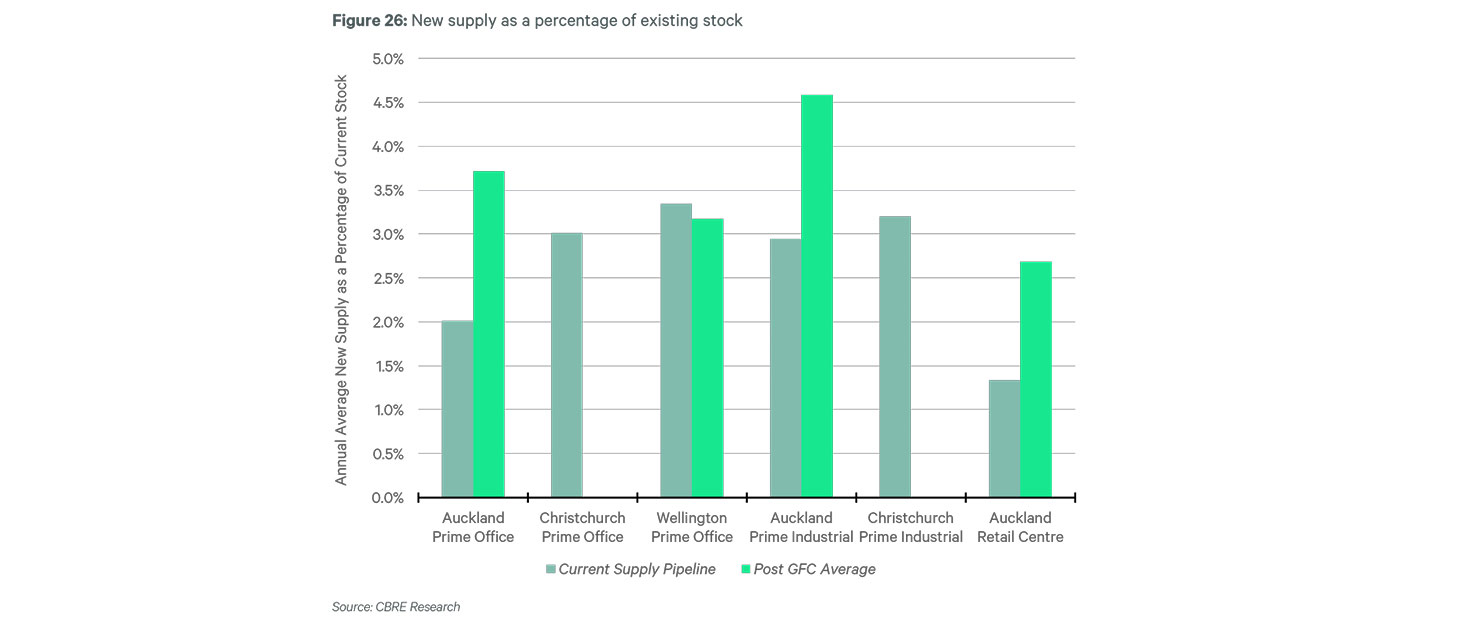
Supply pipelines are generally diminishing
Wellington’s office market cycle of building refurbishments and strengthening, in addition to a few new builds, will deliver a material amount of NLA during 2026 and 2027, but not much beyond, adding 14% to Wellington CBD’s 2025 levels of Prime office stock.
Christchurch’s industrial supply pipeline remains active, driven by some large logistic occupier's requirements, and its office supply cycle is in full swing. As we outlined in last year’s report, the city has proven itself a strong office occupier market, its demand led vacancy improvements in recent years outperforming the other major centres in New Zealand.
Given this environment, the market’s focus has shifted to the next round of supply to meet emerging demand. 28,000 sqm of new and refurbished office space is expected in 2026/2027. While the short term Christchurch supply environment is elevated, the pipeline shows diminishing volumes beyond 2027.
Vacancy Outlook Across Sectors
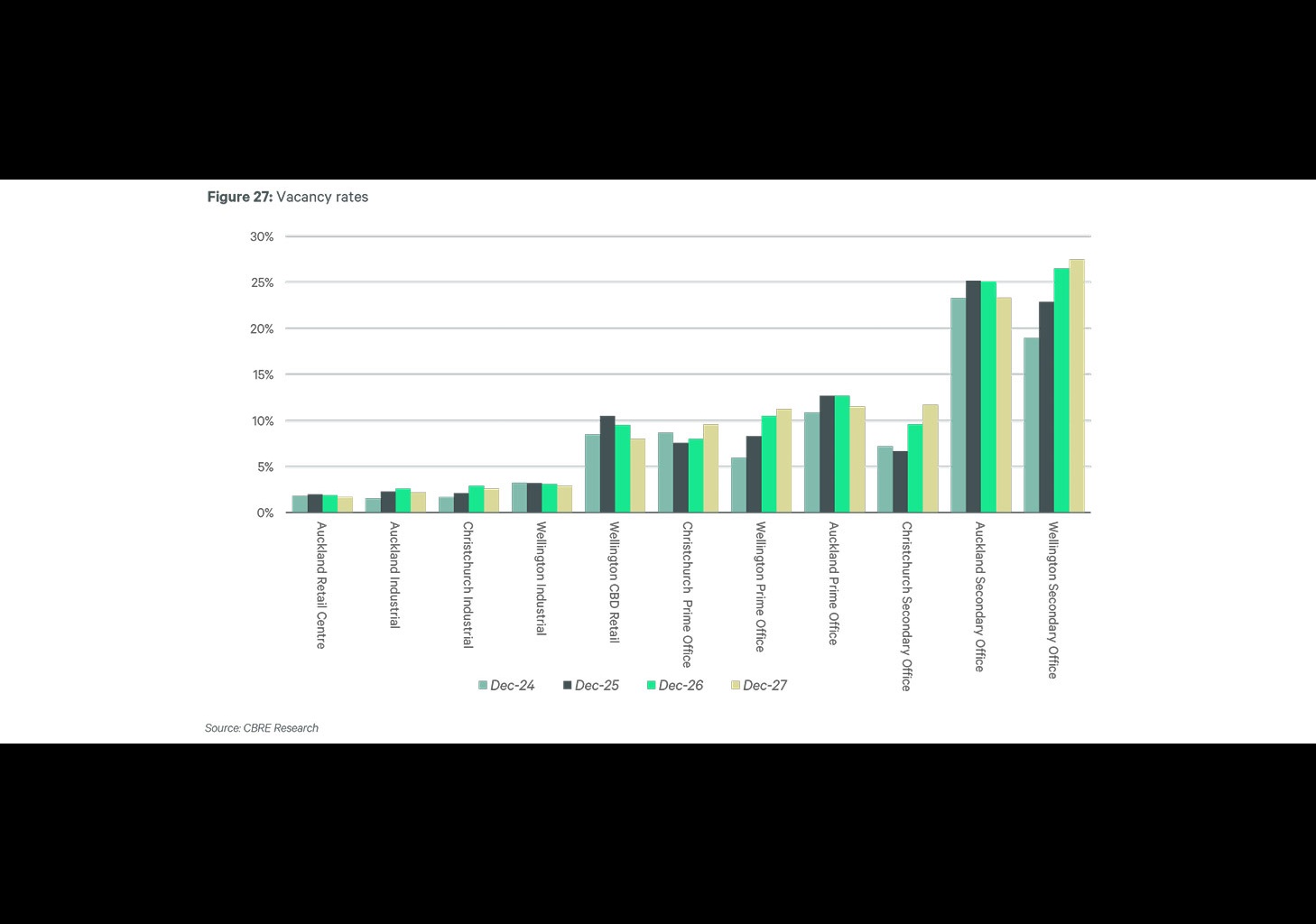
Demand dynamics are improving but supply and flight to quality will escalate vacancies in some sectors.
Vacancies are close to peaking in key sectors such as the Auckland office and retail centres. Other markets, most notably Auckland and Christchurch industrial, will continue to see higher vacancies in 2026 due to the size of their supply pipelines in an environment of modest demand growth, although absolute vacancy rates will remain modest at below 3%. By 2027, we forecast that both moderating supply and strengthening demand will result in improved dynamics in these sectors.Ongoing supply will continue to weigh on the Christchurch and Wellington Prime office sectors into 2027, although their vacancies will likely peak below, or close to, 10%. We are forecasting flight to quality trends to adversely impact Wellington and Christchurch CBD Secondary office occupancy, although in H2 2025, they bucked this trend, and a positive absorption outcome provided a welcome upside surprise. A greater volume of stock withdrawals for alternative uses could further help stabilise Secondary vacancies in these markets.
Rental Growth Resumes in 2026
Positive rental momentum building in 2026 and strengthening in 2027.
Rental trends have been mixed but generally weak during the past two years. Although face rents remained resilient, many lessors’ weaker bargaining position has resulted in higher leasing incentives. By 2027, the improving economic and demand backdrop is reflected in strengthening rent growth even in markets such as Wellington offices, where vacancy will remain relatively elevated.In markets such as Auckland Prime office, net effective market rents will likely benefit from a combination of both face rent growth and, perhaps more importantly, reducing incentives. In the industrial market, recent rental weakness, especially in Auckland, is likely to persist in the first half of 2026, but our forecast model indicates that improving demand conditions will likely lead to the resumption of modest growth by the end of the year.

Yields and Capital Returns
Improving liquidity and occupier market conditions provide a platform for modest cap rate compression.
During the past two years, interest rate declines have not translated to a one-for-one yield firming. As a result, Prime property yield margins to 2 yr swap rates have recovered from a low of 115bps in the late 2022-2023 period to 400bps in Q3 2025.We forecast yields firming moderately in 2026 as investor confidence and liquidity lifts, and the occupier market turns more positive. This scenario leads to average (across office, industrial, and retail centres) Prime yields falling from 6.53% in December 2025 to 6.37% in December 2026. It also implies that Prime yield to two-year swap rate margins will come back to around 300 bps, higher than the pre-GFC average but still materially below post-GFC.

Investment Returns Outlook 2026–2029
Investment returns restore to healthier levels.
Total returns strengthened from 3.5% in 2024 to 9.7% in 2025, largely due to increasingly widespread yield firming, particularly in the shopping centre sector, where yields have firmed by nearly 50 basis points on average. In 2026, yield movements will continue to contribute positively to total returns, but not as strongly as in 2025.After two years of negative contribution from rent growth, the stronger economy and improved occupier market are expected to drive positive rent growth, contributing 1.5% to 3.0% annually to total returns between 2026 and 2029.
In summary, in 2026, both yields and rents will contribute positively to capital returns, helping total return reach over 10%. Rent growth will strengthen from 2027 onwards and, combined with some further moderate yield firming, will help total return remain above 10%.

Sectoral Risk and Return
Sectoral total returns to 2029 are forecast between 9.6% and 12.2% pa.
Our rental and cap rate forecasts indicate that CBD Grade A office, LFR, and Secondary industrial will outperform the market average in terms of capital returns relative to income returns, boosting these sectors’ total returns.While Prime industrial and Premium grade offices also provide comparably strong capital returns, they do so with lower income returns (lower yields). Non catchment dominant medium-sized shopping centres are forecast to underperform, although asset specific performance in the retail sector tends to show wide variations around sector averages.

Where are the opportunities?
-
Office Space Demand
The office sector will benefit from a positive re-rating by investors as the decade long disconnect between employment growth and net absorption draws to a close, and increasing employment will more readily translate into office space demand.
-
Successful Asset Management
Proactive asset management approaches combined with well-judged capex are proving successful in turning around occupancy and rental performance in some previously challenging assets.
-
Location, Location, Location
Across the commercial and residential markets, location is a major factor to pique lessee and buyer interest and to maximise pricing. This applies to both broader amenity, public transport proximity, and micro factors such as streetscapes.
Related Insights
-
Report | Intelligent Investment
Pacific Real Estate Market Outlook - April 2026 edition
January 27, 2026

CBRE’s 2026 Pacific Market Outlook highlights key trends and overarching themes that will guide market shifts and decision making.
-

CBRE’s 2026 Asia Pacific Investor Intentions Survey uncovered a further improvement in buying intentions across most markets in Asia Pacific this year
-
The latest New Zealand Property Occupancy Costs and Rental Affordability report examines occupancy cost ratios and their implications for investors and occupiers. Read now.
-

Discover key insights into hybrid working, workplace trends, and real estate strategies shaping New Zealand’s office market in 2025. Explore data-driven guidance for occupiers and landlords on office attendance, space utilisation, and sustainable workplace solutions.
-

Discover how the gap between the sustainability goals of major occupiers and the environmental performance of the buildings they occupy presents a significant opportunity for landlords and developers.
-
In Q3, market yields experienced notable firming, the most significant since Q2 2021, as lower interest rates enhanced liquidity and pricing for assets.